
How to Know if a Martial Arts Gym Is Good
A good martial arts gym is defined by four things: instructors who correct students individually, a structured program that welcomes beginners, safe and maintained equipment, and the confidence to let you try a class before you commit. Visit at least two or three gyms, take a drop-in class at each, and judge them on teaching quality rather than on mirrors, music, or price alone.
On this page
- What Makes a Martial Arts Gym Good?
- Do the Instructors Actually Teach — or Just Demonstrate?
- Is the Program Structured for Beginners?
- Is the Gym Safe Enough to Train Hard At?
- Will You Get Individual Attention in a Group Class?
- Can You Try a Class Before You Commit?
- Is the Pricing Transparent?
- What Should You Watch During a Trial Visit?
- Does the Community Feel Supportive?
- Are the Facilities and Equipment Well Maintained?
- What Should Travelers Look for in a Gym Abroad?
- How Many Gyms Should You Visit Before Choosing?
- When Should You Walk Away From a Gym?
A good martial arts gym is defined by four things: instructors who correct students individually, a structured program that welcomes beginners, safe and maintained equipment, and the confidence to let you try a class before you commit. Visit at least two or three gyms, take a drop-in class at each, and judge them on teaching quality rather than on mirrors, music, or price alone. If a gym pressures you to sign up immediately, hides its pricing, or cannot explain its instructors' backgrounds, walk away.
What Makes a Martial Arts Gym Good?
A good gym is one where teaching quality, beginner structure, safety, and honest pricing all pass the same test — not one with the best facilities or the loudest music. You can judge all four on a single trial visit: watch whether coaches correct individual students, ask what beginners learn first, check the state of the mats and gear, and see whether you can pay for one class instead of a membership. Gyms that pass those checks keep their students for years; gyms that fail them churn through newcomers. If you are comparing gyms in Siem Reap specifically, our guide to the best Kun Khmer club in Siem Reap applies this same checklist locally.
The four-point test, applied in one visit
| Criterion | What good looks like | How to check |
|---|---|---|
| Teaching | Coaches watch and correct individual students | Observe a full class before joining |
| Structure | A defined beginner program with a progression path | Ask what first-timers learn first |
| Safety | Clean mats, sound gear, supervised contact | Inspect equipment and the warm-up |
| Community | Students help each other; no intimidation | Talk to members after class |
| Pricing | Full costs stated up front, drop-in available | Ask for the written price list |
Do the Instructors Actually Teach — or Just Demonstrate?
The biggest difference between gyms is whether instructors teach or merely demonstrate. A good coach walks the floor, corrects individual mistakes, and can explain why a technique works; a poor one runs a workout and calls it a lesson. Backgrounds matter too — for combat sports especially, real fighting or coaching experience is what separates instruction from imitation, and a good gym answers questions about it directly. At our own club, head coaches Kon Phanet and Ramon have a combined 50+ professional Kun Khmer fights in Cambodia — that is the kind of specific answer you should expect from any gym you ask.
- Ask each instructor where they trained and fought or coached — and note whether the answer is specific
- Watch a full class and count how many times the coach corrects individual students
- Ask what beginners learn in their first month — a real program has a ready answer
- Look at the senior students; long-term members' habits mirror the coaching quality
Is the Program Structured for Beginners?
A structured gym can describe its beginner path in one sentence: fundamentals first, combinations later, contact last. If the answer to "what will I learn first?" is "whatever the class is doing," you will drill advanced techniques before you own the basics, and bad habits follow. Structure is also what makes consistency realistic — the World Health Organization recommends adults do at least 150 minutes of moderate-intensity activity a week, and a program you can safely step into at any level is how weeks of attendance turn into that.
The one-sentence beginner-path test
Ask the coach what a first-timer learns in month one. A good answer follows a visible progression — a named beginner track, stance and guard, then single strikes, then combinations, then pads — with technique reviewed before intensity and nobody thrown into sparring on day one. A vague answer ("you'll pick it up as you go") means there is no program, and coaches who scale drills to mixed levels are part of that same structure.
Is the Gym Safe Enough to Train Hard At?
All combat training carries risk, and a good gym's job is to shrink it — through structured warm-ups, maintained equipment, supervised contact, and a culture where nobody is pressured to train through pain. Safety is also the easiest thing to observe: torn mats, dead pads, and unsupervised sparring tell you everything in one visit. For how a properly run beginner class manages that risk in practice, see our guide to whether Kun Khmer is safe for beginners.
Safety checks: green lights and red flags
| Safety check | Green light | Red flag |
|---|---|---|
| Equipment | Intact mats, firm pads, working bags | Torn vinyl, rock-hard pads, broken buckles |
| Warm-up | Guided warm-up every class | No warm-up, or "warm up on your own" |
| Contact | Supervised, geared, consent-based sparring | Unsupervised sparring, no shin guards |
| Culture | "Tap early, train tomorrow" attitude | Pressure to train through pain or injury |
Will You Get Individual Attention in a Group Class?
In a well-run group class, yes — the coach circulates, corrects by name, and gives feedback rather than demonstrating at the front and disappearing. Class size and coach habits decide this more than any marketing, and the test is whether beginners receive corrections during your own trial visit. Reviews are useful evidence here, because students write about attention and explanation more than about anything else.
"Great coach! Explains everything very well and really takes the time for you! The classes are also a good combination of cardio, strength, and technique, where you learn a lot right from lesson 1! Highly recommended!"
Can You Try a Class Before You Commit?
Any gym confident in its teaching will let you pay for one class first, and a refusal to allow that is itself an answer. Ask for the drop-in price, whether you can watch first, and what is included — gyms that train travelers usually lend gear for the trial too. In Siem Reap we make the trial the product: tourists can train Kun Khmer in Siem Reap without a membership on a $9 day pass, with gloves, wraps, and pads provided.
- Message or walk in and ask for the drop-in rate and the next class time
- Watch a class first if you want to — a good gym welcomes observers
- Take the class and note corrections, safety, and whether you were taught or just worked out
- Decide after the class, not during a sales conversation
Is the Pricing Transparent?
Transparent pricing means the full list — classes, gear, extras, membership terms — is available before you commit, with a cheap short-term option for first-timers. Hidden fees revealed after signing are the classic bad-gym pattern, and pressure to buy a long membership on day one is the same red flag wearing a nicer shirt. Our own price list is public and simple, and our cost guide explains what each option includes.
Our published price list (Kun Khmer Club, Siem Reap)
| Option | Price | What it covers |
|---|---|---|
| Day pass | $9 | One group class, all gear included |
| Weekly pass | $69 | Seven days of group classes |
| Monthly membership | $129 | A month of group classes |
| Private lesson | $25 / hour | One-on-one coaching, per person |
| Fight camp | $299 | The full 6-week structured camp |
What Should You Watch During a Trial Visit?
Go to the trial with a short list and score what you see rather than what you are told. Ten minutes of observation answers most of the questions a sales conversation exists to avoid.
- Coaches correcting individual students, not just demonstrating at the front
- Beginners getting scaled versions of drills instead of sitting out or floundering
- Mats cleaned and gear inspected between sessions
- A structured warm-up and cool-down actually happening
- Students talking to each other and to the coach after class
- Nobody limping through drills and nobody being shouted at
Does the Community Feel Supportive?
A supportive community is what keeps people training for years, and it shows in small ways: partners who adjust their pace for beginners, senior students offering tips, and no ritual humiliation of newcomers. Public reviews are an honest window into this, because students write about how they were treated rather than about the mirrors. Our Google listing currently holds a 5.0 average across eight reviews (Google Maps listing), and the coaching comments in them keep returning to the same themes — technique explained clearly and time taken with first-timers.
"We did a great class here today! We were shown all the techniques for kun khmer, and had a great laugh with our instructor. Could not recommend this class enough"
Are the Facilities and Equipment Well Maintained?
Maintenance is the cheapest honesty test a gym offers, because care for the gear predicts care for the students. You are not looking for luxury — serious training happens in open-air sheds and plain halls all over Southeast Asia. You are looking for intact mats, pads that still absorb, clean changing areas, and air that moves.
- Mats intact and clean, with no torn seams or missing chunks
- Pads and bags that absorb strikes rather than rock-hard or split leather
- Loaner gloves and wraps clean, or issued fresh per use
- Working lights, fans or airflow, and drinkable water nearby
- Changing space and toilets kept to the same standard as the training area
What Should Travelers Look for in a Gym Abroad?
Travelers add three checks to the standard list: communication, short-term access, and gear. Kun Khmer is Cambodia's national martial art and is taught to visitors across Siem Reap, but quality varies — so ask directly whether instruction is in English, whether you can buy single days instead of weeks, and whether gloves and pads are provided. Location matters less than opening hours in a compact city like Siem Reap; our guide to where to train martial arts in Siem Reap compares the local options.
Traveler-specific checks and what a good answer sounds like
| Traveler need | What to ask | Good answer sounds like |
|---|---|---|
| Language | Is instruction in English? | "Coaches explain in English throughout" |
| Duration | Single-day or weekly passes? | "Day pass is $9, walk in any day" |
| Gear | Loaner gloves, wraps, pads? | "All gear provided, bring sports clothes" |
| Schedule | Class times vs your itinerary? | "Group class daily at 5:00 PM" |
How Many Gyms Should You Visit Before Choosing?
Two or three, each with a trial class — one visit is too little information, and five is analysis paralysis. The comparison only works if every visit is the same kind: a real class, not a lobby tour. If you have not yet chosen which art to start with, settle that first with our comparison of the best martial arts for beginners.
- Shortlist two or three gyms using reviews and their own pages
- Take a drop-in class at each, on different days if you can
- Score each on teaching, structure, safety, and how welcome you felt
- Choose on evidence, commit for a month, then re-evaluate
When Should You Walk Away From a Gym?
Walk away the moment a gym fails the honesty tests: pressure to commit, hidden costs, vague instructor backgrounds, or visible safety neglect. Each of those is cheap for the gym to fix and expensive for you to discover, so their persistence tells you how the place operates when nobody is watching. Trust the exit instinct — training should feel challenging, never cornered.
Walk-away triggers
| Red flag | Why it means walk away |
|---|---|
| No trial class, or a fee just to watch one | They profit from commitment, not teaching |
| A full membership pushed before you have trained once | Sales priority over student progress |
| Prices that change between the website and the front desk | Hidden-cost behavior at the front door |
| Instructors who cannot name their own training history | Coaching quality you cannot verify |
| Broken equipment, dirty mats, or unsupervised sparring | Safety neglect you can see with your own eyes |
| A culture that mocks beginners or celebrates injuries | An environment that drives students out |
FAQ
What is a good boxing/martial arts gym in Siem Reap?
One where coaches correct individual students, beginners follow a structured program, equipment is maintained, and you can drop in for a single class before committing. In Siem Reap, Kun Khmer Club runs that model: a daily 5:00 PM group class, a $9 day pass, and all gear provided.
Is this the right gym for me?
It is, if it passes four checks on a trial visit: instructors who teach and correct, a beginner structure you can step into, safe and maintained gear, and pricing you can verify in writing. Take one drop-in class and judge it on what happened, not on what was promised.
Can I drop in for a class?
Yes at most gyms in tourist areas, including ours. The $9 day pass covers one group class with gloves, wraps, and pads included — no membership and no advance booking needed. Walk in before the 5:00 PM class or message on WhatsApp to confirm.
Do I need any experience?
No. A good beginner program assumes zero experience: stance, guard, and basic strikes first, with intensity scaled to you. At our club most first-time visitors have never trained any martial art before.
Is there risk of injury?
Combat sports carry inherent risk, and a well-run gym minimizes it with structured warm-ups, maintained equipment, supervised and consent-based contact, and a no-training-through-pain culture. Broken pads and unsupervised sparring are the visible red flags — walk away from gyms that show them.
Do I get one-on-one time in Muay Thai group classes?
In a well-run group class, yes — the coach circulates and corrects individuals throughout the session rather than only demonstrating at the front. If you want undivided attention, private lessons exist at most serious gyms; ours are $25 per hour, per person.
How much does a gym membership cost in Siem Reap?
Martial arts gyms in Siem Reap usually sell day, weekly, and monthly tiers rather than a single membership: at our club that is $9 per day, $69 per week, and $129 per month, with private lessons at $25 per hour. General fitness gyms price separately, so ask for the full written price list wherever you train.
Key takeaways
- Judge a gym on teaching first — instructors who correct individuals beat better facilities every time.
- A structured beginner program and visible safety routines are non-negotiable.
- Never join a gym that will not let you take one class first; transparent pricing is the same test.
- Visit two or three gyms and take a drop-in class at each before you decide.
- In Siem Reap, the $9 day pass makes the trial cheap — apply the same checklist to every gym, including ours.
Sources & further reading
- WHO — Physical activity fact sheet — The recommendation that adults do at least 150 minutes of moderate-intensity aerobic activity per week — source
- Wikipedia — Kun Khmer — Kun Khmer's status as Cambodia's national martial art — source
- Google Maps — Kun Khmer Club listing — The club's 5.0 average rating across eight reviews and its Siem Reap location — source
Reviewed 2026-10-26

Written by the coaches
Kun Khmer Club — Coaches Kon Phanet & Ramon
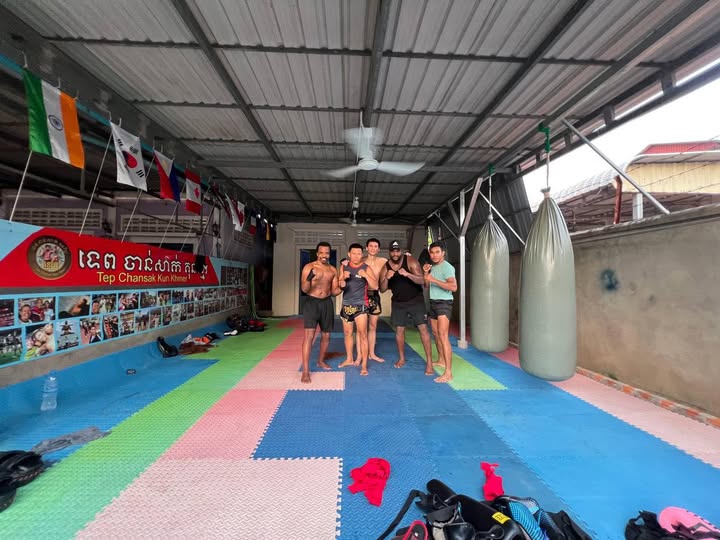
Head coaches Kon Phanet and Ramon have a combined 50+ professional Kun Khmer fights in Cambodia. We coach beginners, travelers, expats, and fighters at our gym in Siem Reap.

Ready to train in Siem Reap?
Drop in for a $9 day pass — the group class starts at 5:00 PM every day, and all gear is provided. Message us for today’s times.