
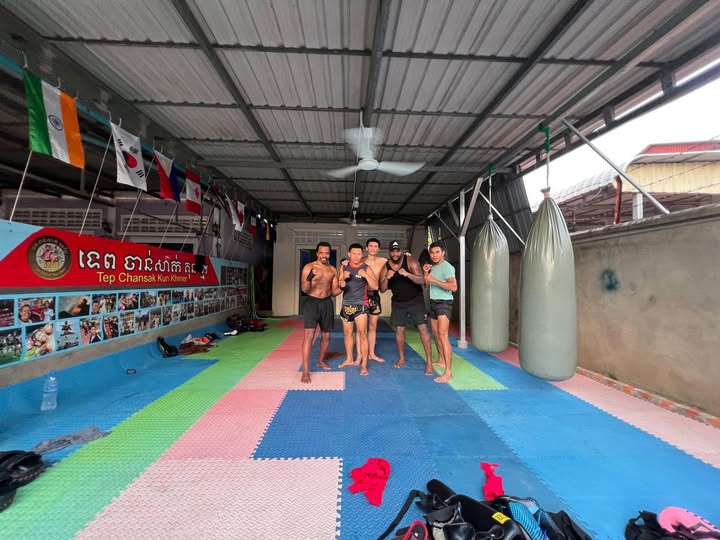
Kun Khmer Rules Explained for Beginners
A Kun Khmer bout runs five three-minute rounds inside a boxing-style ring, decided by knockout or by judges scoring clean, damaging strikes — with elbow strikes weighted more heavily than in most neighboring striking sports. The technique list looks a lot like Muay Thai's, but the pace is generally faster and the scoring rewards elbow work more directly.
Match Structure
- Five rounds, three minutes each, fought in a roped ring traditionally around 6.1 meters (20 feet) square — a scale that keeps fighters within striking range for most of the bout, unlike the larger rings used in some Western boxing venues
- A rest period of roughly 1.5–2 minutes between rounds, used to catch breath, get corner instructions, and reset for the next round's pace
- Bouts open with a kun kru (also called tvay kru) — a slow, ritual dance performed to live music that pays respect to the fighter's trainers before the fight begins
- Live music (sampho drum, sralai oboe, chhing cymbals) plays through the fight itself and audibly speeds up as the action intensifies, often stopping abruptly at a knockout
- Victory is decided by knockout, technical knockout (referee stoppage), or a judges' points decision at the end of five rounds if no stoppage occurs
How Judges Score a Fight
Judges are scoring effective, clean, damaging strikes and ring control over pure activity — a fighter who lands fewer but harder shots can outscore one who is busier but softer. That's a real shift for anyone coming from a points-boxing background, where volume tends to matter more. The detail that surprises newcomers most: elbow strikes are judged especially favorably in Kun Khmer. More fights are historically won by elbow technique here than by any other single strike type, which is a real point of difference from how some other regional striking sports are scored, and it shapes how coaches build a fighter's game plan from early training onward — clinch entries and elbow set-ups get real attention, not just power punching. You don't need to memorize any of this to start training. At Kun Khmer Club in Siem Reap, beginners build stance, pad work, and conditioning long before scoring rules or sparring ever come up, so none of this is something you need to arrive already knowing. Our group class starts at 5:00 PM every day, and the coaches can arrange other training times on request.
Legal and Illegal Techniques
The technique list itself is short to memorize, even if mastering each item takes years. Anything under the four core weapons — punches, kicks, knees, elbows — plus controlled clinch work is fair game; anything targeting a downed or defenseless opponent, or relying on grappling holds rather than striking, is not.
| Legal | Illegal |
|---|---|
| Punches | Striking a downed opponent |
| Kicks (primarily shin kicks) | Biting |
| Knee strikes, including from the clinch | Strikes to the back or spine |
| Elbow strikes, including from the clinch | Strikes to the groin |
| Clinch fighting and controlled off-balancing | Holding the ropes for leverage |
Kun Khmer vs. Muay Thai, Rules-Wise
The two sports share a common technical ancestry and look similar to an untrained eye, but coaches who have trained in both consistently point to these differences in how a fight actually plays out.
| Element | Kun Khmer | Muay Thai |
|---|---|---|
| Rounds | 5 x 3 minutes | 5 x 3 minutes (standard professional format) |
| Elbow scoring | Weighted especially heavily — most fights are historically won on elbows | Elbows score well but are one of several equally valued strikes |
| Pre-fight ritual | Kun kru / tvay kru dance | Wai kru ram muay dance |
| Live music | Sampho, sralai, chhing | Pi chawa, klong khaek, ching |
| Overall pace | Often described as faster and more forward-pressing | Often more measured, clinch- and rhythm-heavy |
FAQ
How many rounds is a Kun Khmer fight?
Five rounds of three minutes each, with roughly 1.5–2 minutes of rest between rounds.
What's illegal in Kun Khmer?
Striking a downed opponent, biting, strikes to the back or groin, and holding the ropes are all prohibited.
Why do elbows matter so much in scoring?
Kun Khmer judging traditionally weights elbow strikes more heavily than other techniques, and historically more fights are decided by elbows than by any other single strike.
Do beginners spar on day one?
No. Classes build stance, pad work, and conditioning first — sparring comes later, once fundamentals and control are in place.
Sources & further reading
Written by the coaches
Kun Khmer Club — Coaches Kon Phanet & Ramon
Head coaches Kon Phanet and Ramon have a combined 50+ professional Kun Khmer fights in Cambodia. We coach beginners, travelers, expats, and fighters at our gym in Siem Reap.


Ready to train in Siem Reap?
Drop in for a $9 day pass — the group class starts at 5:00 PM every day, and all gear is provided. Message us for today’s times.