
Kun Khmer Clinch Explained
The clinch is the close-range phase of a Kun Khmer fight where fighters control each other's head, neck, or arms and fight for position to land knees, elbows, and off-balancing sweeps — rather than simply holding on. It's arguably the sport's signature phase, since so much elbow and knee scoring happens there, and beginners are taught to enter it deliberately, not just fall into it.
What the Clinch Is and Why It Matters
In Western boxing, a clinch is a stalling tactic a referee breaks up quickly. In Kun Khmer, as in Muay Thai, it's the opposite: an active phase of the fight where continued striking is not only allowed but expected. Fighters grip behind the neck (sometimes called a "plumb" or collar tie), fight for underhooks or overhooks on the arms, and use that control to land short knees and elbows or to off-balance and sweep an opponent to the floor. Because Kun Khmer scoring rewards knees and elbows so heavily, and because both techniques are most damaging at close range, a fighter who can dominate the clinch has a direct route to winning rounds. It's also a control tool: a fighter who wins the clinch battle can dictate distance, tire an opponent out, and set up the exact angle they want for a knee or elbow — which is why coaches treat clinch work as a core skill, not an optional add-on.
Core Clinch Skills
- Neck and collar-tie control — securing a grip that limits an opponent's head movement and strike options
- Framing and underhooks — using the arms to prevent an opponent from controlling you first
- Off-balancing and sweeps — using leverage rather than strength to put an opponent on the back foot or the floor
- Short knees — close-range knee strikes to the body or head thrown from inside the clinch
- Elbow entries — using clinch control to create a clean angle for an elbow strike
- Breaking cleanly — disengaging from the clinch without giving up position or eating a free strike
- Staying within the rules — no biting, groin strikes, spine strikes, or rope-holding; the same fouls that apply everywhere else in the sport apply inside the clinch too
How Beginners Learn to Clinch Safely
Clinch work looks aggressive from the outside, but it's taught in stages for a reason — bad position or bad grips can turn into an easy way to get hurt. New students typically start with slow, cooperative position drills (learning grips, frames, and off-balancing without resistance) long before live clinch sparring, and coaches keep a close eye on grip safety and neck control throughout. At Kun Khmer Club in Siem Reap, clinch fundamentals are introduced only once a student has solid stance and striking basics in place — it's a mid-stage skill, taught progressively, not a day-one one.
Clinch vs. a Regular Boxing Clinch
The biggest mental shift for anyone coming from Western boxing is that the clinch isn't a break — it's a live exchange. Where a boxing referee separates fighters almost immediately, a Kun Khmer (and Muay Thai) referee lets the clinch continue as long as both fighters are actively working, since so much of the sport's real scoring happens in exactly that space. Referees will step in mainly to reset a clinch that has stalled into pure holding with no active work from either side. For a striker who has only ever boxed, this usually means unlearning the instinct to disengage the moment things get close, and instead learning to work — and defend — at a range that Western boxing simply doesn't ask you to fight in.
FAQ
Is clinching allowed in Kun Khmer?
Yes — it's a core, actively scored phase of the fight, not a stalling tactic to be broken up quickly.
What can you do in the clinch?
Control the head, neck, or arms; off-balance or sweep your opponent; and land knees and elbows at close range.
Is clinch fighting safe for beginners?
It's taught progressively — cooperative position and grip drills first, live clinch sparring later — specifically to manage the risk of bad grips or neck control.
How is the Kun Khmer clinch different from a boxing clinch?
In boxing, referees break the clinch quickly. In Kun Khmer, fighters are expected to keep working — striking with knees and elbows — while clinched.
Sources & further reading
Written by the coaches
Kun Khmer Club — Coaches Kon Phanet & Ramon
Head coaches Kon Phanet and Ramon have a combined 50+ professional Kun Khmer fights in Cambodia. We coach beginners, travelers, expats, and fighters at our gym in Siem Reap.

Ready to train in Siem Reap?
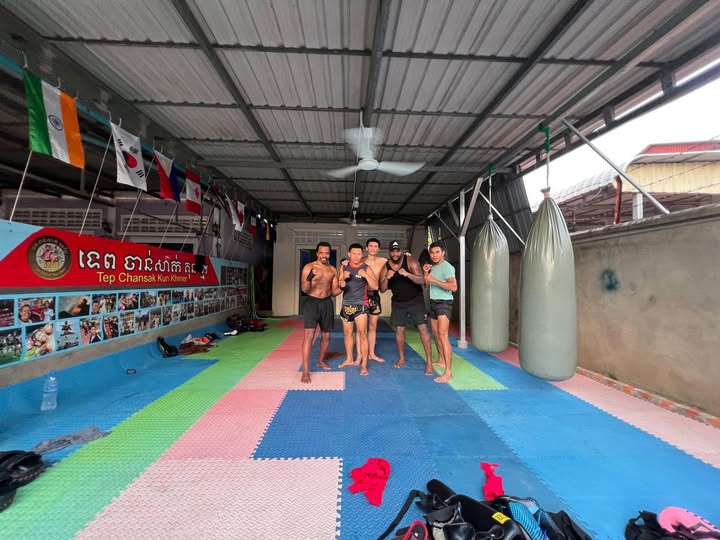
Drop in for a $9 day pass — the group class starts at 5:00 PM every day, and all gear is provided. Message us for today’s times.