
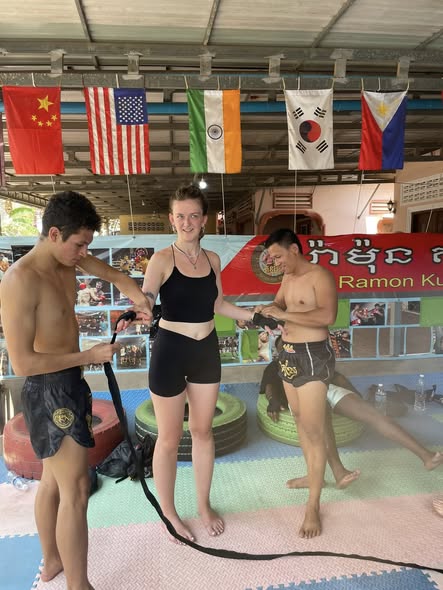
How Do Kun Khmer Rules Work? Beginner Guide
Kun Khmer fights run five three-minute rounds — won by knockout after a ten-second count or on judges' points, with elbows scoring above every other strike and a short, strict foul list. Here is the complete ruleset explained for beginners, and how it differs from Muay Thai.
On this page
- How Many Rounds Is a Kun Khmer Fight?
- How Big Is the Ring, and What Happens Between Rounds?
- What Strikes Are Legal in Kun Khmer?
- What Moves Are Illegal in Kun Khmer?
- How Do Judges Score a Kun Khmer Fight?
- Why Do Elbows Decide So Many Kun Khmer Fights?
- Can You Lose Points for Running Away in Kun Khmer?
- What Is the Kun Kru Ritual Before a Fight?
- What Music Plays During a Kun Khmer Fight?
- Who Enforces Kun Khmer Rules?
- How Do Kun Khmer Rules Differ From Muay Thai Rules?
- Do You Need to Know the Rules Before Your First Class?
- How Big Is the Kun Khmer Fight Scene Under These Rules?
- Can a Beginner Work Up to Fighting Under These Rules?
A Kun Khmer bout runs five three-minute rounds in a 6.1-meter square ring, decided by knockout after a ten-second count or by judges' points at the final bell. Fighters may strike with punches, kicks, knees, and elbows plus clinch work, while striking a downed opponent, blows to the back, rope-holding, and groin strikes are banned. Elbows carry the sport's scoring weight — more victories come by elbow technique than any other strike.
How Many Rounds Is a Kun Khmer Fight?
A professional Kun Khmer bout is five three-minute rounds, with a break of one-and-a-half to two minutes between each round, per Wikipedia's rules summary. If neither fighter is stopped, the bout goes to the judges' scorecards at the end of round five, and level totals produce a draw. That five-round distance makes conditioning as decisive as technique: a fighter who fades by round three still has two rounds to survive, which is why come-forward pace is coached from the start.
- Five rounds per bout, three minutes each — the fixed professional format
- A 1.5–2 minute rest between rounds for corner instructions and recovery
- A knockout ends the bout immediately, once a downed fighter cannot continue after the referee's 10-second count
- No stoppage means the fight is decided on points after the fifth round
- Equal totals on the cards are declared a draw
If you would rather see the format live than read about it, where to watch kickboxing in Siem Reap maps the city's fight nights and what entry costs.
How Big Is the Ring, and What Happens Between Rounds?
Kun Khmer is fought in a 6.1-meter square boxing ring — compact enough that fighters are almost always within striking range, which is one reason the sport plays so aggressively. Between rounds the fighters return to their corners for the 1.5–2 minute break, where cornermen give instructions and the pace is reset for the next three minutes. Modern promoters have experimented with the arena itself: the Hanuman Kun Khmer Stage uses a non-traditional hexagon ring, a crossover format aimed at international audiences, per Wikipedia.
The bout environment at a glance (per Wikipedia's Kun Khmer rules section)
| Feature | Specification |
|---|---|
| Ring | 6.1 m square, roped boxing ring |
| Breaks | 1.5–2 minutes between rounds |
| Officials | Referee and judges, plus time-keepers |
| Modern variants | Hexagon-ring stages (Hanuman Kun Khmer Stage) |
That standardization has a history — who set the ring size and round times, and why, is part of how the sport was codified. For the one-paragraph version of the sport itself, start with what Kun Khmer actually is.
What Strikes Are Legal in Kun Khmer?
Four strike types are legal — punches, kicks, elbows, and knee strikes — plus clinching, per Wikipedia's technique list. That is the whole offensive toolkit: there is no throwing, no grappling, and no ground fighting in the rulebook, only standing strikes. Each weapon owns a range, and combinations chain them — punches to close distance, kicks to the legs and body, then knees and elbows once the fight gets tight.
- Punches — boxing-style jabs, straights, hooks, and uppercuts
- Kicks — primarily shin kicks to the legs, body, and head
- Knees — at range, and more decisively from inside the clinch
- Elbows — the sport's highest-value strike
- Clinch — legal and actively fought, not broken up the way a boxing referee separates fighters
Each weapon has its own mechanics — the full techniques breakdown covers them weapon by weapon, and how the clinch works covers the close-range phase where so much scoring happens.
What Moves Are Illegal in Kun Khmer?
The illegal list is short and strict: a fighter may not strike a downed opponent, bite, deliver blows to the back, hold the ropes, or strike the genitals — and the referee stops the bout when a fighter cannot continue, per Wikipedia's rules section. These bans descend directly from the French colonial reforms of the 1920s–30s, which prohibited life-threatening techniques after ring deaths made the pre-rules folk sport unsustainable. Everything else within the four weapons is fair game, including knees and elbows from the clinch.
Legal and illegal, side by side (per Wikipedia's Kun Khmer foul list)
| Legal | Illegal |
|---|---|
| Punches, kicks, knees, elbows | Striking a downed opponent; biting |
| Clinch control of the neck and arms | Blows to the back; blows to the genitals |
| Active striking inside the clinch | Holding the ropes for leverage |
The foul list doubles as the safety framework — whether Kun Khmer is safe for beginners explains what those rules mean for a first-timer, and the full Kun Khmer vs Muay Thai comparison shows where the two rulebooks overlap.
How Do Judges Score a Kun Khmer Fight?
Victory comes two ways: knockout — a fighter down who cannot continue after the referee's 10-second count — or, at the end of five rounds, judges deciding by a point system which fighter was more effective, with level scores declared a draw. In practice, clean and damaging strikes outweigh busy volume, and elbow work plus clinch control carry outsized weight because they produce the stoppages. Per Wikipedia, judges, referees, and time-keepers are all licensed officials, so the same scoring framework governs provincial cards and televised main events alike.
- Both fighters complete the kun kru ritual, then contest five 3-minute rounds
- A knockout — no continuation after the 10-second count — ends the bout immediately
- If nobody is stopped, judges score effectiveness by points across all five rounds
- Equal totals are declared a draw
Scoring only matters once you are in the ring yourself: how beginners work toward a fight covers that path, and the fighters these rules made famous shows what elite output under this scoring looks like.
Why Do Elbows Decide So Many Kun Khmer Fights?
Because the outcomes say so — Wikipedia notes that more victories come by way of an elbow technique than any other strike, and that Cambodian fighters use elbows more than neighboring martial arts in the region. Elbows cut, stop fights, and land cleanly from inside the clinch, so game plans are built around creating elbow angles rather than avoiding them. For opponents, that makes a closed guard and tight clinch defense survival skills before they are tactics.
In Kun Khmer, more victories come by way of an elbow technique than any other strikes.
The mechanics behind that record — horizontal, diagonal, upward, and downward elbows, plus elbow entries from the clinch — are broken down strike by strike in the techniques guide.
Can You Lose Points for Running Away in Kun Khmer?
Yes — the rules explicitly penalize passivity: constantly retreating when the opponent attempts to approach causes a fighter to lose points, as does kicking a downed opponent, per Wikipedia's rules section. The retreat rule is the one newcomers find most surprising: the sport is built to force engagement, which is why bouts so often look like two fighters pressing forward rather than one circling away. It also means a points lead is rarely defended by running out the clock.
- Kicking a downed opponent — points deducted
- Constantly retreating when the opponent advances — points deducted
- Practical effect: come-forward fighters are rewarded and quiet rounds are rare
- For spectators: the rule explains the relentless pace the sport is known for
That forward pressure is one of the clearest rulebook contrasts with Thai boxing, where rhythm and ring-craft can win rounds more defensively — Muay Thai training in Siem Reap covers that style honestly.
What Is the Kun Kru Ritual Before a Fight?
Every bout opens with the kun kru — a slow, praying ritual performed before fighting begins. Wikipedia counts 17 variations of the ritual, named after characters from the Reamker (the Khmer version of the Ramayana), each paying homage to the fighter's spirit trainer. It is not mere ceremony: the same sequence warms the muscles and increases blood flow before five hard rounds, making it tradition and physical preparation in one.
The kun kru at a glance (per Wikipedia)
| Element | Detail |
|---|---|
| When | Start of every match, before fighting begins |
| Versions | 17 variations, named after Reamker characters |
| Honors | The fighter's spirit trainer |
| Physical purpose | Warms muscles and increases blood flow |
The words that travel with the ritual — kru, achar, kun kru itself — are collected in the Kun Khmer vocabulary you'll hear.
What Music Plays During a Kun Khmer Fight?
Live traditional music plays through the entire bout: the sampho drum, sralai oboe, and chhing cymbals perform a suite called vung phleng pradall. It opens slow, to help the fighters concentrate, then shifts into a faster fight section that builds as the rounds progress, per Wikipedia's description of the tradition. When a fight ends by knockout, the music commonly stops with it — an unmistakable sound from the stands.
The music accelerates with the progression of the round.
Hearing it live is half the experience — things to do in Siem Reap besides Angkor Wat lists fight nights among the city's evening options.
Who Enforces Kun Khmer Rules?
The Cambodian Boxing Federation does: judges, referees, and fighters must all be licensed by the federation (under its former name, the Cambodian Amateur Boxing Federation, per the source), and it supplies match officials including time-keepers, per Wikipedia. That single licensing chain is what keeps the five-round, points-decided format consistent from provincial shows to televised main events. It is also a fair question to put to any gym — under what federation do its coaches compete, and who credentialed them?
- Judges — licensed by the Cambodian Boxing Federation
- Referees and time-keepers — supplied and licensed by the federation
- Fighters — must hold federation licenses to compete
- Effect — one consistent ruleset from provincial cards to TV main events
For a beginner, the practical takeaway is vetting: the best Kun Khmer club in Siem Reap applies exactly that criteria-based test, and the best place to train Muay Thai in Siem Reap runs the same check on the Thai-style side.
How Do Kun Khmer Rules Differ From Muay Thai Rules?
The two rulebooks are close cousins — both full-contact ring sports — but they are not one document. Kun Khmer fixes its format at five three-minute rounds, licenses everyone through the Cambodian Boxing Federation, and is defined by elbow-heavy outcomes. Muay Thai, as defined by IFMA rules on Wikipedia, is the full-contact art using the fists, elbows, knees, and feet; its clinch is not separated by the referee; and under traditional Thai rules, strikes to the groin were permitted into the late 1980s and remain so in Thailand itself. The rituals differ by name too: kun kru in Cambodia, wai kru in Thailand.
Rules comparison — Kun Khmer vs Muay Thai (per each sport's Wikipedia entry)
| Element | Kun Khmer | Muay Thai |
|---|---|---|
| Weapons | Punches, kicks, knees, elbows | Fists, elbows, knees, feet |
| Clinch | Legal and actively fought | Legal — fighters are not separated when they clinch |
| Pre-fight ritual | Kun kru, 17 variations | Wai kru, before the trainer removes the mongkol |
| Elbow outcomes | More victories by elbow than any other strike | Elbows legal; no comparable outcome statistic cited |
The sport-level comparison goes deeper than rules in Kun Khmer vs Muay Thai in full — and the naming question is its own story: why the two names exist.
Do You Need to Know the Rules Before Your First Class?
No — the rulebook governs competition, not your first session, and nothing in a beginner class requires you to know a single rule. Class time goes into stance, guard, pad work, and conditioning, coached at your pace with gloves, wraps, and pads provided. At Kun Khmer Club in Siem Reap the group class runs at 5:00 PM every day, a day pass is $9, and walk-ins are welcome — the rules can wait until you are watching your first full fight.
- Coaches fit you with gloves and wraps — all gear provided
- The session covers stance, guard, basic strikes, and pad rounds at your pace
- No sparring, no clinch battles, and no rules test on day one
- 5:00 PM daily group class; $9 day pass; walk-ins welcome
Practical prep takes two minutes: what to wear to a Kun Khmer class, whether to book a Kun Khmer class in advance, or what one day of training looks like if you want the play-by-play first.
How Big Is the Kun Khmer Fight Scene Under These Rules?
Large and busy: Wikipedia records 1,000 registered boxers across 78 martial arts schools in 2011, more than 50 Kun Khmer fights every week in the Phnom Penh region as of 2012, and roughly 17 to 20 programs each week currently. Pay scales with profile — around $25 per fight for new boxers, up to $75 for experienced ones, past $100 for stars, and $1,000 and up for televised tournaments. Those numbers shape the style too: with weekly bouts and modest purses, fighters build careers on volume, conditioning, and stoppage finishes under exactly the ruleset described above.
Kun Khmer by the numbers (per Wikipedia)
| Measure | Figure |
|---|---|
| Registered boxers (2011) | 1,000 across 78 schools |
| Fights per week, Phnom Penh region (2012) | 50+ |
| Weekly programs (current) | About 17–20 |
| Purses | ~$25 new boxers → $1,000+ televised tournaments |
You do not need the capital for it — the kickboxing spectator guide maps Siem Reap's own fight nights and entry prices.
Can a Beginner Work Up to Fighting Under These Rules?
Yes — the ladder is climbable from zero: five-round bouts reward exactly the conditioning and technique that structured training builds, and gyms take beginners through fundamentals long before any ring involvement. At Kun Khmer Club the progression runs from the $9 day-pass group class through weekly ($69) and monthly ($129) training to the $299 6-week fight camp, coached by Kon Phanet and Ramon, who between them have 50+ professional Kun Khmer fights in Cambodia. First-timers are the normal case here, not the exception — one visitor's first-ever martial arts class turned into a planned return.
Had a great lesson and experience with Kun Phaneth. Was the first time in my life to do any type of boxing or martial arts - will definetely do it again
If that is the direction you are heading, how a fight camp works for beginners covers the six-week structure, and the cost of Kun Khmer classes in Siem Reap prices every tier.
FAQ
Is Kun Khmer the same as Muay Thai?
No — they are closely related ring sports sharing punches, kicks, knees, elbows, and clinch work, but Kun Khmer is Cambodia's own sport with its own federation, its kun kru ritual, and elbow-heavy outcomes that shape how fights are judged and won.
What is the difference between Kun Khmer and Muay Thai?
The rulebooks overlap — both are full-contact striking sports — but Kun Khmer fixes the format at five three-minute rounds, licenses fighters and officials through the Cambodian Boxing Federation, and produces more victories by elbow than any other strike. Muay Thai runs under IFMA rules internationally and its own traditional ruleset in Thailand.
What is the difference between Muay Thai and Pradal Serey?
For rules, essentially nothing: Pradal Serey is the older name for the same Cambodian sport now promoted as Kun Khmer, and both share the five-round, four-weapon ruleset. The names reflect eras and audiences, not different rulebooks.
Where to watch Khun Khmer in Siem Reap?
Siem Reap hosts regular fight nights at its kickboxing arenas, and community-reported entry prices run around $10–15 per event (Tripadvisor reviews, community-reported). A class at Kun Khmer Club is the other way in: train at 5:00 PM, then watch the same sport fought under full rules the same week.
Is There Risk of Injury?
In competition, yes — it is a full-contact sport, which is exactly why the rules ban downed-opponent strikes, biting, blows to the back, and groin strikes. In class, beginners train technique and pad work with gear provided, and sparring is not part of day one.
Can beginners join a class?
Yes. The 5:00 PM group class runs daily, a $9 day pass covers it, gear is provided, and coaches teach stance and basics before anything harder — no experience or rules knowledge needed.
Key takeaways
- A Kun Khmer fight runs five three-minute rounds with 1.5–2 minute breaks, in a 6.1-meter square ring.
- Wins come by knockout after a 10-second count or on judges' points — level totals are a draw.
- Legal weapons are punches, kicks, knees, and elbows plus the clinch; downed-opponent strikes, biting, blows to the back or groin, and rope-holding are banned.
- Elbows are the decisive strike — more victories come by elbow than any other technique, and constant retreating itself costs points.
- You need none of this to start: the 5:00 PM daily class ($9 day pass, gear included) teaches stance and pad work — no rules test.
Sources & further reading
- Wikipedia — Kun Khmer — Five 3-minute rounds, 1.5–2 minute breaks, 6.1 m square ring, knockout after a 10-second count, judges' point system and draws, the foul list, point deductions for kicking a downed opponent and for constantly retreating, elbow-strike dominance in outcomes, Cambodian Boxing Federation licensing, the kun kru ritual (17 Reamker variations), sampho/sralai/chhing fight music, hexagon-ring stages, French-era rule reforms after 1920s–30s ring deaths, and the participation/purse statistics — source
- Wikipedia — Kun Khmer — Codification by the French colonial administration in the early 20th century (gloves, time limits, rest periods), the formal name Kbach Kun Pradal Khmer, the meanings of the names Kun Khmer and Pradal Serey, and the fight-music suite structure including the verbatim line on music accelerating with the rounds — source
- Wikipedia — Muay Thai — The IFMA full-contact definition (fists, elbows, knees, feet), the clinch not being separated by the referee, the wai kru ritual and mongkol, and the traditional-rules history on groin strikes used only in the comparison section — source
- Google Maps — Kun Khmer Club reviews — The verbatim Manuel Jungwirth first-class review quote and the real review base (8 reviews at 5.0, per docs/seo-evidence/google-reviews.md) — source
Reviewed 2026-10-26
Written by the coaches
Kun Khmer Club — Coaches Kon Phanet & Ramon
Head coaches Kon Phanet and Ramon have a combined 50+ professional Kun Khmer fights in Cambodia. We coach beginners, travelers, expats, and fighters at our gym in Siem Reap.

Ready to train in Siem Reap?
Drop in for a $9 day pass — the group class starts at 5:00 PM every day, and all gear is provided. Message us for today’s times.