

Can Beginners Join a Fight Camp in Cambodia? Yes
Yes — beginners can join a fight camp in Cambodia: the 6-week Kun Khmer camp costs $299, runs under coaches with 50+ combined professional fights, and paces every week to where each student actually is — no fight experience required.
On this page
- What Is a Fight Camp, and How Is It Different From Drop-In Classes?
- Can a Total Beginner Really Keep Up in a Six-Week Camp?
- What Does a Training Day in the Camp Look Like?
- How Fit Do You Need to Be Before Day One?
- How Much Does a Fight Camp in Cambodia Cost?
- Is Six Weeks Actually Enough Time to Progress?
- Do You Have to Fight at the End of a Fight Camp?
- Is It Safe to Train This Hard as a Beginner?
- What Should You Pack for a Training Trip to Siem Reap?
- When Is the Best Time of Year for a Fight Camp in Cambodia?
- How Many Calories Does Fight-Camp Training Burn?
- Do You Need a Visa for a Six-Week Training Trip?
Yes — beginners can join a fight camp in Cambodia: the 6-week Kun Khmer camp at Kun Khmer Club in Siem Reap costs $299, assumes no fight experience, and paces drilling to where each student actually is. What it asks for instead is consistency — six weeks of showing up to the daily 5:00 PM class. Here is what the camp involves, what it costs, and what to know before you commit.
What Is a Fight Camp, and How Is It Different From Drop-In Classes?
A fight camp is a structured multi-week training block with a progression built into it — not a single harder class. The difference matters for beginners: a drop-in gives you one session's worth of work and restarts from zero each visit, while a camp layers technique week on week so fundamentals exist before the harder clinch, elbow, and sparring work arrives. The daily group class still runs at 5:00 PM and campers train inside it, so the camp is a commitment to six weeks of the same class with a coaching structure wrapped around it. If you have never trained at all, what a single drop-in class actually looks like is the honest starting point, and how to build skill faster between sessions covers the habits that make a camp week productive.
Drop-in class vs. the 6-week fight camp at Kun Khmer Club
| Aspect | Drop-in class | 6-week fight camp |
|---|---|---|
| Structure | Same daily class, join any day | Progressive curriculum built week to week |
| Commitment | Single sessions, no schedule required | Six weeks of consistent, structured training |
| Price | $9 per class | $299 for the full camp |
| Goal | General fitness, flexible training | A real foundation — or preparing to fight |
Can a Total Beginner Really Keep Up in a Six-Week Camp?
Yes — coaches pace the camp to the student, so a true beginner is not thrown into advanced sparring in week one, and someone with prior striking experience is not stuck redoing basics they already have. What beginners need going in is motivation and consistency, not a background: fundamentals are taught from zero and intensity is scaled round by round. Most guests training here have never done any martial art before — the review below is from a first-timer's very first session.
Had a great lesson and experience with Kun Phaneth. Was the first time in my life to do any type of boxing or martial arts - will definetely do it again
If the zero-experience question is the thing holding you back, whether you can try Kun Khmer with no experience at all answers it directly, and how beginners train safely covers how sessions are scaled.
What Does a Training Day in the Camp Look Like?
Every training day runs inside the same session shape: a warm-up to raise the heart rate, technique instruction on the day's strikes, pad rounds as the main work block, and a conditioning finisher to end. Kun Khmer itself consists of four types of strikes — punches, kicks, elbows, and knee strikes — plus the clinch, so camp weeks rotate through all of them. As the weeks progress, pad work gets more live and less scripted, and controlled sparring is introduced once fundamentals and control are solid. What beginner Kun Khmer classes cover walks a first week in detail, and what Kun Khmer actually is explains the sport itself.
- Warm-up — raise the heart rate before anything flies at a pad
- Technique — the session's punches, kicks, knees, and elbows taught from zero
- Pad rounds — the main output block, in gloves and pads that are provided
- Conditioning finisher — bodyweight and core volume to close the hour
How Fit Do You Need to Be Before Day One?
Less than most people fear — you build camp fitness by training, not before arriving, and the real entry requirements are showing up consistently and telling the coaches about any injuries. The CDC's own starting advice cuts the same way: some physical activity is better than none, and adults who do any amount of moderate- or vigorous-intensity activity gain some benefit. A full camp week will exceed the CDC's weekly benchmark of 150 minutes of moderate activity plus 2 strength days, so build into the volume across week one rather than arriving and sprinting.
- You need: sports clothes, water, and the willingness to be a beginner in week one
- You don't need: gloves, wraps, or prior striking experience — gear is provided and training is barefoot on mats
- You should bring: honesty about injuries, so pad rounds are scaled from day one
- If in doubt: a $9 day pass before the camp answers the fitness question with data instead of anxiety
For a wider comparison of starting points, the best martial arts for beginners ranks the usual options honestly, and whether older beginners can train Kun Khmer speaks to starting later in life.
How Much Does a Fight Camp in Cambodia Cost?
The 6-week fight camp costs $299 flat at Kun Khmer Club — no per-session accounting, and a defined block to commit to rather than deciding day by day whether to show up. The shorter passes exist for exactly the testing phase before that commitment: a $9 day pass for one class, $69 for a week of daily training, and $129 for a month. Private sessions at $25 per hour, per person add one-on-one attention alongside the camp. The full class-cost breakdown for Siem Reap compares every tier in detail.
Kun Khmer Club training prices, from lib/business.ts
| Option | Price | What it includes |
|---|---|---|
| Day pass | $9 | One group class — test the format first |
| Weekly pass | $69 | A week of daily training |
| Monthly | $129 | A month of daily training |
| Private 1-on-1 | $25 / hour / person | Form work arranged directly with the coaches |
| 6-week fight camp | $299 | The full structured camp block |
Is Six Weeks Actually Enough Time to Progress?
Yes for a working foundation — six weeks of daily, structured training builds the movement, basic strikes, and clinch fundamentals that scattered drop-ins never accumulate, though nobody becomes a finished fighter in six weeks and the coaches won't pretend otherwise. The body adapts week over week instead of restarting each visit, which is the entire reason the camp format exists. How that progression typically unfolds:
- Weeks 1–2 — stance, guard, and the basic strikes; the conditioning base builds and soreness peaks
- Weeks 3–4 — combinations chain together; clinch work begins under close coaching
- Weeks 5–6 — pad rounds get live; controlled, optional sparring for those who want it
For the travel side of the same decision — flights, accommodation, budget, and booking order — how to plan a Kun Khmer training trip around the camp walks the whole trip end to end.
Do You Have to Fight at the End of a Fight Camp?
No — fighting at the end is optional, not the exit exam. Most camp students build skill, conditioning, and ring literacy without ever taking a bout, and the camp's value does not depend on one. Anyone who does want the fight path raises it with the coaches — Kon Phanet and Ramon, with 50+ professional Kun Khmer fights between them — and match-making only happens after they have seen weeks of your training, not before.
- The default camp — skill, conditioning, and confidence; no bout required, ever
- The fight track — for students who ask; the coaches decide when a fighter is ready, and beginners are told the truth about the gap
- Either way, know the rules — how Kun Khmer fights are scored and won explains the format, and where Kun Khmer fits for MMA fighters covers the crossover path
Is It Safe to Train This Hard as a Beginner?
Yes, within the way the training is actually run: beginners hit pads, not people; sparring arrives late and controlled, if at all; and the clinch — Kun Khmer's signature — is taught at walking pace before anyone tries it live. The sport is most well known for its kicking and elbow technique, which is exactly why those weapons are drilled on pads for weeks before they appear in partner work. Soreness in week one is normal; injury is not a prerequisite of the camp.
Beginner worries vs. how the camp actually runs
| Worry | How the camp handles it |
|---|---|
| Getting hit in week one | Pad work only — sparring arrives gradually, after fundamentals and control are solid |
| The clinch looks intimidating | Taught step by step at walking pace, then progressively live |
| I have an old injury | Tell the coaches — rounds are scaled, and private 1-on-1 sessions exist for targeted work |
The mechanics behind the scariest-looking part are covered in how the clinch actually works, and private lessons for targeted one-on-one work are the pressure-relief valve if anything needs extra attention.
What Should You Pack for a Training Trip to Siem Reap?
Almost nothing specialized — gloves, hand wraps, and pads are provided and you train barefoot on mats, so the packing list is ordinary sports kit plus the things this climate punishes you for forgetting. Water discipline and quick-dry clothes matter more in Siem Reap's heat than any equipment purchase. Book the first class before you fly and the rest arranges itself.
- Sports clothes for daily training — quick-dry beats cotton in this humidity
- Two of everything you would sweat through; laundry is cheap and fast in town
- Your own mouthguard if you ever opt into sparring — the one item worth buying before you fly
- Water bottle and electrolytes — the heat taxes you more than the pads do
- A message to the coaches on WhatsApp, Telegram, or +855 96 228 8585 before you fly
The kit question in full is settled by what to wear to a Kun Khmer class, and the first message to send is covered in how to book a class in advance.
When Is the Best Time of Year for a Fight Camp in Cambodia?
Any month works for training because the class runs daily at 5:00 PM year-round — the season changes comfort, not availability. Siem Reap's hot season lasts from about March 13 to May 17 with average daily highs above 93°F, and April is the hottest month near 95°F, while December is the coolest month at roughly 85°F highs and 71°F lows. The wetter period runs from late April to late October with afternoon showers and a September rainfall peak around 8.5 inches; December is the driest month at 0.2 inches.
- November–February — the coolest, driest stretch, with December highs near 85°F: the comfortable-camp window
- March–May — hot season: highs above 93°F and April near 95°F; train early in the day and hydrate hard
- June–October — wet season: showers most days and September the wettest month, but the 5:00 PM class runs regardless and crowds are thinner
- Year-round floor — typical temperatures run 70°F to 95°F and rarely fall below 64°F or exceed 102°F, per WeatherSpark's Siem Reap record
Weighing the seasons against temple travel is the best time to visit Siem Reap for training and travel, and why the 5:00 PM class time makes sense in this heat covers the daily scheduling question.
How Many Calories Does Fight-Camp Training Burn?
An hour of camp-style work burns an estimated 540–840 calories depending on body weight and intensity — an estimate derived from Harvard Health's published figures, not a measurement of any specific class. Harvard's table puts boxing sparring at 270–378 calories per 30 minutes and martial-arts-style training at 300–420 for adults weighing 125, 155, and 185 pounds; doubled to a training hour, that is 540–756 for sparring-style work and 600–840 for pad-heavy sessions. Across a six-week camp, the total depends on how many of the daily sessions you actually attend — which is the honest answer, not a marketing number.
Estimated calories per training hour, derived by doubling Harvard Health's published 30-minute figures. Estimates, not measurements.
| Body weight | Sparring-style hour | Pad-heavy martial-arts hour |
|---|---|---|
| 57 kg / 125 lb | ~540 kcal | ~600 kcal |
| 70 kg / 155 lb | ~648 kcal | ~720 kcal |
| 84 kg / 185 lb | ~756 kcal | ~840 kcal |
The full calories-burned guide shows the derivation step by step, and how training fits weight-loss goals covers the diet half of that equation.
Do You Need a Visa for a Six-Week Training Trip?
Yes, and one timing detail matters: Cambodia's tourist visa — $30, obtained as an e-visa online or on arrival for most nationalities — allows a maximum stay of 30 days, and extensions are possible. A six-week camp runs 42 days, so a 30-day visa does not cover the full block on its own; plan the extension before you arrive rather than discovering the problem in week four. Since January 2025, air arrivals must also submit the Cambodia e-Arrival Card in the seven days before arrival. None of this is a barrier — it is ordinary paperwork, best done early.
- Tourist visa — $30 for 30 days, as an e-visa online or on arrival for most nationalities
- Extension — possible beyond 30 days; a 42-day camp needs one, so build it into the trip plan
- e-Arrival Card — required for air arrivals since January 2025, submitted in the seven days before arrival
- Insurance — travel and health cover is worth arranging before you fly; injuries are rare but hospitals are real
Arrival itself is the easy part — tourists walk in and train the same day — and what to do around training hours fills the mornings and rest days between sessions.
If the six-week block sounds like your trip, book the 6-week fight camp directly — a message to the coaches on WhatsApp, Telegram, or +855 96 228 8585 confirms start dates and paces your first week correctly. Everything else about longer stays — costs, seasons, trip planning, the camp itself — is collected in the fight camp and training trips hub.
FAQ
Do I need experience before going to a training camp?
No. The camp assumes no fight experience — coaches teach fundamentals from zero and pace the block to where each student actually is. What beginners need is consistency for six weeks, not a striking background.
What Makes a Fight Camp Good for Beginners?
Structure, pacing, and honest coaching: a progressive curriculum instead of one fixed mixed-level class, sparring introduced gradually, and intensity scaled round by round. That is exactly how the 6-week camp at Kun Khmer Club is built.
How long should you go for?
Six weeks is the camp format and enough for a genuine working foundation — movement, basic strikes, and clinch fundamentals. If that is too long, a $9 day pass, $69 weekly pass, or $129 month covers shorter stays; the camp is the strongest single block if you have the time.
What's the best time of year to go?
Training runs year-round because the class starts daily at 5:00 PM. For comfort, November through February is coolest and driest — December's highs sit near 85°F — while March to May is the hot season with highs above 93°F.
Is Sparring Required?
No. Beginners spend camp weeks on pads, sparring arrives gradually once fundamentals and control are solid, and it stays optional. Most camp students build real skill without ever taking a bout.
What if I have an injury or medical condition?
Tell the coaches before you book or on day one — pad rounds and conditioning are scaled to what you can do. For anything medical, get cleared by your own doctor before a six-week intensive; the coaches would rather adjust the plan than find out mid-camp.
What happens if I get sick or injured and cannot train?
Stop and tell the coaches — a camp block can be adjusted, and returning too fast in this heat makes things worse. Message the club on WhatsApp, Telegram, or +855 96 228 8585 as soon as it happens so your first session back is paced safely.
Is it worth going to Siem Reap if I'm only there 2 weeks?
Yes — two weeks is a real block, not a token visit: a $69 weekly pass covers the first week and consecutive days of the 5:00 PM class build fast. You will not finish a full 6-week camp, but the fundamentals and conditioning are real, and Siem Reap's temples and markets fill the mornings.
Key takeaways
- Yes — beginners can join: the 6-week camp costs $299, assumes no fight experience, and is paced to each student by coaches Kon Phanet and Ramon (50+ combined professional fights).
- A camp is a progressive block, not a harder drop-in — technique layers week on week, and sparring stays optional and arrives late.
- Entry fitness is low: gear is provided, the class runs daily at 5:00 PM, and a $9 day pass tests the format before the $299 commitment.
- Training hours burn an estimated 540–840 kcal (Harvard-derived figures), and November–February is the comfortable window — highs near 85°F versus 95°F in April.
- Paperwork first: Cambodia's $30 tourist visa covers 30 days, so a 42-day camp needs an extension — arrange it before you fly.
Sources & further reading
- Harvard Health — Calories burned in 30 minutes for people of three different weights — Boxing sparring burns 270/324/378 kcal and martial-arts-style training 300/360/420 kcal per 30 minutes at 125/155/185 lb — the published figures doubled for the 540–840 hourly estimates. — source
- WeatherSpark — Average Weather in Siem Reap, Cambodia, Year-Round — Hot season March 13–May 17 with daily highs above 93°F (April ~95°F/81°F); December the coolest month (~85°F/71°F); wetter period April 27–October 23 with a September rainfall peak (~8.5 in); December driest (0.2 in); typical temperatures 70–95°F year-round. — source
- Wikipedia — Visa policy of Cambodia — Tourist visa $30 for a maximum stay of 30 days, obtainable as an e-visa or on arrival; extensions are possible; the Cambodia e-Arrival Card has been required for air arrivals since January 2025. — source
- CDC — Physical Activity Guidelines for Adults — Adults need at least 150 minutes of moderate-intensity activity a week (or 75 vigorous) plus 2 days of muscle-strengthening; some physical activity is better than none. — source
- Wikipedia — Kun Khmer — Kun Khmer consists of four types of strikes — punches, kicks, elbows, and knee strikes — plus the clinch, and is most well known for its kicking and elbow technique. — source
Reviewed 2026-10-26
Written by the coaches
Kun Khmer Club — Coaches Kon Phanet & Ramon
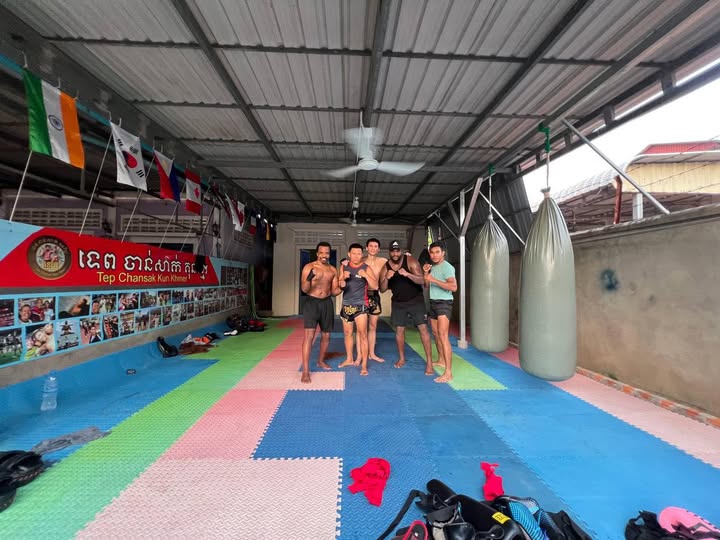
Head coaches Kon Phanet and Ramon have a combined 50+ professional Kun Khmer fights in Cambodia. We coach beginners, travelers, expats, and fighters at our gym in Siem Reap.

Ready to train in Siem Reap?
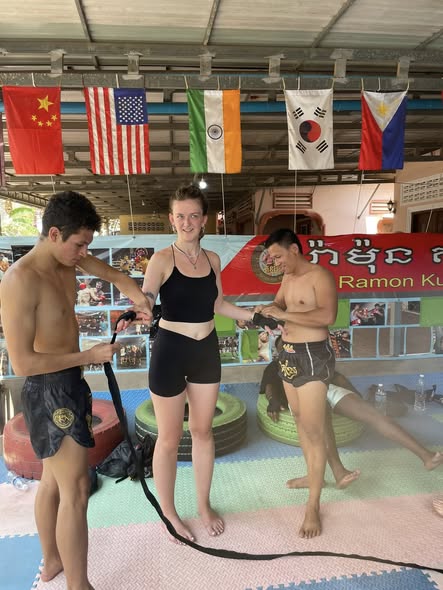
Drop in for a $9 day pass — the group class starts at 5:00 PM every day, and all gear is provided. Message us for today’s times.