
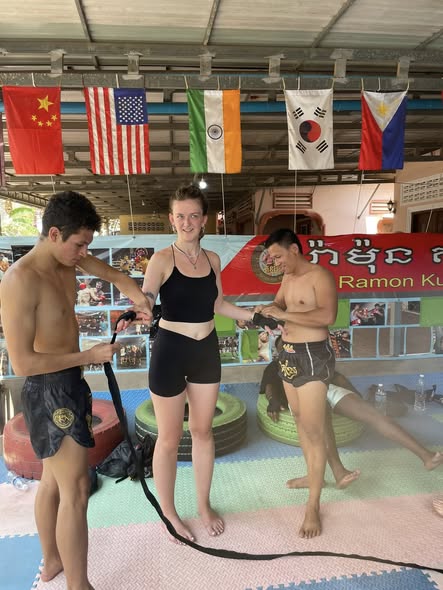
Best Time to Visit Siem Reap? November-February
The best time to visit Siem Reap is November through February — the dry season's coolest, driest stretch. Training never pauses either way: the daily 5:00 PM class runs year-round, so any month works.
On this page
- When Is the Best Time to Visit Siem Reap for Training and Travel?
- What Does Siem Reap's Climate Actually Do Through the Year?
- How Do Heat and Humidity Change a Kun Khmer Class?
- Is the Rainy Season a Bad Time to Train?
- Should You See Angkor Wat Before or After Your Training Day?
- How Much Does Training Cost, Whatever the Season?
- Can Beginners Handle Training in This Climate?
- How Many Days Should You Plan in Siem Reap?
- What Should You Pack for Each Season?
- Is the Hot Season a Deal-Breaker for a Training Trip?
- What Do Trainees Who Visited Actually Say?
- Does the Season Change the Workout — or the Calories?
- When Should You Plan a Longer Fight-Camp Stay?
- Traveling With Family or Staying Long-Term — Does the Season Advice Change?
- Where Should You Start Planning the Trip?
November through February is the best time to visit Siem Reap for training and travel — the dry season's coolest, driest stretch, when December and January average daily means of about 25-26°C and rainfall nearly disappears. There is no wrong month to train here, though: the Kun Khmer Club group class runs at 5:00 PM every day of the year, indoors, so the season changes comfort outside the gym, never availability inside it. Pick your month for the temples; the gym runs the same schedule in all of them.
When Is the Best Time to Visit Siem Reap for Training and Travel?
November through February, and December in particular if you want the coolest air of the year. Siem Reap has a tropical wet and dry climate — the wet season runs from May to October and the dry season covers the remaining six months — and within that dry season, December and January are the coolest months, with daily means of 25.6°C and 26.0°C and nights dipping to roughly 20.5°C. January and February are also the driest months, averaging just 3.7 mm and 4.7 mm of rain, so a full day of temple-walking followed by an evening class asks the least of your body in this stretch.
Siem Reap's three travel-and-training stretches, from Wikipedia's climate data for the city
| Stretch | Months | What it feels like | Best suited to |
|---|---|---|---|
| Cool, dry | November-February | December-January daily means 25.6-26.0°C; January-February nearly rain-free | First visits: full temple days plus evening training |
| Hot, dry | March-May | The hottest stretch — April's mean daily maximum reaches 35.8°C | Early-morning sightseeing and deliberately paced training |
| Wet | May-October | June averages about 18 rainy days; September is the wettest month at 287.7 mm | Quieter temples, greener countryside, unchanged training |
Whatever month you land on, the training day has a fixed shape: the class starts at 5:00 PM, after the harshest sun has passed. The best time of day to train in Siem Reap covers that clock-side decision in detail, and the martial arts scene in Siem Reap shows where an evening class sits among the town's other options.
What Does Siem Reap's Climate Actually Do Through the Year?
One number frames everything: average high temperatures in Siem Reap never drop below 30°C in any month, so this is always a warm-climate trip — the seasons differ in rain, humidity, and how far above 30°C the days climb. The city collects roughly 1,406 mm of rain a year, almost all of it inside the May-October wet season, and humidity averages 66% annually, peaking at 75% in September and October and bottoming out at 58% in March.
- Dry season (November-April): the rain largely stops — January averages 3.7 mm — and humidity eases before March turns it into heat with clear skies
- Hot season (March-May): April is the hottest month, with a mean daily maximum of 35.8°C and a recorded high of 41.2°C, while March is the least humid month at 58%
- Wet season (May-October): June averages about 18 rainy days and September delivers the year's heaviest rainfall at 287.7 mm, with humidity at its 75% peak in September and October
For the travel side of the calendar — how these seasons shape sightseeing rather than sport — what Siem Reap is like beyond Angkor Wat maps the rest of the itinerary.
How Do Heat and Humidity Change a Kun Khmer Class?
The heat is real every month of the year — that is why the class starts at 5:00 PM, deliberately after the day's peak — and it means hydration and pacing do work your gym back home may never have asked of you. The WHO's heat guidance is blunt about the mechanism: the body's inability to regulate internal temperature in extreme heat increases the risk of heat exhaustion and heatstroke, and heatstroke is a medical emergency. The same guidance says to avoid strenuous activity during the hottest time of day and to drink water regularly — about a cup per hour and 2-3 litres across the day. A 5:00 PM start in a shaded gym is exactly the kind of scheduling that respects that advice, and the coaches pace drills to the room rather than expecting a visitor to match a local's acclimatization.
The heat rules that matter here
Drink water through the whole day before class, not just during it — the WHO's benchmark is a cup per hour and 2-3 litres daily. Expect sweat volume to feel enormous; that is cooling, not a scoreboard. Treat dizziness, chills, or a racing heart as stop-and-sit signals, and say so — sitting out a round is handled without comment. And remember direct sun can make it feel 10-15°C hotter than the air temperature, which is why the 5:00 PM slot matters.
For the fuller honest risk picture of a first class, whether Kun Khmer is safe for beginners covers it without spin, and what changes when an older beginner starts matters extra in this climate, since the WHO counts people over 65 among the most heat-vulnerable.
Is the Rainy Season a Bad Time to Train?
No — the rainy season (May-October) changes your sightseeing more than your training, because the gym runs indoors on the same 5:00 PM schedule whatever the sky is doing. June, the wettest-start month, averages about 18 rainy days, and showers tend to arrive as discrete events rather than all-day washouts, so the practical wet-season pattern is mornings out, a dry midday break, and an evening class that never noticed the weather. The trade is real but symmetric: greener countryside and thinner temple crowds in exchange for planning around showers.
- Training: unchanged — same coaches, same 5:00 PM start, indoors on mats, gear provided
- Temples: mornings usually clear; showers cluster later in the day, so start sightseeing early
- Crowds and prices: the wet season is the low season, with fewer tour groups at the main sites
- Packing: a light rain shell and quick-dry clothes cover most of the sightseeing side
If a day does turn fully wet, how the fitness classes in Siem Reap compare shows the town's other indoor options — and the gym stays the steadiest schedule of the lot.
Should You See Angkor Wat Before or After Your Training Day?
Temples in the cool morning, class at 5:00 PM — that ordering wins in every season, and it is not close. Angkor is one of the most important archaeological sites of Southeast Asia, extending over approximately 400 square kilometres and holding the remains of successive Khmer Empire capitals from the 9th to the 15th century, so a temple day here means an early start, hours of walking, and sustained sun. By mid-afternoon you will want shade, food, and a rest — and the 5:00 PM class sits exactly on the far side of that recovery window, turning the hottest hours into downtime instead of a second outdoor commitment.
- Dawn to late morning: the temples — coolest hours, thinnest crowds, and the light photographers cross the world for
- Midday to late afternoon: lunch, a nap, a pool, or a slow café — the mandated cool-place hours in this climate
- 5:00 PM: arrive at the gym, wrap up, and train the full class
- Evening: dinner in town — you will have earned it twice over
What one evening class actually covers walks the session step by step, so a temple-plus-training day needs no other homework.
How Much Does Training Cost, Whatever the Season?
The prices never move with the calendar: a $9 day pass buys any single group class, and the longer passes simply lower the per-class cost the longer you stay. There is no high-season surcharge, no peak pricing, and no gear rental at any time of year — the same five options apply in April's heat and January's cool alike.
Kun Khmer Club pricing — identical in every season
| Option | Price | What it covers |
|---|---|---|
| Day pass | $9 | One group class — the drop-in option, gear included |
| Weekly pass | $69 | Every class for a week — the natural fit for a 5-7 day trip |
| Monthly pass | $129 | Best value for stays of several weeks |
| Private lesson | $25 per hour, per person | 1-on-1 session arranged with the coaches |
| 6-week fight camp | $299 | Structured camp: technique, pads, conditioning |
The crossover math between tiers is laid out in the full class cost breakdown, and affordable martial arts in Siem Reap compares what the same money buys across town's other gyms.
Can Beginners Handle Training in This Climate?
Yes — the class scales to whoever is in the room, and the climate is managed by the schedule, not by your fitness. The 5:00 PM start keeps you out of peak heat, the WHO names athletes among the groups exposed to excess heat precisely because exertion and heat stack, which is why the coaches pace a visitor's conditioning block rather than throwing them into a local's volume. Nobody is asked to spar on day one, gloves and wraps are provided, and the pads take every strike.
- Technique stages run slow with hands-on correction, before any intensity rises
- Conditioning is scaled to the individual — first-timers finish tired, not wrecked
- Water breaks are part of the session structure, not a favor you have to request
- Arriving hydrated and fed lightly an hour or two before class does most of the climate work for you
What beginner classes cover week to week shows the longer arc beyond a single session, and trying Kun Khmer with no experience answers the zero-background question directly.
How Many Days Should You Plan in Siem Reap?
Three to four days covers the essential temples plus at least one or two training evenings, and it is the most common shape we see from visiting students. How much time for Siem Reap? is one of the most-asked questions in travel planning threads, and the honest answer depends on depth: the small temple circuit plus a class is a three-day trip, while a week lets you add outlying sites, the lake, and enough training evenings for the weekly pass to pay off. A sample four-day plan:
- Day 1: small circuit temples in the morning, rest through midday, first 5:00 PM class ($9 day pass — the low-commitment try)
- Day 2: Angkor Wat at dawn, afternoon recovery, second class — this is usually the evening people buy the weekly pass
- Day 3: Angkor Thom and Bayon in the morning, Tonlé Sap or the old town in the afternoon, third class
- Day 4: countryside, markets, or a second temple loop, then a final class — or a private lesson at $25 per hour, per person, to lock in what you learned
How to plan a Kun Khmer training trip to Siem Reap turns this skeleton into a full itinerary with flights, lodging, and booking order, and the training tips that apply in any month make consecutive evenings land better.
What Should You Pack for Each Season?
Almost nothing: light sports clothes, water, and a small towel for class — gloves, wraps, and pads are provided, and training is barefoot on mats, so shoes come off at the door. The season only changes the extras you carry during the day, not anything the gym requires.
- Every season: breathable workout clothes, refillable water bottle, small towel, sunscreen and a hat for temple days
- Cool months (November-February): a light layer for early-morning tuk-tuk rides — that is as cold as it gets, with December-January lows around 20.5°C
- Hot months (March-May): more water capacity than you think you need and a plan to be indoors for the 2-3 midday hours the WHO advises spending somewhere cool
- Wet season (May-October): a packable rain shell and quick-dry clothes for sightseeing — training needs nothing extra, since the gym runs indoors
What to wear to a Kun Khmer class settles the training-kit question completely, and training under the sport's other name, Khmer boxing, covers the same ground for anyone booking under that label.
Is the Hot Season a Deal-Breaker for a Training Trip?
It is a filter, not a wall: March through May asks more of you, but the class structure is already built for it. April's mean daily maximum of 35.8°C is the number to respect — outdoor sightseeing wants a dawn start and a done-by-noon shape, and the WHO's advice to spend 2-3 hours a day in a cool place becomes non-negotiable rather than optional. Training itself stays workable because the 5:00 PM class sits after the worst of it, the gym is shaded, and the coaches will pace your conditioning to the conditions — March even brings the year's lowest humidity at 58%, which many trainees find more tolerable than the wet season's 75%. The visitors who struggle in hot season are the ones who stack a full temple afternoon onto the class; the ones who split the day train fine and report the gyms and temples are quieter.
If your dates land in March-May
Book temples for dawn, keep the 2-3 midday hours indoors or shaded (the WHO's cool-place advice, which matters year-round and becomes non-negotiable in April), carry more water than feels necessary against the 2-3 litres-daily benchmark, and let the 5:00 PM class be the evening's one commitment. The ordering does the climate work for you.
If your dates are fixed to the hot months, message ahead so the coaches know what to expect: whether tourists can train Kun Khmer in Siem Reap covers access for visitors, and how booking works explains the WhatsApp-first confirmation that takes one message — useful in any season, valuable in April.
What Do Trainees Who Visited Actually Say?
The most useful signal comes from people who chose Siem Reap over the famous Thai camps — and they exist in numbers that surprise people planning around Thailand by default. When one r/MuayThai thread asked for gyms with accommodation outside Thailand, a reply steered the asker here in no uncertain terms (community-reported):
My vote is going to Siem Reap and training Khun Khmer… Some of the best training I ever did was there.
That tracks with what the seasons cannot touch: the coaching and the training itself are the same twelve months a year. For the comparative picture, where to train Muay Thai in Siem Reap lays out the town's options under the Thai-labeled sport too.
Does the Season Change the Workout — or the Calories?
No — the session shape is fixed all year, so the energy cost is too: an hour-long Kun Khmer-style class burns an estimated 540-840 calories depending on body weight and intensity, an estimate built by doubling Harvard Health's published 30-minute figures for boxing (sparring) and martial arts, not a measurement of our specific classes. The season changes how much you sweat, not how much you burn — sweat is cooling, and treating it as a scoreboard is a mistake in this humidity. What the hot months do change is how deliberately you should eat and hydrate around the session.
Estimated hourly burn, derived from Harvard Health's published 30-minute figures for boxing (sparring) and martial arts doubled to an hour. Estimates, not measurements.
| Body weight | Lower-intensity hour | Higher-intensity hour |
|---|---|---|
| 57 kg / 125 lb | ~540 kcal | ~600 kcal |
| 70 kg / 155 lb | ~648 kcal | ~720 kcal |
| 84 kg / 185 lb | ~756 kcal | ~840 kcal |
How many calories a Kun Khmer class burns shows the full derivation and why the range is so wide, and whether Kun Khmer helps with weight loss puts the burn in the only context that matters — the calorie balance your diet sets.
When Should You Plan a Longer Fight-Camp Stay?
Any season works for the 6-week camp, because the camp lives on the same year-round schedule as everything else — but the dry stretch from November to February makes the long stay easier, since six weeks of recovery days and sightseeing feel very different at 26°C than at 35.8°C. The camp costs $299 for the structured six weeks, and the shorter passes exist precisely so you can bridge into it: a $69 weekly pass or $129 monthly pass converts a trip into a camp decision without pressure. Privates at $25 per hour, per person, slot in alongside the group schedule whenever you want dedicated correction.
- Short trip, testing the water: day passes at $9, then a weekly pass at $69 once the second evening lands
- Multi-week stay: monthly pass at $129, with privates at $25 per hour, per person, added as needed
- Committed stay: the 6-week fight camp at $299 — technique, pads, and conditioning on a progressive curriculum
- Timing: start the camp when you can commit six real weeks; every start month trains identically
Whether beginners can join a fight camp in Cambodia answers the eligibility question directly, and private Kun Khmer lessons in Siem Reap covers the 1-on-1 option in full.
Traveling With Family or Staying Long-Term — Does the Season Advice Change?
The calendar advice holds for both groups, but what the season actually touches differs. Families usually plan around school holidays that can land in any month, and the cool months simply make the temple half of a family day kinder while the training stays exactly where it was. Long-termers — remote workers, half-year residents — often pick the wet season deliberately, because the same low-season logic that thins temple crowds thins the town, and the daily training schedule never notices.
Who visits, and what the calendar actually changes for them
| Who | The season matters for | What never changes |
|---|---|---|
| Families | The sightseeing half of the day — cooler months are kinder to kid-paced temple mornings | The evening class runs daily at 5:00 PM with gear provided |
| Long-term visitors and remote workers | Rent, crowds, and the town's pace — the wet season thins all three | The same coaches and the same 5:00 PM class, year-round |
| First-time visitors | Choosing between comfort (November-February) and quiet (June-October) | Walk-in access and the $9 day pass, in any month |
Whether kids themselves can step on the mats is covered in martial arts for kids and teens in Siem Reap, and Kun Khmer classes for locals is the year-round resident's guide to training here beyond the trip.
Where Should You Start Planning the Trip?
Start with dates, then book training the way you book temples: lightly, and late if you like. The season decision is genuinely low-stakes for the training itself — November to February optimizes comfort, the wet season optimizes quiet — because the 5:00 PM class runs every single day regardless. Everything specific to this cluster — the camp, the trip planning, the season guides — is collected in the fight camp and training trips hub.
- Fix your dates around the temples first — the gym flexes to any of them, not the reverse
- Message the coaches on WhatsApp, Telegram, or +855 96 228 8585 to confirm your first evening — one message, no deposit
- Walk in for your first class with the $9 day pass and decide anything longer after you have trained once
FAQ
When is the best time to visit Siem Reap?
November through February — the dry season's coolest, driest stretch, with December and January averaging daily means of 25.6-26.0°C and January-February nearly rain-free. The daily 5:00 PM class runs year-round, so no month is wrong for training; the season only changes comfort outside the gym.
What's the best time of year to go?
For comfort, November through February. For quieter temples and greener countryside, the June-October wet season trades showers for thinner crowds — training runs on the same 5:00 PM schedule either way, indoors, with gear provided.
How much time for Siem Reap?
Three to four days covers the essential temples plus one or two training evenings — enough for a first class and often a second once visitors buy the weekly pass. A week or more adds outlying sites and enough evenings to make the $69 weekly or $129 monthly pass the better buy.
What should you pack for your stay & training with us?
Light sports clothes, water, and a small towel — gloves, wraps, and pads are provided and training is barefoot on mats. For the hot months add serious water capacity; for the wet season a light rain shell covers temple mornings; for cool December-January evenings a single light layer is plenty.
What happens if I get sick or injured and cannot train?
Sit out and recover — day passes are single sessions and passes carry no attendance obligation, so nothing is wasted. Message the coaches on +855 96 228 8585 if you are unsure. In this heat, treat dizziness or a racing heart as a stop signal: the WHO warns extreme heat raises the risk of heat exhaustion and heatstroke, and heatstroke is a medical emergency.
Is an Angkor Wat sunrise tour worth it?
Usually yes — the dawn start beats both the crowds and the day's heat, which is exactly why it pairs so well with training. You sightsee in the coolest hours, rest through midday, and train at 5:00 PM once the day has cooled, instead of stacking two outdoor commitments into the hot hours.
Key takeaways
- November through February is the most comfortable window — December and January average daily means of 25.6-26.0°C, and January-February are nearly rain-free.
- Training never stops for weather: the group class runs at 5:00 PM every day of the year, indoors, in every season.
- Temple mornings and 5:00 PM classes split the day around the heat — sightsee early, rest midday, train after.
- Prices are season-proof: $9 day pass, $69 weekly, $129 monthly, $25 per hour, per person, for privates, $299 6-week fight camp.
- Hot season (March-May) asks more — April's mean daily maximum hits 35.8°C — so hydrate the WHO way (2-3 litres daily) and let the coaches pace the session.
Sources & further reading
- Wikipedia — Siem Reap (climate) — Tropical wet and dry climate; wet season May-October and dry season the remaining six months; ~1,406 mm annual rainfall; September wettest at 287.7 mm; June most rainy days (18.0); January driest at 3.7 mm and February 4.7 mm; April hottest with 35.8°C mean daily maximum and 41.2°C record high; December/January coolest with daily means 25.6°C/26.0°C and minima 20.7°C/20.4°C; average highs never below 30°C in any month; humidity 66% annual, 75% Sep-Oct, 58% March (fetch-verified 2026-10-26) — source
- WHO — Climate change, heat and health fact sheet — Heat raises the risk of heat exhaustion and heatstroke; heatstroke is a medical emergency; advice to avoid strenuous activity during the hottest time of day, drink water regularly (1 cup/hour, 2-3 litres/day), and spend 2-3 hours daily in a cool place; athletes named among groups exposed to excess heat; sun can make it feel 10-15°C hotter; people over 65 among the most vulnerable (fetch-verified 2026-10-26) — source
- UNESCO World Heritage Centre — Angkor — Angkor, in Siem Reap province, as one of the most important archaeological sites of Southeast Asia, extending over approximately 400 square kilometres, with remains of the capitals of the Khmer Empire from the 9th to the 15th century (fetch-verified 2026-10-26) — source
- Harvard Health — Calories burned in 30 minutes for people of three different weights — Published 30-minute figures for boxing (sparring) at 270/324/378 kcal for 125/155/185 lb and martial-arts training, doubled to an hour for the 540-840 kcal class estimate — the same derivation used in the calories and weight-loss posts (fetch-verified 2026-10-26) — source
- Reddit — r/MuayThai, "Looking for Muay Thai gym with accommodation outside [Thailand]" — Community-reported reply recommending Siem Reap Kun Khmer training: "Some of the best training I ever did was there" (docs/seo-evidence/phase1-community.md:13) — source
Reviewed 2026-10-26
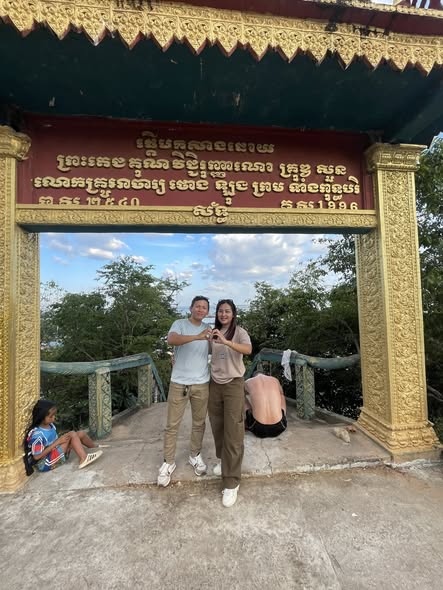
Written by the coaches
Kun Khmer Club — Coaches Kon Phanet & Ramon
Head coaches Kon Phanet and Ramon have a combined 50+ professional Kun Khmer fights in Cambodia. We coach beginners, travelers, expats, and fighters at our gym in Siem Reap.

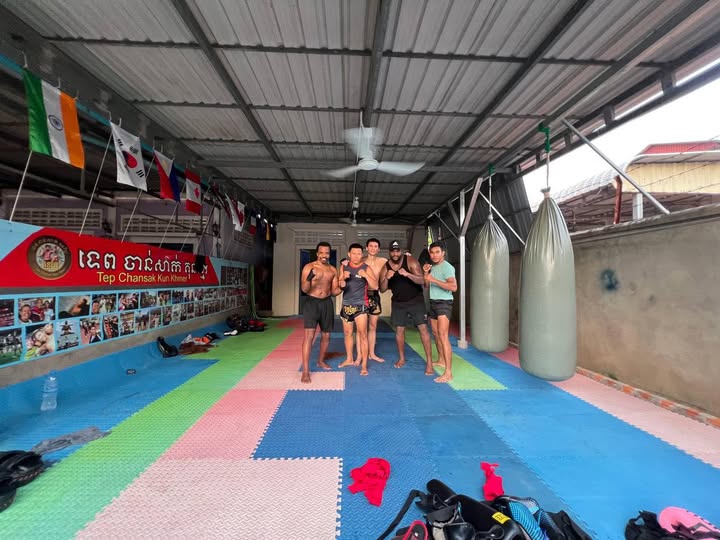

Ready to train in Siem Reap?
Drop in for a $9 day pass — the group class starts at 5:00 PM every day, and all gear is provided. Message us for today’s times.