
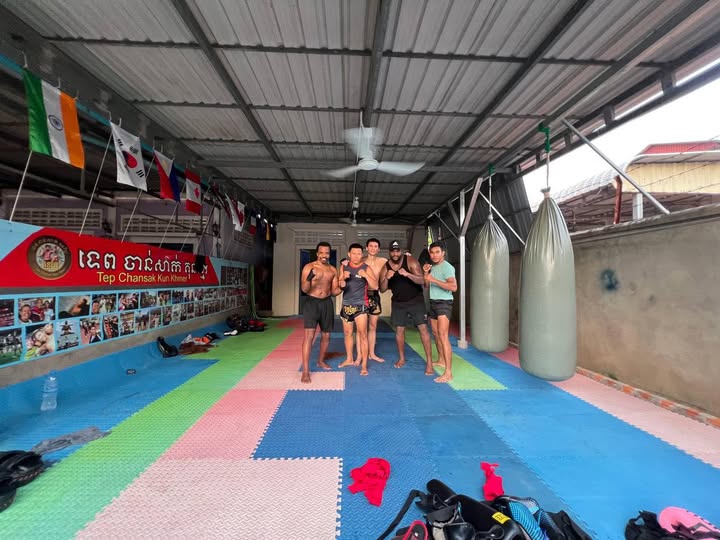
How to Plan a Kun Khmer Training Trip to Siem Reap
Plan a Kun Khmer training trip to Siem Reap around one fixed daily anchor: the 5:00 PM class. Passes run $9–$299, training needs no advance booking, and this guide walks timing, budget, packing, and the training week step by step.
On this page
- How Far in Advance Should You Plan a Kun Khmer Trip to Siem Reap?
- When Is the Best Time of Year to Go?
- How Long Should You Go For?
- What Does a Training Trip Cost?
- What Does the Daily Class Look Like?
- How Hard Is Daily Training in Siem Reap's Heat?
- How Do You Balance Training with the Temples and Sightseeing?
- What Should You Pack for a Training Trip?
- Is Siem Reap Good for Solo Travelers and First-Timers?
- What Happens If You Get Sick or Sore Mid-Trip?
- Can You Watch Fights While You're There?
- How Does a Siem Reap Trip Compare with a Muay Thai Camp in Thailand?
- What If You Want to Stay Longer Than Planned?
- Is a Kun Khmer Training Trip Worth It?
Planning a Kun Khmer training trip to Siem Reap comes down to four decisions: how long you stay, which pass you buy, when you fly, and how the rest of each day fits around the daily 5:00 PM class. Training itself needs almost no advance planning — passes run from a $9 day pass to the $299 6-week fight camp, gear is included in every tier, and there is no enrollment process or paperwork. This guide walks through timing, budget, packing, and the training week step by step, with every number sourced.
How Far in Advance Should You Plan a Kun Khmer Trip to Siem Reap?
Almost nothing needs months of lead time — flights and lodging are the real advance work, and training can be arranged the same day you land. Walk-ins are welcome at the daily group class, the $9 day pass is paid on arrival, and there is no booking system or minimum headcount behind it. Cambodia's tourist visa is low-friction too: most visitors qualify for a visa on arrival or an e-visa, good for a maximum 30-day stay at US$30, per the country's visa policy, which requires a passport valid at least six months with one empty page. A single message ahead of travel still has value — it lets the coaches know you are coming and lets you ask anything before you fly. The practical route is covered in booking a Kun Khmer class in advance, and whether tourists can train Kun Khmer in Siem Reap answers the who-is-this-for question outright.
- Pick dates and book flights — the one decision everything else hangs on.
- Book lodging for your stay length; Siem Reap is compact and everywhere is close.
- Arrange the tourist visa — on arrival or online — and submit the Cambodia e-Arrival Card in the seven days before you fly.
- Send one WhatsApp or Telegram message to +855 96 228 8585 with your dates — helpful, not required.
- Walk in before the 5:00 PM class; pay on the day, gear provided, no experience assumed.
When Is the Best Time of Year to Go?
November to early March is the most comfortable window for a training trip, and April is the month to respect. Siem Reap stays hot all year — average highs never drop below 30 °C, April's average high peaks at 35.8 °C, and roughly 1,406 mm of annual rain falls mostly in the May–October wet season, per Wikipedia's climate summary for the city. WeatherSpark's comfort analysis lands the same way: the hot season runs from mid-March to mid-May with average daily highs above 93 °F, the best time of year for hot-weather activities is mid-November to early March, and September is the wettest month while December is the driest. None of this changes the gym's side of the trip — the class runs at 5:00 PM every day of the year — it changes how hard the sightseeing half of your day feels. The month-by-month detail is in the best time to visit Siem Reap for training and travel.
Siem Reap's seasons overlap at the edges — May is both the tail of the hot stretch and the start of the rains (sources: Wikipedia, WeatherSpark).
| Stretch | Months | What it means for the trip |
|---|---|---|
| Dry and cooler | November–February | The year's lowest highs (30.6 °C in December) and coolest nights; the comfort window WeatherSpark extends to early March |
| Dry and hottest | March–early May | The hot season — average daily highs above 93 °F from mid-March to mid-May, peaking at 35.8 °C in April |
| Wet season | roughly May–October | Afternoon showers building to a September peak of 287.7 mm; greenest countryside and quieter temples |
How Long Should You Go For?
Match the length to the goal: a day or two tells you whether the sport is for you, a week builds working fundamentals, a month changes your conditioning, and six weeks is a real training block. The pass structure mirrors that ladder exactly — $9 for a day, $69 for a week, $129 for a month, $299 for the 6-week fight camp — so you never pay for a commitment you have not made yet. Most travelers who combine training with sightseeing settle on one to two weeks of daily classes with rest days built in: enough repetition for real progress without turning the holiday into a schedule. The one-day Kun Khmer class guide shows what a single visit delivers, and whether beginners can join a fight camp in Cambodia explains who the 6-week block actually suits.
- One day — $9 day pass: a complete class, gear included, zero commitment
- A week — $69 weekly pass: daily 5:00 PM sessions, enough repetition for fundamentals to stick
- A month — $129 monthly pass: conditioning and technique change you can feel
- Six weeks — $299 fight camp: a structured, progressive block — the serious option
What Does a Training Trip Cost?
Training is the fixed part of the budget and it is small: $9–$299 total depending on trip length, with gear included in every tier. A week of daily training costs $69, a month costs $129, private sessions add $25 per hour per person, and the 6-week fight camp is $299 — and there are no hidden kit costs, because gloves, wraps, and pads are provided and training is barefoot on the mats. What varies is everything around the training: lodging and food in Siem Reap span a wide range, so check current options when you book flights rather than trusting any fixed daily-budget number. The full class-cost guide for Siem Reap breaks every tier down, and affordable martial arts training in Siem Reap puts the numbers in town-wide context.
Kun Khmer Club prices by length of stay (from lib/business.ts).
| Option | Price | What it covers |
|---|---|---|
| Day pass | $9 | One group class, gear included |
| Weekly pass | $69 | A week of daily 5:00 PM classes |
| Monthly pass | $129 | A month of daily training |
| Private session | $25 / hour / person | One-on-one work arranged with the coaches |
| 6-week fight camp | $299 | The full structured camp block |
What Does the Daily Class Look Like?
Every traveler trains the same session: the group class runs once a day at 5:00 PM, in the same shape for a first-timer as for a returning regular. Kun Khmer is Cambodia's own striking art — a traditional Cambodian combat sport of punches, kicks, knees, and elbows, also known as Pradal Serey or Khmer boxing — and the class builds from movement to contact in that order. A coach fits you with wraps and gloves, walks you through stance and the day's techniques, then builds you up to pad rounds at your pace; you train barefoot on the mats and nothing hits back at beginner pace. Coaches Kon Phanet and Ramon — 50+ professional fights between them — lead every session. What beginner Kun Khmer classes cover walks a first week in detail, and trying Kun Khmer with no experience at all answers the zero-background worry directly.
- Warm-up — raise the heart rate before anything flies at a pad.
- Technique — the session's strikes taught from zero, corrections as you go.
- Pad rounds — the main output block, in provided gloves and pads.
- Conditioning finisher — bodyweight and core work to close the hour.
How Hard Is Daily Training in Siem Reap's Heat?
Harder than a gym session at home, and the heat is a real part of that math. An hour of comparable boxing or martial-arts training burns an estimated 540–840 calories depending on body weight and intensity — derived by doubling Harvard Health's published 30-minute figures for boxing sparring (270–378) and martial-arts training (300–420) at reference weights of 125, 155, and 185 pounds — an estimate for planning, not a measurement of any specific class. Heat makes every session cost more effort: even in the coolest month the average high sits above 30 °C, and the 5:00 PM start exists precisely so the hardest work lands after the worst of the afternoon. Drink more water than feels necessary all day, pace temple mornings so you are not walking for hours straight before class, and treat your first two or three sessions as acclimatization. How many calories a Kun Khmer class burns works through the numbers in full, and the best time of day to train in Siem Reap explains why evenings win here.
Estimated hourly burn for comparable training, derived from Harvard Health's published 30-minute figures doubled to an hour. Estimates, not measurements.
| Body weight | Lower-intensity hour | Higher-intensity hour |
|---|---|---|
| 57 kg / 125 lb | ~540 kcal | ~600 kcal |
| 70 kg / 155 lb | ~648 kcal | ~720 kcal |
| 84 kg / 185 lb | ~756 kcal | ~840 kcal |
How Do You Balance Training with the Temples and Sightseeing?
Split the day: temples and sightseeing in the morning, rest through the early afternoon, training at 5:00 PM. Angkor alone justifies the mornings — the archaeological park in Siem Reap province extends over some 400 km2 and ranks among the most important archaeological sites in Southeast Asia, per UNESCO — and a full morning of walking it is genuinely tiring in this climate. Trying to stack a temple marathon and a hard striking session into the same hours is the mistake; spacing them is the fix, and it is the structure experienced training travelers here settle on. Non-training hours are covered in things to do in Siem Reap besides Angkor Wat.
- Morning — the big sightseeing block, started early to beat heat and crowds
- Midday — proper rest, food, and water; this is the recovery window
- Late afternoon — easy movement, then the 5:00 PM class
- Evening — markets and dinner; the class ends with your evening still ahead
What Should You Pack for a Training Trip?
Almost nothing training-specific: sports clothes and a water bottle, and that is genuinely the list. Gloves, hand wraps, and pads are provided at the gym, training is barefoot on mats, and there is no uniform or kit to buy before you arrive — packing for a training trip is ordinary hot-weather packing plus one set of workout clothes per training day. The full wardrobe answer is in what to wear to a Kun Khmer class.
The whole packing list
Breathable clothes you can move in, a refillable water bottle, and normal travel kit — the gym supplies gloves, wraps, and pads, and you train barefoot. Lighter is correct here: even the coolest months sit around 30 °C by day, so heavy gear is dead weight.
Is Siem Reap Good for Solo Travelers and First-Timers?
Yes — the daily class means the room always holds a rotating mix of travelers, expats, and locals, so a solo first-timer is never the only newcomer, and the coaches shape the session around whoever shows up. First-timers are the normal case here, not the exception: reviews of first sessions at the gym read like the one below. Whether Kun Khmer is safe for beginners covers how sessions are scaled, and Khmer boxing training for beginners sets out the learning path from zero.
We did a great class here today! We were shown all the techniques for kun khmer, and had a great laugh with our instructor. Could not recommend this class enough
What Happens If You Get Sick or Sore Mid-Trip?
Rest days are a normal part of a training week, not a failure of one — soreness in legs, hips, and core for the first week or two is untrained muscles meeting new work, and it fades as you adapt. The pass structure makes resting cheap: a weekly or monthly pass covers the stretch rather than counting sessions, so a day off costs nothing. Tell the coaches what is going on and they scale pad rounds and intensity to what you can do; private sessions at $25 per hour per person are the lower-contact option for targeted work on a tired day, and the other fitness classes in Siem Reap give sore legs an active-recovery alternative. Private Kun Khmer lessons in Siem Reap explains what a one-on-one covers.
The mid-trip protocol
Say it early — tell the coaches before class what hurts or feels off. Take the rest day — a pass covers the stretch, so a day off costs you nothing. Then swap, don't stop: privates, lighter drilling, or an active-recovery session keep the routine alive until the soreness fades.
Can You Watch Fights While You're There?
Yes — Siem Reap is a live venue for the sport, not only a place that trains it, and a fight night is the fastest way to see Kun Khmer's forward pressure and elbows used at full intensity. Cards move around, so the reliable move is to ask the coaches which nights are running during your week rather than trusting listings — they know the current schedule. Watching one pairs naturally with a training class in the same week, because the exchanges you drilled on pads become legible in the ring. The spectator side of the scene is covered in watching kickboxing in Siem Reap.
- Ask at the gym — coaches know which fight nights are actually running during your dates
- Watch the elbows — the weapon Kun Khmer is best known for among Southeast Asian ring sports
- Go the same week you train — the techniques you drill become readable at full speed
How Does a Siem Reap Trip Compare with a Muay Thai Camp in Thailand?
The Thai camp model — fly in, train daily, stay for weeks — is the template every fight-camp trip copies, and Siem Reap runs the same structure under a different flag: you train Cambodia's own art with Cambodian coaches rather than a Thai art in somebody else's country. The honest way to compare any two camps is with the same four questions, wherever they are, because those questions cut across marketing in every destination. Here the answers are fixed and public: Kon Phanet and Ramon lead every session, the class runs daily at 5:00 PM, a week is $69 and the 6-week camp is $299, and the temples give your rest days a second purpose. How Kun Khmer compares with Muay Thai goes through the styles themselves, and Muay Thai-style training in Siem Reap covers the Thai-named option available in town.
The four comparison questions that work for any camp, in any country.
| Compare | Why it matters |
|---|---|
| Coaching continuity | Rotating instructors versus the same coaches all camp changes what six weeks builds |
| Daily format | One fixed class versus split sessions decides how your whole day structures itself |
| Full-stay cost | Compare the whole block, not the per-day rate — inclusions differ wildly between camps |
| Non-training fit | Rest-day options determine whether a long stay stays sustainable |
What If You Want to Stay Longer Than Planned?
Upgrading mid-trip is a conversation, not paperwork: moving from a weekly pass to the monthly rate or into the 6-week fight camp happens directly with Phanet or Ramon once you are here, and nothing requires committing to the longer package before you land. The 30-day tourist visa gives a month-long training stay room to breathe, and extensions are possible under the visa rules — worth confirming current terms for your nationality when you apply. Longer stays change the questions too: Kun Khmer classes for locals in Siem Reap covers the resident's side of training, and families working out whether to bring everyone are answered in martial arts for kids and teens in Siem Reap.
Upgrades happen mid-trip
Day pass → weekly → monthly → fight camp is a ladder you climb only as far as the trip justifies. Coaches confirm the fit in person; there is no pre-arrival commitment and no cancellation to manage.
Is a Kun Khmer Training Trip Worth It?
Worth it on three grounds that are easy to verify before you book: the training is real — a daily coached class with 50+ professional fights behind it — the cost is unusually low for structured training ($9–$299 total across any trip length), and the destination gives your rest days world-class content in the temples. This suits travelers who want training and travel in the same trip rather than a monastic camp block; if that is you, the combination is Siem Reap's whole pitch. Specific goals are answered separately: what Kun Khmer does for weight loss covers the fitness question, and the full cluster — camp structure, timing, booking — lives in the fight-camp hub.
Had a great lesson and experience with Kun Phaneth. Was the first time in my life to do any type of boxing or martial arts - will definetely do it again
FAQ
What's the best time of year to go?
November to early March is the most comfortable window — average highs ease to around 30–31 °C with the year's coolest nights. The class itself runs at 5:00 PM every day of the year, so training never closes for a season; the season only changes how hard your sightseeing half feels.
How long should you go for?
Any length works, because the pass ladder matches the trip: $9 for a day, $69 for a week of daily classes, $129 for a month, and $299 for the 6-week fight camp. One to two weeks with rest days built in is the most common shape for travelers combining training with the temples.
Do I need a visa?
Most visitors get a tourist visa on arrival or online as an e-visa — a maximum 30-day stay for US$30, needing a passport valid at least six months with one empty page, plus a Cambodia e-Arrival Card submitted in the seven days before you fly. Training itself needs no paperwork at all.
Do I need travel and health insurance?
We don't provide or arrange insurance — sorting your own travel and health cover is part of trip prep, the same as flights. Training is real physical activity in serious heat, so come covered and tell the coaches about any medical conditions before class.
What should you pack for your stay & training with us?
Sports clothes and a water bottle — that is the training list. Gloves, wraps, and pads are provided, training is barefoot on mats, and there is no uniform to buy. Add whatever the temples and evenings need and the bag is done.
Can you drink the tap water in Siem Reap?
Visitors stick to bottled or filtered water, which is the default across town, and hydration matters doubly on training days in this heat. Bring a refillable bottle, drink through the day, and arrive at the 5:00 PM class already watered rather than catching up.
What happens if I get sick or injured and cannot train?
Tell the coaches — they scale sessions to what you can do, and a rest day costs nothing on a weekly or monthly pass because the pass covers the stretch, not a session count. Take the day, recover, and come back; fight camp members pace this with Phanet and Ramon directly.
Can I upgrade or extend my program?
Yes, mid-trip and in person: moving from a weekly pass to the monthly rate or into the $299 6-week fight camp is a direct conversation with the coaches once you are here. There is no pre-arrival commitment to unwind and no cancellation to manage.
Key takeaways
- The trip anchors on one fixed session — the daily 5:00 PM group class — so plan mornings for temples, afternoons for rest, evenings for training.
- The pass ladder matches any stay: $9 day, $69 week, $129 month, $299 6-week fight camp — gear included in every tier, paid on arrival, no advance enrollment.
- Advance planning is just flights, lodging, and the visa: tourist visa on arrival or e-visa, 30 days, US$30, plus the e-Arrival Card.
- Timing: November to early March is the comfort window; April peaks at an average high of 35.8 °C and May–October is wet season.
- Upgrade mid-trip by conversation, not paperwork — a weekly pass can become the monthly rate or the fight camp after you have trained a week.
Sources & further reading
- WeatherSpark — Siem Reap climate, weather by month — Hot season runs March 13–May 17 with average daily highs above 93 °F; April is the hottest month (95 °F high); the best time of year for hot-weather activities is mid-November to early March; the wetter season runs April 27–October 23. — source
- Wikipedia — Siem Reap (climate section) — Tropical wet-and-dry climate; average highs never drop below 30 °C; April average high 35.8 °C, December 30.6 °C; wet season May–October with a September peak of 287.7 mm and a January low of 3.7 mm; about 1,406 mm of rain a year. — source
- Wikipedia — Visa policy of Cambodia — Visa on arrival or e-visa available for tourism, maximum 30-day stay at US$30; passport valid at least six months with one empty page required; Cambodia e-Arrival Card in the seven days before you fly; extensions possible. — source
- Harvard Health — Calories burned in 30 minutes for people of three different weights — Boxing sparring burns 270/324/378 and martial-arts training 300/360/420 calories per 30 minutes at 125/155/185 lb — the published figures doubled to derive the 540–840 per-hour range. — source
- UNESCO World Heritage Centre — Angkor — Angkor, in Cambodia's northern province of Siem Reap, is one of the most important archaeological sites of Southeast Asia and extends over some 400 km2, including the temples of Angkor Wat, Bayon, Preah Khan, and Ta Prohm. — source
- Wikipedia — Kun Khmer — Kun Khmer is a traditional Cambodian combat sport of stand-up striking, also known as Pradal Serey, Khmer boxing, or Cambodian boxing. — source
Reviewed 2026-10-26
Written by the coaches
Kun Khmer Club — Coaches Kon Phanet & Ramon
Head coaches Kon Phanet and Ramon have a combined 50+ professional Kun Khmer fights in Cambodia. We coach beginners, travelers, expats, and fighters at our gym in Siem Reap.

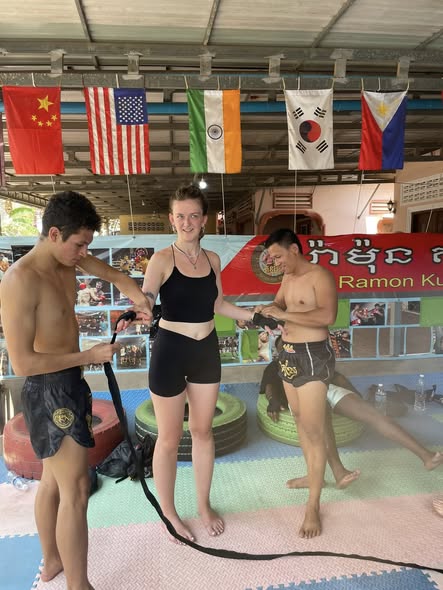

Ready to train in Siem Reap?
Drop in for a $9 day pass — the group class starts at 5:00 PM every day, and all gear is provided. Message us for today’s times.