

Fight Camp Cambodia: What Is It? $299, 6 Weeks
A fight camp in Cambodia is a multi-week structured training stay — not a fighters-only bootcamp. Ours runs 6 weeks for $299 in Siem Reap, beginner-friendly, built around the daily 5:00 PM class, with an honest cost, visa, and language comparison against Thailand camps and a length ladder from $9 day passes to the full block.
On this page
- What Is a Fight Camp in Cambodia?
- Who Is a Fight Camp For — Fighters Only?
- How Much Does a Fight Camp in Cambodia Cost?
- How Does a Cambodia Fight Camp Compare With Thailand?
- How Long Should You Book — a Week, a Month, or Six Weeks?
- What Does a Camp Week Look Like at Our Gym?
- Can Beginners Do a Fight Camp in Cambodia?
- Do You Have to Fight at the End of a Camp?
- How Hard Is Six Weeks of Training in Siem Reap's Heat?
- What Does a Camp Week Do for Your Fitness?
- What Should You Pack for a Camp?
- What Does Siem Reap Give You Beyond the Mats?
- How Do You Book a Fight Camp in Cambodia?
- Is a Fight Camp in Cambodia Worth It?
A fight camp in Cambodia is a multi-week structured training stay — daily coached sessions in one gym, progression planned across weeks instead of restarting with every drop-in — and it is not a fighters-only bootcamp. The concrete version at our Siem Reap gym is a 6-week Kun Khmer fight camp at $299, beginner-friendly, paced to each student, and built around the daily 5:00 PM class. This page covers what a camp is, who it fits, what it costs, an honest comparison with Thailand, and how to choose your length.
What Is a Fight Camp in Cambodia?
A fight camp is a defined training block — ours runs six weeks — where you train in the same gym every day, build technique in a planned order, and let conditioning accumulate instead of resetting. The daily work itself is the same skeleton every serious striking gym runs: Thai Boxing Institute answers the "typical session" question with "Warm-up Technique instruction Pad work Conditioning Cool down" (their FAQ), and our published walkthrough runs the same arc inside the daily 5:00 PM class. What makes it a camp rather than a run of drop-ins is the through-line: drills build on last week's, coaches see your progression daily, and the block has a start and an end you can plan a trip around. What a typical class is like breaks the session itself down stage by stage, how long classes are covers the daily time commitment, and the fight camp and training trips hub collects every longer-stay guide.
A typical session includes: Warm-up Technique instruction Pad work Conditioning Cool down.
Who Is a Fight Camp For — Fighters Only?
No — the camp format serves at least four kinds of traveler, and only one of them is a competitor. Our own camp is described from the start as being for "tourists, expats, and locals," and the published beginner answer is explicit: it "assumes no fight experience, and paces drilling to where each student actually is" (what beginners joining a camp involves). Camp students here include people who never intend to take a bout — the camp is "built for someone who wants real, visible progress rather than a one-off session, whether or not you're actually planning to compete." Anyone who does want the competition path can raise it with the coaches — and matchmaking there runs on demonstrated weeks of training, not on enrollment. If you are brand new to striking, a camp built for beginners is the better first read.
- Trip-builders — travelers who want one structured anchor (the daily 5:00 PM class) around which to plan weeks in Siem Reap
- Beginners — no fight experience assumed; drills are paced to where you actually are
- Fitness-stayers — people trading a hotel gym for coached, progressive training
- Competitors — fighters using the block as a structured pre-fight window, with matchmaking only after weeks of observed training
How Much Does a Fight Camp in Cambodia Cost?
Our 6-week fight camp costs $299 — one price for the full structured block, arranged directly with the coaches, with no per-session accounting. Set against the pass ladder it is built to undercut: the same six weeks bought as day passes would be 42 × $9 = $378, and the camp page itself notes the block "comes out well below what the equivalent number of day passes or private lessons would cost, which makes it the strongest value we offer" — $299 across 42 days is our arithmetic for roughly $50 a week, about $7 a day. The shorter tiers exist precisely for the testing phase before that commitment, and the live price list carries the current numbers. The full class-cost breakdown for Siem Reap compares every tier in detail, while what a training camp costs takes the camp-cost question apart on its own.
Kun Khmer Club training prices (lib/business.ts:27-36 — every figure exactly as published)
| Option | Price | What it covers |
|---|---|---|
| Day pass | $9 | One group class — test the format first |
| Weekly pass | $69 | A week of daily training |
| Monthly | $129 | A month of daily training |
| Private 1-on-1 | $25 / hour / person | Coaching arranged directly with the coaches |
| 6-week fight camp | $299 | The full structured camp block |
How Does a Cambodia Fight Camp Compare With Thailand?
Honestly: both countries sell the same product shape — weeks of daily training at a dedicated gym — and the real differences are cost, logistics, and language, so compare those. On cost, a well-known Thailand camp guide publishes "Training fees: 8,000-15,000 THB per week ($350-650 AUD) at most camps. Longer stays are cheaper per week. Some camps include accommodation in the price," and budgets a two-week trip "roughly $2,000-3,000 AUD all-in including flights" (Supa Phat's Thailand training camp guide); our camp's $299 for six weeks is our arithmetic for about $50 a week at the training tier — flights and accommodation are extra in both countries, and Thai camp prices vary camp by camp, so check any camp's current published rates before comparing totals. On logistics, visa rules depend on your nationality and change, so check your passport's options with official Cambodian sources before booking — and note that Cambodia's General Department of Immigration states "All travelers can submit the Cambodia e-Arrival within 7 days before or on arrival. Submission is Free." (immigration.gov.kh). On language, traveler threads carry a recurring worry (community-reported, as these snippets are) that local gyms "don't speak English" — while the published reality for visitors here is the opposite of a barrier: you don't need Khmer to train in Siem Reap, and coaches scale explanations to whoever is in the room (our vocabulary guide covers the few words that help). The deep side-by-side lives in the Muay Thai camp in Cambodia guide, and how Kun Khmer compares with Muay Thai covers the sports themselves — cousins, not rivals.
Training fees: 8,000-15,000 THB per week ($350-650 AUD) at most camps. Longer stays are cheaper per week. Some camps include accommodation in the price.
How Long Should You Book — a Week, a Month, or Six Weeks?
Match the length to the trip you are actually taking — and pick from the same ladder either way. The Thailand guide's own length advice maps cleanly onto our tiers: "Two weeks: The sweet spot for most people… One month: Transformative," and "If it's your first trip, do two weeks" (Supa Phat) — two weeks here fits a $69 weekly pass pair or a $129 month if you land shorter, while the full camp format exists for the stay where you want one planned arc with a beginning and an end. Six weeks is not a minimum; it is the length at which progression compounds instead of restarting — stance and strikes settle, then combinations, then the sharper weapons. How long a training camp should be works this question in full, the best time to visit Siem Reap covers the season, and the step-by-step trip planner turns a length into a plan.
Our stay ladder, mapped to trip lengths (prices per lib/business.ts:27-36; camp description per lib/blogContent/booking.ts:116)
| Stay | Pass | What it fits |
|---|---|---|
| 1 day | $9 | Testing the format before any commitment |
| 1–2 weeks | $69 / week | The guide-standard "sweet spot" first trip |
| 3–4 weeks | $129 / month | A month-long stay with one daily anchor |
| 6 weeks | $299 | The full camp — one planned arc, start to finish |
What Does a Camp Week Look Like at Our Gym?
The week is anchored on one fixed point: the daily 5:00 PM group class, with private sessions at other times "available by arrangement with the coaches" — so a camp week here is daily class, optional privates layered on, and recovery around both. Each session runs the same five-stage skeleton as day one (wrap, warm-up, technique, pads, conditioning), while what changes across the weeks is the content: drills build on the previous week's, and pad work gets progressively less scripted. The honest boundary: the week-by-week camp structure is arranged with the coaches rather than published as a fixed syllabus — our own page tells enquirers to "message us on WhatsApp for the current weekly structure and what each week of the camp looks like" — so nobody can truthfully print a generic week-one-to-six curriculum, including us. For the regional shape comparison, the Thailand guide's example camp runs "7:00-9:00am: Morning session… 3:30-5:30pm: Afternoon session… six days a week. Sunday is rest day" (Supa Phat) — "two sessions a day, six days a week" is that country's common rhythm; ours builds the block around the single daily evening class, and the best time of day to train in Siem Reap explains why the 5:00 PM slot wins in this climate. How many days you can honestly commit decides the rest — how often you should train covers the recovery math.
One fixed anchor, flexible around it
Every camp day contains the 5:00 PM class — that part never moves. What flexes around it is you: optional private Kun Khmer lessons at $25 per hour, per person, rest as needed, and a weekly plan the coaches set with you rather than at you.
Can Beginners Do a Fight Camp in Cambodia?
Yes — the camp assumes no fight experience and paces the drilling to where each student actually is, which is the published design rather than a reassurance. Week one is stance, guard, and the basic strikes on pads nobody hits back with; sparring "arrives late and controlled, if at all," and going further is always the student's call. The entry requirement is consistency — showing up for the daily class — not a striking background, and the soreness of week one is the normal kind: delayed-onset muscle soreness is "a common side effect of challenging your muscles" that "should go away in a few days" (Cleveland Clinic). The beginner fight-camp guide walks a first week in detail, and sparring in Kun Khmer covers exactly when and whether sparring ever enters the picture.
- Bring: consistency, sports clothes, water — and honesty with the coaches about any injuries
- Don't bring: gear, experience, or the fear you must spar — gloves, wraps, and pads are provided, and sparring is opt-in
- Week one feels like: pad-focused technique work at beginner pace, with normal next-day soreness that fades in days
- The coaches scale: pad combinations and conditioning are adjusted to whoever is in the room, every single day
Do You Have to Fight at the End of a Camp?
No — fighting at the end is optional, not the exit exam. Most camp students build skill, conditioning, and ring literacy without ever taking a bout, and the camp's value does not depend on one; anyone who wants the fight path raises it with the coaches, and match-making only happens after they have seen weeks of your training, not before. For scale, the sport those bouts happen in is compact and codified: "a match consists of five three-minute rounds" in a 6.1-meter ring (Wikipedia — Kun Khmer) — short, sharp, and nothing a beginner is pushed toward. How Kun Khmer rules work explains the full ruleset, and what beginners joining a camp actually involves covers the eligibility question in depth.
A match consists of five three-minute rounds and takes place in a 6.1 meter square boxing ring. A one-and-a-half or two-minute break occurs between each round.
How Hard Is Six Weeks of Training in Siem Reap's Heat?
The heat is the real opponent of a long stay here — Siem Reap's "average high temperatures never falling below 30 °C or 86 °F in any month" (Wikipedia — Siem Reap) — and a camp manages it with timing and hydration rather than willpower. Every class runs at 5:00 PM, after peak heat, and the wet season (roughly May–October per the same source) actually brings the cloud and rain that take the edge off afternoons. The hydration rule is the CDC's, not ours: "Drink more water than usual, and don't wait until you're thirsty to drink more" (CDC) — start the bottle in the afternoon, not at the gym door. Evening training in the heat covers the daily timing, and the best months to plan around maps the seasons.
Heat rules for a six-week block
Train at 5:00 PM, not midday. Drink through the afternoon, not just during class. Expect the first week to feel harder than your fitness says it should — heat adaptation is real and arrives within days, not weeks.
What Does a Camp Week Do for Your Fitness?
The honest answer is arithmetic, not promises: a camp week stacks 7 × 60–90 minute sessions = 420–630 minutes of training against the WHO's recommendation that adults get "at least 150 minutes of moderate-intensity physical activity per week" (WHO fact sheet) — a camp week clears that floor several times over on minutes alone (420–630 ÷ 150 — our arithmetic), which is the factual statement; any body-composition result beyond it is yours to earn and not ours to promise. For intensity, Harvard Health's published table puts martial arts (judo, karate, kickboxing) at 300, 360, and 420 calories per 30 minutes for people weighing 125, 155, and 185 pounds (Harvard Health) — and the per-class column below is our own linear scaling of those published rates, labeled as such, never as a Harvard figure. The CDC's starting advice cuts the same way for anyone worried about readiness: "Some physical activity is better than none" (CDC). The detailed per-weight math lives in how many calories a class burns, and what Muay Thai training does for weight loss covers the fat-loss question without hype.
Harvard Health's published rates per 30 minutes (fetched 200 per docs/seo-evidence/phase4w2-citations.md:24); the right-hand column is our own linear scaling for one 60–90 minute class — individual sessions vary
| Harvard's activity row | 125 lb | 155 lb | 185 lb | One 60–90 min class (2–3× rate, our arithmetic) |
|---|---|---|---|---|
| Martial arts: judo, karate, kickbox | 300 | 360 | 420 | ≈600–1,260 |
| Boxing: sparring | 270 | 324 | 378 | ≈540–1,134 |
What Should You Pack for a Camp?
Less than you think — both the Thailand guide and our own gear advice converge on the same answer, because gloves, hand wraps, and pads are provided here and training is barefoot on mats. Supa Phat's guide puts it plainly: "Pack less gear than you think (buy cheap stuff in Thailand)" — and in this heat, plan on sweat soaking a full set of clothes every session, so pack a spare shirt even though the gym provides all the training gear. If you later decide to buy, the standard guidance is "For most beginners, 14 oz or 16 oz gloves are the safe default for class" (Fairtex) — a keep-training decision, not a packing decision. The beginner gear guide separates day-one needs from worth-buying-later, and the first-class checklist covers water, towel, and timing.
- Two sets of light training clothes — one per daily session, because the heat soaks the first
- Water bottle and a small towel — the two things every camp FAQ says to carry
- Nothing else on day one: gloves, hand wraps, and pads are provided at the gym
- Buy gear later, only if the habit sticks — 14–16 oz gloves are the safe first purchase
What Does Siem Reap Give You Beyond the Mats?
A camp here is a training block wrapped inside one of Southeast Asia's great travel towns: mornings are free by design, and the recovery days have real content. Angkor — "one of the most important archaeological sites in South-East Asia," the remains of the Khmer Empire's capitals from the 9th to the 15th century (UNESCO) — sits a short ride from the gym, and sunrise temple days pair cleanly with evening training. The sport itself is part of the town's week too: Kun Khmer tournaments air live on TV5, CTN, and Bayon with weekly fight cards (Wikipedia — Kun Khmer), and Siem Reap hosts its own fight nights you can watch as a spectator on any rest day. Things to do in Siem Reap besides Angkor Wat lists the rest, and Cambodia boxing covers the televised fight scene you'll be watching.
Angkor is one of the most important archaeological sites in South-East Asia. Stretching over some 400 km2, including forested area, Angkor Archaeological Park contains the magnificent remains of the different capitals of the Khmer Empire, from the 9th to the 15th century.
How Do You Book a Fight Camp in Cambodia?
Directly with the coaches — the camp, like private lessons, is "arranged directly with the coaches, so message us ahead to lock in a time or start date," by WhatsApp, Telegram, phone at +855 96 228 8585, or Google Maps and Facebook. Unlike the daily class, which runs on walk-ins with no booking system, a camp start date is worth fixing before you fly so your first week is paced correctly and the coaches can plan around your arrival. The same message is where you ask anything else — current weekly structure, privates, group requests — before money changes hands. Whether to book a class in advance covers the walk-in side for single visits, and remember the free e-Arrival submission within 7 days of arrival (immigration.gov.kh).
- Message the coaches on WhatsApp (or Telegram / +855 96 228 8585) with your rough dates and goal
- Confirm a start date so week one is paced to you — and ask for the current weekly structure
- Optional: arrive a few days early and test the water with a $9 day pass first
- Submit the free Cambodia e-Arrival within 7 days before or on arrival; check your visa options with official sources
- Show up on day one with clothes, water, and nothing else — the gym provides the gear
Is a Fight Camp in Cambodia Worth It?
It is worth exactly what your calendar can honor: the format's entire value is consistency, so a camp you attend daily for six weeks is the strongest per-week value we offer — $299 against $378 for the same days as day passes, our arithmetic — and one you skip half the sessions of is just an expensive week. The honest ceiling is the one our own published answer states: "nobody becomes a finished fighter in six weeks and the coaches won't pretend otherwise" — what six weeks buys is a working foundation: movement, basic strikes, clinch fundamentals, and a conditioning base that scattered drop-ins never accumulate. If that trade sounds right, the next step costs one message, not a deposit. Whether Kun Khmer is effective gives the sport's honest verdict, and the camp itself is booked here.
The one-line verdict
Book the camp if you will show up daily; book a monthly pass ($129) if you might not. The $299 / six-week block is the best value on the ladder precisely because the format rewards the people who use every day of it.
FAQ
How long should you go for?
Match it to your trip: the Thailand camp guide's own advice is "Two weeks: The sweet spot for most people… One month: Transformative," and "If it's your first trip, do two weeks." Here that maps to $69 weekly passes or a $129 month — and the full 6-week camp at $299 is for the stay where you want one planned progression instead of restarted weeks.
Do I need experience before going to a Thailand training camp?
No — and the same is true in Cambodia: the guide's answer to that exact question is "No, but it helps. Most camps accept complete beginners and will teach you from scratch." Our camp goes one step further and assumes no fight experience, pacing drills to where each student actually is.
Do I need a visa?
That depends on your nationality, and rules change — so check your passport's options with official Cambodian sources (immigration.gov.kh) before booking; we can't give immigration advice. What the official site does state is that "All travelers can submit the Cambodia e-Arrival within 7 days before or on arrival. Submission is Free."
Do I need travel and health insurance?
That is a personal-risk decision we can't make for you — check what your current policy covers abroad and decide before you travel. What we can tell you: training is coached and scaled, beginners run on pads rather than contact, and the coaches adjust load if you flag an injury.
What's the best time of year to go?
November through February — the dry season's coolest, driest stretch — is the published best window, and training never pauses regardless: the daily 5:00 PM class runs year-round, so any month works.
Can I extend my package?
Yes, by arrangement: the pass ladder runs $9 day, $69 week, $129 month, and the $299 six-week camp, all arranged directly with the coaches — extending is a message, not a contract negotiation. Ask in the same WhatsApp thread where you set your start date.
Should I bring my own gear or buy everything there?
Bring almost nothing: gloves, hand wraps, and pads are provided here and training is barefoot on mats — the same "pack less gear than you think" advice the Thailand guide gives. Bring two sets of training clothes for the heat, and buy 14–16 oz gloves only if the habit sticks.
Key takeaways
- A fight camp in Cambodia is a multi-week structured training stay — daily coached sessions, planned progression — not a fighters-only bootcamp; ours is built for "tourists, expats, and locals" and assumes no fight experience.
- Our concrete version: 6 weeks, $299, arranged directly with the coaches — versus $378 for the same days as $9 day passes, and against Thailand camp guides publishing 8,000–15,000 THB (≈$350–650 AUD) per training week.
- The honest Thailand trade-off is cost, logistics, and language — not quality: visa rules are nationality-dependent (check official sources; e-Arrival is free), and you don't need Khmer to train in Siem Reap.
- Pick length from one ladder: $9 day, $69 week, $129 month, $299 six weeks — the camp earns its price only if you'll show up daily for the full block.
- Six weeks buys a working foundation, not a finished fighter — fighting at the end is optional, match-making only follows weeks of observed training, and every camp day anchors on the 5:00 PM class.
Sources & further reading
- Supa Phat — Thailand training camp guide — "Training fees: 8,000-15,000 THB per week ($350-650 AUD) at most camps. Longer stays are cheaper per week. Some camps include accommodation in the price."; "For a two-week trip, budget roughly $2,000-3,000 AUD all-in including flights."; "Two weeks: The sweet spot for most people. Your body adapts in the first week. The second week is where the real improvement happens. You'll come back noticeably better. One month: Transformative."; "If it's your first trip, do two weeks."; "No, but it helps. Most camps accept complete beginners and will teach you from scratch."; "7:00-9:00am: Morning session… 3:30-5:30pm: Afternoon session… runs six days a week. Sunday is rest day."; "Pack less gear than you think (buy cheap stuff in Thailand)". Fetched live 2026-10-27 per docs/seo-evidence/w3-fight-camp-cambodia-fresh-fetch.md §1; prior 200-curl verification at docs/seo-evidence/phase4w1-citations.md row 31. — source
- General Department of Immigration, Cambodia — "All travelers can submit the Cambodia e-Arrival within 7 days before or on arrival. Submission is Free." Fetched fresh 2026-10-27 per docs/seo-evidence/w3-fight-camp-cambodia-fresh-fetch.md §2. The official e-visa portal (evisa.gov.kh) was BLOCKED this run (§3), so no visa fee or duration is stated anywhere in this article. — source
- Wikipedia — Kun Khmer — "Kun Khmer consists of four types of strikes: punches, kicks, elbows, and knee strikes"; "A match consists of five three-minute rounds and takes place in a 6.1 meter square boxing ring. A one-and-a-half or two-minute break occurs between each round."; TV5/CTN/Bayon live-tournament schedule. Fetched as raw wikitext (200) 2026-10-26 per docs/seo-evidence/phase4w2-citations.md:19 (earlier record phase3b1-citations.md:15). — source
- Wikipedia — Siem Reap — "The city is generally hot throughout the course of the year, with average high temperatures never falling below 30 °C or 86 °F in any month."; wet season May–October; mean daily max 30.6 °C (Dec) to 35.8 °C (Apr). Fetched live (200 curl) per docs/seo-evidence/phase3b2-citations.md:18 and phase4w1-citations.md row 7. — source
- World Health Organization — Physical activity fact sheet — The recommendation of "at least 150 minutes of moderate-intensity physical activity per week" (page-supported wording; the 150–300 range is not on the page, per docs/seo-evidence/phase3b1-citations.md mismatch #2). Fetched live (200 curl) 2026-10-26 per docs/seo-evidence/phase4w2-citations.md:25. — source
- Harvard Health — Calories burned in 30 minutes — Table rows "Boxing: sparring 270 324 378" and "Martial Arts: judo, karate, kickbox 300 360 420", per 30 minutes at 125/155/185 lb. Fetched live (200 curl) 2026-10-26 per docs/seo-evidence/phase4w2-citations.md:24. The per-class column in this article is our own linear scaling of these published rates, labeled as such. — source
- CDC — Heat and Athletes — "Drink more water than usual, and don't wait until you're thirsty to drink more." Fetched live via Exa 2026-10-26 per docs/seo-evidence/phase4w1-citations.md:9. — source
- CDC — Adult physical activity guidelines — "Some physical activity is better than none."; "Adults need at least 150 minutes of moderate-intensity physical activity a week." 403 curl → 200 via WebFetch per docs/seo-evidence/phase3b3-citations.md:33. — source
- Cleveland Clinic — Delayed onset muscle soreness (DOMS) — "DOMS (delayed onset muscle soreness) is a common side effect of challenging your muscles."… "DOMS should go away in a few days." Fetched live (200 curl) per docs/seo-evidence/phase3b2-citations.md:28. — source
- Thai Boxing Institute — FAQ — "A typical session includes: Warm-up Technique instruction Pad work Conditioning Cool down." Fetched live (200 curl) 2026-10-26 per docs/seo-evidence/phase4w1-citations.md:51. — source
- Fairtex — What to wear to Muay Thai class — "For most beginners, 14 oz or 16 oz gloves are the safe default for class." Fetched live (200 curl) with every quoted sentence verified verbatim per docs/seo-evidence/phase4w1-citations.md row 30. — source
- UNESCO World Heritage Centre — Angkor — "Angkor is one of the most important archaeological sites in South-East Asia. Stretching over some 400 km2… contains the magnificent remains of the different capitals of the Khmer Empire, from the 9th to the 15th century." Fetched live (200 curl) per docs/seo-evidence/phase3b1-citations.md:38. — source
- Kun Khmer Club — fight camp page and price list — First-party facts read from lib/business.ts:4-36 this session: camp for "tourists, expats, and locals"; $9 day pass, $69 weekly, $129 monthly, $25 per hour per person privates, $299 6-week fight camp; daily 5:00 PM class with privates by arrangement; coaches Kon Phanet and Ramon, combined 50+ professional Kun Khmer fights; camp description and "strongest value" comparison per lib/blogContent/booking.ts:116; booking channels per lib/blogContent/commercial.ts:54; "$299 / All Inclusive" label per lib/translations.ts:369-370; weekly structure arranged with coaches per lib/blogContent/authority.ts:420; "no fight experience… paced to where each student actually is" per templated-fragments/can-beginners-join-a-fight-camp-in-cambodia.ts:54,83; fighting optional and match-making after weeks of training per :186; "nobody becomes a finished fighter in six weeks" per :164. — source
Reviewed 2026-10-27
Written by the coaches
Kun Khmer Club — Coaches Kon Phanet & Ramon
Head coaches Kon Phanet and Ramon have a combined 50+ professional Kun Khmer fights in Cambodia. We coach beginners, travelers, expats, and fighters at our gym in Siem Reap.

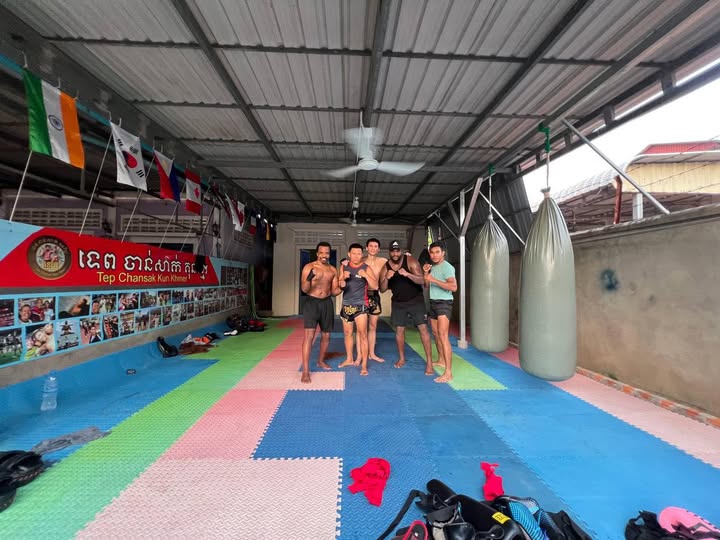
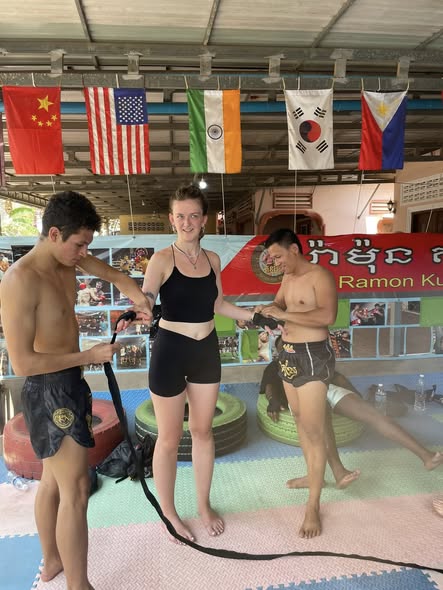
Ready to train in Siem Reap?
Drop in for a $9 day pass — the group class starts at 5:00 PM every day, and all gear is provided. Message us for today’s times.