

What Is a Typical Muay Thai Class Like? 5 Stages
A typical muay thai class runs five stages — hand wrapping, warm-up, technique instruction, pad work, and conditioning — in about 60–90 minutes. Here is our daily 5:00 PM Siem Reap class mapped stage by stage: what beginners drill, what the pads build, and what you'll feel the next day.
On this page
- What Are the Five Stages of a Typical Class?
- How Long Does a Typical Class Run?
- What Happens Before the Warm-Up Starts?
- How Does the Warm-Up Open the Session?
- What Happens During Technique Instruction?
- Why Is Pad Work the Heart of the Class?
- Do Elbows and the Clinch Show Up in a Beginner Class?
- What Happens in the Conditioning Block?
- How Many Calories Does a Typical Class Burn?
- What Does the Cool-Down Do — and Why Stay for It?
- What Does Not Happen in a Beginner Class?
- What If You Can't Keep Up With the Class?
- What Will You Feel the Next Day?
- What Should You Do With This Map Tonight?
What is a typical Muay Thai class like? Five stages, in the same order everywhere: hand wrapping and a warm-up, technique instruction, pad work, conditioning, and a cool-down, run in about 60–90 minutes — and that is exactly how the daily 5:00 PM class at our Siem Reap gym plays out. Beginners drill stance and strikes in the air, land them hard on pads a coach holds, and finish tired but not wrecked, with nobody hitting back at any point.
What Are the Five Stages of a Typical Class?
Every well-run striking class follows the same five-stage skeleton — wrapping, warm-up, technique, pads, conditioning — and ours is no exception. Thai Boxing Institute answers its own "typical class" question with a session that includes "Warm-up Technique instruction Pad work Conditioning Cool down" (their FAQ), and Chonburi Muay Thai tells students that "all classes are different in content, but the structure is similar" (their FAQ) — the drills change day to day, the skeleton holds. Our published walkthrough runs the same arc: hand-wrapping, a warm-up, technique drills, pad work with a coach, and conditioning, closing with a short cooldown and stretch. What to expect from beginner Kun Khmer classes covers the beginner-specific version of this arc, and the beginner-training hub collects every other first-timer question in one place.
The five stages on the 5:00 PM clock (structure per our published walkthrough, lib/blogContent/booking.ts:372-396; warm-up length per commercial.ts:357)
| Stage | On the 5:00 PM clock | What you do |
|---|---|---|
| Wrapping | Before 5:00 PM | Check in, pay the $9 day pass, get wraps fitted by a coach |
| Warm-up | First 10–15 minutes | Mobility, light footwork, easy shadowboxing |
| Technique instruction | After the warm-up | Stance, guard, and strikes drilled slowly, coach correcting hands-on |
| Pad work | The heart of the class | Short pad rounds — you strike, a coach or partner holds the pads |
| Conditioning + cool-down | Final block | Bodyweight work scaled to the room, then a stretch |
How Long Does a Typical Class Run?
About 60–90 minutes door to door — long enough for all five stages, short enough to plan an evening around. That range is our published answer for a first class, and in practice group sessions "typically run a little over an hour, covering warm-up, technique, pad rounds, and conditioning" — both figures come from the same walkthrough we give anyone booking their first visit. What varies is not the length but the density: the room on a given night decides how many pad rounds fit and how hard the conditioning block lands, while the stage order never changes. How long Muay Thai and Kun Khmer classes are takes the duration question apart in full, and the one-day Kun Khmer class shows what fits inside a single session if you only have one evening in town.
The one duration number: about 60–90 minutes
All five stages fit inside it, and in practice a session lands a little over an hour. What flexes with the room is the pad-round count and the conditioning load — what never flexes is the stage order: wrap, warm-up, technique, pads, condition, stretch.
What Happens Before the Warm-Up Starts?
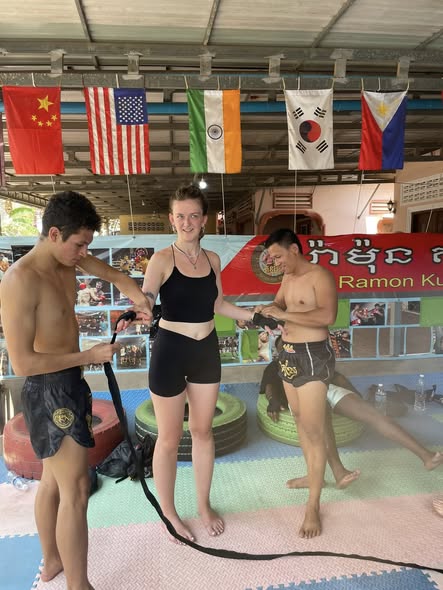
The pre-class block runs on rails: check in, pay, get your hands wrapped, and let the coach take a quick read on your experience so the session is pitched at you rather than at the room's average. There is no booking system behind the daily class, no roster, and no minimum group size — you can decide that afternoon and walk in, though a WhatsApp message during the day is a courtesy so a coach knows to expect you. Chonburi Muay Thai recommends first-timers "arrive 20 minutes prior to the start time" (their FAQ) — a sensible norm here too, since wrapping plus a word with the coach fits neatly in that window. Whether to book a class in advance covers the whole logistics question, and what a gym day pass includes explains what the $9 covers before you even reach the mats.
- Arrive ~20 minutes early — enough for wrapping and a word with the coach
- Check in and pay the $9 day pass at the door (or use your pass)
- Get hand wraps fitted by a coach, or shown how to fit them yourself
- Coach takes a quick read on your experience — the class ahead gets pitched to you
- Barefoot on the mats from here: shoes stay at the edge
How Does the Warm-Up Open the Session?
The first 10–15 minutes raise your heart rate and loosen the joints you are about to use — mobility, light footwork, and easy shadowboxing, before any contact work starts. That is the standard anatomy of a warm-up: "a gradual increase in intensity in physical activity (a 'pulse raiser'), joint mobility exercise, and stretching, followed by the activity," per Wikipedia's warm-up article, and shadowboxing is its most common striking-sport form — an exercise "commonly used as a warm-up" where you throw punches at the air to set rhythm and stance (Wikipedia). Nobody tests you in this block; you move at the group's pace, and it doubles as the moment the new-person nerves wear off. Light clothes you can lunge and sweat in are all the warm-up asks — what to wear to a Kun Khmer class covers the wardrobe, and the beginner gear guide explains why you need to buy nothing for day one.
A warm-up generally consists of a gradual increase in intensity in physical activity (a 'pulse raiser'), joint mobility exercise, and stretching, followed by the activity.
What Happens During Technique Instruction?
Technique is where the class slows down: stance, guard, and the core strikes get broken down and drilled slowly, before speed or power come into it. Kun Khmer's arsenal is "four types of strikes: punches, kicks, elbows, and knee strikes" (Wikipedia — Kun Khmer), and day one spends most of its time on the fundamentals — stance, guard, and basic punches — because that coordination is what everything else builds on. A coach corrects form hands-on through this block, adjusting your hip rotation or guard height in real time rather than calling corrections from across the room. The core Kun Khmer techniques catalogs the strikes in detail, and how martial arts training is built for beginners explains why this slow-drill stage never gets skipped.
The four weapons, as day one actually meets them (four-strike list per Wikipedia — Kun Khmer; drill order per our published walkthrough, lib/blogContent/booking.ts:396, commercial.ts:359)
| Strike | How day one drills it | Where it goes later |
|---|---|---|
| Punches | First — stance, guard, and jab-cross at a beginner pace | Full pad combinations |
| Kicks | Broken down in the air, slowly, then applied on pads | Power rounds on pads and bags |
| Knees | Drilled slowly like the rest, before speed or power | Clinch-range pad work |
| Elbows | Introduced once your basics hold — and optional to go further | The scored weapon Kun Khmer is known for |
Why Is Pad Work the Heart of the Class?
Pad work is where the class comes alive: a coach or partner holds the pads and calls combinations while you strike, at real speed and power, with the pads absorbing everything. Our pad rounds run short, with rest between them — not one long continuous grind — so beginners get useful reps instead of collapse. The pattern is the international norm: Chonburi Muay Thai describes a class where "nearly half of the class time is dedicated to drills," after which students "apply those skills at a greater speed and power, hitting Thai pads" (their FAQ) — drills first, pads second, every time. In a beginner session nobody strikes back at you; the pad is the opponent. Whether Kun Khmer is a contact workout answers the contact question in full, and how a drop-in class works shows the same pad-first session for single visits.
Nearly half of the class time is dedicated to drills wherein students wear only gloves and shin guards. After drills, students will apply those skills at a greater speed and power, hitting Thai pads. Class concludes with conditioning.
Do Elbows and the Clinch Show Up in a Beginner Class?
Yes, as technique — and staged, so neither ever arrives before your basics hold. Elbows are drilled in the air and on pads like every other strike, and they matter here more than almost anywhere: in Kun Khmer, "more victories come by way of an elbow technique than any other strikes" (Wikipedia — Kun Khmer). The clinch — where "punching, elbows, and knee strikes… also sometimes referred to as 'dirty boxing,'" are a defining aspect of the sport's Southeast Asian family (Wikipedia — Clinch fighting) — is taught in stages: new students start with slow, cooperative position drills (grips, frames, off-balancing without resistance) long before any live version exists. What a class never contains is pressure to go further — elbows, clinch, and sparring are all opt-in steps, not tests you get dragged into. The Kun Khmer clinch explained covers the position in depth, and how competition rules work shows why the clinch scores so heavily in the ring.
- Elbows: the sport's most decisive strike — but drilled in the air and on pads first
- Clinch: taught as slow, cooperative grip-and-frame drills long before anything live
- Order is deliberate: bad grips and bad position are how people get hurt
- Going further is always your call — nobody is pushed into contact they did not ask for
What Happens in the Conditioning Block?
Conditioning closes the class — bodyweight work scaled to the room, or light bag rounds depending on the group that night — and it is deliberately the finale, not an extra. Chonburi's class "concludes with conditioning" too, which is the same placement most gyms use: skills first, engine last. This is "the part most people feel the next morning," which is exactly why the load scales to whoever showed up rather than to the fittest person present. In Siem Reap's heat, hydration for this block is a preparation question — the CDC's advice for exercising in heat is to "drink more water than usual, and don't wait until you're thirsty to drink more" (CDC) — so start the bottle well before 5:00 PM. One block per class is enough to build the engine, which is why how often you should train matters more than how hard any single night runs.
Drink more water than usual, and don't wait until you're thirsty to drink more.
How Many Calories Does a Typical Class Burn?
Harvard Health's calories-burned table is the cleanest published yardstick: martial arts (judo, karate, kickboxing) burn 300, 360, and 420 calories per 30 minutes for people weighing 125, 155, and 185 pounds, and boxing sparring burns 270, 324, and 378 at the same weights (Harvard Health). Scaled linearly across a 60–90 minute class — our arithmetic on Harvard's published rates, not a Harvard figure — a full session lands somewhere in the hundreds-to-thousand range depending on your size and effort; individual sessions vary. For the weekly picture, the WHO recommends adults get "at least 150 minutes of moderate-intensity physical activity per week" (WHO fact sheet): two classes at the top of our range clear that floor outright (2 × 90 = 180 minutes), and three short-end classes do the same (3 × 60 = 180). The per-class math, with sources, is worked through in how many calories a class burns, and what Muay Thai does for weight loss covers the honest version of the fat-loss question — no outcomes promised, just the arithmetic.
Harvard Health's calories-burned table, per 30 minutes (fetched live 2026-10-26 per docs/seo-evidence/phase4w2-citations.md; the right-hand column is our own linear scaling of those rates — individual sessions vary)
| Harvard's activity row | 125 lb · 30 min | 155 lb · 30 min | 185 lb · 30 min | A 60–90 min class (2–3× the rate) |
|---|---|---|---|---|
| Martial arts: judo, karate, kickbox | 300 | 360 | 420 | ≈600–1,260 |
| Boxing: sparring | 270 | 324 | 378 | ≈540–1,134 |
What Does the Cool-Down Do — and Why Stay for It?
The cool-down is the short stretch that closes every session, and it exists so you walk out loose instead of walking out stiff — a structured warm-up and cool-down bookend every class here by design. It takes a handful of minutes: heart rate comes down, hips and shoulders get stretched while they are still warm, and the coach wraps up whatever the next session will build on. Skipping it costs more than it saves — the five minutes of stretching is the cheapest recovery work you will ever get, and the morning-after difference is noticeable. These martial arts training tips cover the recovery habits that sit on top of it.
Stay for the stretch
The cool-down is part of the class, not an optional extra tacked on the end: a short, structured stretch while the muscles are still warm. It is the difference between waking up stiff and waking up sore-but-working — and it is the coach's sign-off that the session is actually finished.
What Does Not Happen in a Beginner Class?
No sparring, no trading strikes with a partner, and no expectation that you match anyone's pace — the beginner session simply has no block where another student hits you. Our published answer to "will I spar on my first day?" is no: first classes focus on stance, technique, and pad work, and sparring comes later, once fundamentals are solid. Early sessions run on "stance, footwork, and pad work with a coach or bag, not trading strikes with a partner," and you are never expected to match the intensity of someone who has trained for months. Where sparring does exist at gyms that offer it, it is an optional add-on, not a class stage — FitKoh tells guests that classes "sometimes finish with sparring or clinching… but it's completely optional!" (their FAQ). Sparring in Kun Khmer covers the whole question — when it starts, who decides, and why it never has to.
Common fears vs. the actual beginner session (our published policy, lib/blogContent/booking.ts:396-417, wellness.ts:16)
| What people picture | What the class contains |
|---|---|
| Sparring from day one | Not in the session — stance, technique, and pad work |
| A partner striking back | Pads a coach holds, or a bag — nothing strikes back |
| Matching the experienced students' pace | Intensity scales to you; the mixed room is the norm |
| A hidden test or grading | No tests — the coach scales the drills, not the pressure |
What If You Can't Keep Up With the Class?
You won't have to — the coaches scale pad combinations and conditioning to whoever is actually in the room that day, which is the published design of the class, not a favor. "What if I can't keep up in fitness classes?" is a real question beginners ask gyms, and the honest answer is structural: the room always mixes complete first-timers with people who have trained for months, so a class that only worked at one pace would fail every single night. Coaches adjust pad work and conditioning to your level, first-timers included, and nobody is scored against the person next to them. If you would rather build the basics at your own speed first, private Kun Khmer lessons run one-on-one at $25 per hour, per person, before you join the group.
- The room is always mixed — first-timers beside people with months of training
- Coaches adjust pad combinations and pace to whoever showed up
- Conditioning scales to you — no scoring against the fittest person present
- Want a slower on-ramp? Private lessons build the basics one-on-one first
What Will You Feel the Next Day?
Sore — in the normal, productive way: tight hips, sore shins from checking pads, a stiff core from holding stance, because the conditioning block is "the part most people feel the next morning." That delayed-onset muscle soreness is a normal adaptation that eases within days, not a sign something went wrong; most first "injuries" in this sport are exactly that. The line to know is the other one: overtraining is when training "exceed their body's ability to recover from strenuous exercise" (Wikipedia — Overtraining) — performance dropping, fatigue stacking — and one class a day does not put a beginner anywhere near it. "What can I expect the following day(s)?" is a question gyms get often enough to put in their FAQs, and the answer here is: sore legs, a good kind of tired, and the option to come back the next evening. How safe Kun Khmer is for beginners gives the full risk picture, and the first-class checklist has the night-before and morning-after prep.
Sore is the plan; wrecked is not
Normal: tight hips, sore shins, a stiff core — easing within days. Not normal: sharp or joint-level pain, or fatigue that keeps stacking session after session. The first is adaptation; the second is a conversation with the coach about load.
What Should You Do With This Map Tonight?
Use it: the class runs every day at 5:00 PM, gear is included, and the five-stage structure above is the whole mystery — there is nothing else hiding in the hour. Wear light sports clothes, bring water, arrive about twenty minutes early for wrapping, and let the first stage handle the rest; the $9 day pass is the entire commitment, and the coaches — Kon Phanet and Ramon, with a combined 50+ professional Kun Khmer fights in Cambodia — will scale every stage to you. The full cost breakdown shows every pass against how long you are staying, how to plan a Kun Khmer training trip builds the map into a whole visit, and the live price list has the current numbers.
- Wear light sports clothes; bring water and a small towel
- Arrive ~20 minutes before 5:00 PM — wrapping and a word with the coach
- Pay the $9 day pass at the door; gloves, wraps, and pads are provided
- Train the five stages; stay for the stretch
- Decide tomorrow whether it becomes a habit — one session is the whole experiment
FAQ
What Is a Typical Class Like?
Five stages in a fixed order: hand wrapping and a warm-up, technique instruction, pad work, conditioning, and a cool-down, in about 60–90 minutes. Thai Boxing Institute lists the same session shape ("Warm-up, Technique instruction, Pad work, Conditioning, Cool down"), and here it runs daily at 5:00 PM with every stage scaled to whoever is in the room.
How Long Are Classes?
About 60–90 minutes at our gym — our published answer for a first class — typically landing a little over an hour in practice. The stage order never changes; what flexes is how many pad rounds and how much conditioning fit the room that night.
What to expect for first class?
Check in, pay the $9 day pass, get your wraps fitted, and take a 10–15 minute warm-up into slow technique drills, pad rounds with a coach, and a scaled conditioning block with a stretch to finish. Nobody hits you at any point, and you are never expected to match the experienced students' pace.
How should I prepare for class?
Eat light an hour or two beforehand, hydrate through the afternoon — the CDC advises drinking more water than usual and not waiting for thirst — and wear light sports clothes. Bring water and a towel; wraps, gloves, and pads are provided at the gym.
What time should I get to the gym?
About 20 minutes before the 5:00 PM start — the same window Chonburi Muay Thai recommends for first-timers — which covers check-in, wrapping, and a quick word with the coach about your experience. Walking in later still works: there is no booking system, and the class absorbs whoever arrives.
How often should I come?
As often as recovery allows — even one class a week keeps the five stages building, and two to three a week is where most beginners feel the fastest change. Counted against the WHO's recommended 150 minutes of moderate-intensity weekly activity, two 90-minute classes already clear the bar.
What can I expect the following day(s)?
Delayed-onset muscle soreness — tight hips, sore shins from checking pads, a stiff core from holding stance — which is a normal adaptation that eases within days, not a sign something went wrong. Sharp or joint-level pain is the exception worth telling the coach about.
Do I get one-on-one time in Muay Thai group classes?
Yes, in the places it matters: a coach fits your wraps, corrects your form hands-on during technique, and holds the pads for you during pad work. If you want a full session of undivided attention, private lessons run one-on-one at $25 per hour, per person.
Key takeaways
- A typical class is five stages in fixed order — wrapping, warm-up, technique, pad work, conditioning, plus a cool-down — the same skeleton Thai Boxing Institute and Chonburi Muay Thai publish, and ours runs daily at 5:00 PM.
- It lasts about 60–90 minutes — typically a little over an hour in practice — and the stage order never changes even when the room does.
- Pad work is the heart: short rounds where you strike and a coach holds the pads, so you train at real speed and power with nothing striking back.
- Harvard's published rates put martial arts at 300–420 calories per 30 minutes by body weight, and two 90-minute classes here clear the WHO's 150-minutes-per-week floor outright.
- No sparring, no partner strikes, no pace tests — early sessions run on stance, technique, and coach-held pads, scaled to whoever walked in.
Sources & further reading
- Thai Boxing Institute (Los Angeles) — FAQ — "A typical session includes: Warm-up Technique instruction Pad work Conditioning Cool down." Fetched live (200 curl) 2026-10-26; recorded at docs/seo-evidence/phase4w1-citations.md:51. — source
- Chonburi Muay Thai — FAQ — "All classes are different in content, but the structure is similar."; "Nearly half of the class time is dedicated to drills wherein students wear only gloves and shin guards."; "After drills, students will apply those skills at a greater speed and power, hitting Thai pads."; "Class concludes with conditioning."; "For your first class, it is recommended that you arrive 20 minutes prior to the start time." Fetched fresh 2026-10-27 (curl 200); body archived at docs/seo-evidence/tmp-w3-class-chonburi-faq.html, quotes recorded in docs/seo-evidence/phase4w3-citations.md; prior verifications at docs/seo-evidence/phase4w1-citations.md:49. — source
- Wikipedia — Warming up — "A warm-up generally consists of a gradual increase in intensity in physical activity (a 'pulse raiser'), joint mobility exercise, and stretching, followed by the activity." Fetched live 2026-10-26 per docs/seo-evidence/phase3b1-citations.md:30. — source
- Wikipedia — Shadowboxing — Shadowboxing is "commonly used as a warm-up exercise" in striking sports. Fetched live 2026-10-26 per docs/seo-evidence/phase3b1-citations.md:31. — source
- Wikipedia — Kun Khmer — "Kun Khmer consists of four types of strikes: punches, kicks, elbows, and knee strikes"; "In Kun Khmer, more victories come by way of an elbow technique than any other strikes." Fetched as raw wikitext (200) 2026-10-26 per docs/seo-evidence/phase4w2-citations.md:19. — source
- Wikipedia — Clinch fighting — "Punching, elbows, and knee strikes in the clinch, also sometimes referred to as 'dirty boxing', are an important aspect of Muay Thai, Bajiquan, Wing Chun, Lethwei and mixed martial arts." Fetched as raw wikitext (200) 2026-10-26 per docs/seo-evidence/phase4w2-citations.md:12. — source
- Harvard Health — Calories burned in 30 minutes — Table rows "Boxing: sparring 270 324 378" and "Martial Arts: judo, karate, kickbox 300 360 420", per 30 minutes at 125/155/185 lb. Fetched live (200 curl) 2026-10-26 per docs/seo-evidence/phase4w2-citations.md:24. Per-class figures in this article are our own linear scaling of these published rates, labeled as such. — source
- World Health Organization — Physical activity fact sheet — The global recommendation of "at least 150 minutes of moderate-intensity physical activity per week" (page-supported wording; the 150–300 range is not on the page, per docs/seo-evidence/phase3b1-citations.md mismatch #2). Fetched live (200 curl) 2026-10-26 per docs/seo-evidence/phase4w2-citations.md:25. — source
- CDC — Heat and Athletes — "Drink more water than usual, and don't wait until you're thirsty to drink more." Fetched live via Exa 2026-10-26 per docs/seo-evidence/phase4w1-citations.md:9. — source
- FitKoh (Koh Samui, Thailand) — FAQ — "Sometimes classes finish with sparring or clinching – you're welcome to join if you're ready, but it's completely optional!" Fetched 2026-10-26 per docs/seo-evidence/phase4w1-citations.md:50 and the wave-1 sparring fragment sources record. — source
- Wikipedia — Overtraining — "Overtraining occurs when a person exceeds their body's ability to recover from strenuous exercise" — the distinction between normal next-day soreness and its pathological counterpart. Fetched live 2026-10-26 per docs/seo-evidence/phase3b1-citations.md:32. — source
- Kun Khmer Club — price list — $9 day pass, $69 weekly, $129 monthly, $25 per hour per person privates, $299 6-week fight camp; daily 5:00 PM class; gear included; coaches Kon Phanet and Ramon with 50+ combined professional Kun Khmer fights in Cambodia (lib/business.ts:18-36). — source
Reviewed 2026-10-27
Written by the coaches
Kun Khmer Club — Coaches Kon Phanet & Ramon
Head coaches Kon Phanet and Ramon have a combined 50+ professional Kun Khmer fights in Cambodia. We coach beginners, travelers, expats, and fighters at our gym in Siem Reap.
Ready to train in Siem Reap?
Drop in for a $9 day pass — the group class starts at 5:00 PM every day, and all gear is provided. Message us for today’s times.