
Muay Thai Gear for Beginners: What You Need
Muay Thai gear for beginners is a shorter list than most guides admit: for a first class you need nothing at all — the $9 day pass includes gloves, hand wraps, and pads, and you train barefoot on the mats. This guide separates day-one essentials from what is worth buying — 14–16 oz gloves, wraps, shin guards — only if you keep training.
On this page
- What Muay Thai Gear Do Beginners Actually Need?
- Do You Need Any Gear for Your Very First Class?
- What Does the Gym Provide, and What Do You Bring Yourself?
- Should You Buy Your Own Gloves Right Away or Use Gym Loaners?
- Do Beginners Need Shin Guards for Muay Thai?
- Do You Need a Cup (Groin Protector) for Class?
- What About Hand Wraps?
- Do Beginners Need a Mouthguard?
- What Gear Do You NOT Need to Buy?
- Should You Buy Gear Before You Travel to Siem Reap?
- How Do You Care for Gear Once You Own It?
- When Does Buying Gear Actually Make Sense?
- What Does Gear Have to Do with Choosing a Good Gym?
Muay Thai gear for beginners is a shorter list than most gear guides admit: for your first class you need nothing at all, because at Kun Khmer Club in Siem Reap the $9 day pass includes gloves, hand wraps, and pads, and you train barefoot on the mats. The buying talk — 14–16 oz gloves, wraps, shin guards, a cup — belongs to people who have already decided to keep training. This guide separates the day-one essentials (clothes and water) from the purchases worth making, in order, if the sport sticks.
What Muay Thai Gear Do Beginners Actually Need?
For a first class: light sports clothes and water — nothing else, because a beginner-friendly gym supplies gloves, wraps, and pads and trains people barefoot on the mats. The full equipment list only becomes relevant as partner work and sparring enter the picture, which in a structured beginner class happens weeks in, not on day one. What you wear matters more than what you own — the full what-to-wear list for a Kun Khmer class covers clothing in detail, and the first-class packing list turns the day-one essentials into a checklist.
The beginner gear list, consolidated. Class-timing guidance per Fairtex's beginner guide (fetched 2026-10-26); what this gym provides per lib/business.ts.
| Gear item | First class? | When to buy it | Why |
|---|---|---|---|
| Gloves | Provided free | When training consistently | 14–16 oz protects hands on pads and bags |
| Hand wraps | Provided free | First — cheap and hygienic | Keeps wrist stacked and knuckles aligned |
| Shin guards | Not needed | When partner kick drills or sparring start | Protect both shins when kicks meet a person |
| Cup (groin protector) | Optional | When teeps, knees, or sparring appear | Accidents happen even with good control |
| Mouthguard | Not needed | When any contact or sparring starts | Protects teeth and jaw |
| Shoes | Never | Never — train barefoot | Barefoot is the norm in Muay Thai gyms |
| Uniform | No | Never required | Most gyms require no formal uniform |
Do You Need Any Gear for Your Very First Class?
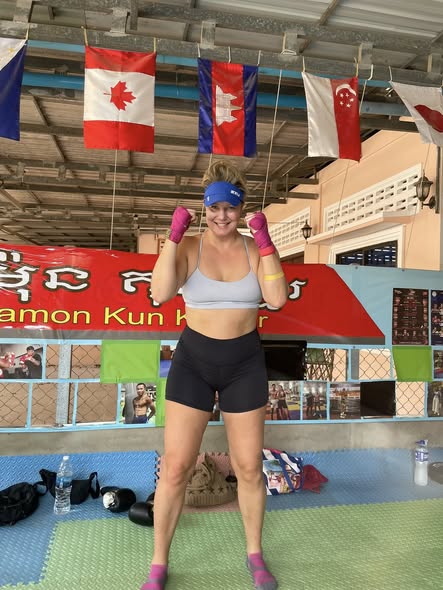
No — walk in with light sports clothes and a water bottle and you are fully equipped, because the $9 day pass at our daily 5:00 PM class in Siem Reap includes gloves, hand wraps, and pads, with training barefoot on mats. The coach fits your wraps and sets you up before the warm-up, and intensity scales to the individual, so complete beginners train the same session as regulars at their own pace. That first-session ease is the most repeated thing in our reviews — one first-timer called a first session of Kun Khmer "what a pleasure." Even industry guidance agrees the barrier is low: Fairtex's beginner guide notes it is normal to show up without shin guards on day one when the class is bag-and-pad focused, which ours is. If you are deciding whether to try at all, trying Kun Khmer with no experience answers the nerves question, and what happens in beginner Kun Khmer classes walks the session minute by minute.
- Bring: light sports clothes, water — more than feels necessary in this heat
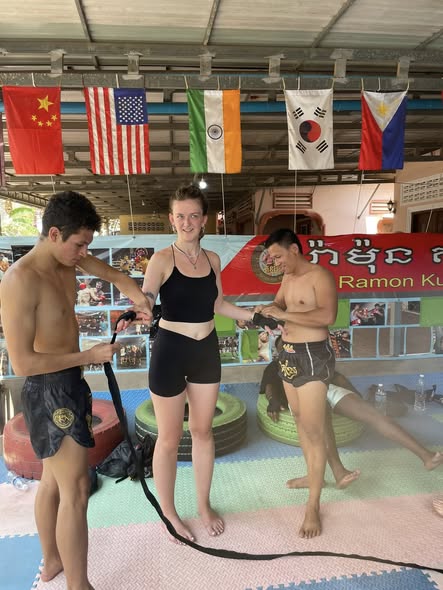
- Provided: gloves, hand wraps, and pads, fitted by the coach before class
- Wear: nothing on your feet — training is barefoot on the mats
- Needed: no experience, no booking, no gear purchase of any kind
What Does the Gym Provide, and What Do You Bring Yourself?
The gym side of the ledger is everything that hits or gets hit — gloves, wraps, and pads — and the you side is what touches your own skin and the heat: light sports clothes and water. The CDC's guidance for athletes exercising in heat is to drink more water than usual and not wait until you are thirsty, and an evening class in Siem Reap earns that advice. Every tier from a single one-day class up to the 6-week fight camp includes the same gear, and the live price list shows what each tier costs.
Who supplies what, per lib/business.ts (all passes include gear)
| The gym provides | You bring |
|---|---|
| Boxing gloves for the class | Light, breathable sports clothes |
| Hand wraps, fitted by the coach | Water |
| Thai pads and focus mitts | A small towel if you want one |
| The mats you train on, barefoot | Nothing else — no purchase required |
Should You Buy Your Own Gloves Right Away or Use Gym Loaners?
Use the loaners for your first sessions and buy your own gloves once training becomes a habit — that is the exact sequence equipment maker Fairtex advises: "If the gym has loaners, you can use them for your first session, but bring your own hand wraps for hygiene. If you plan to train consistently, buying your own gloves early is worth it because fit, padding feel, and wrist support affect your learning." Their sizing rule for beginners is 14 oz or 16 oz, the safe default for a class mixing bagwork and partner drills. The same logic applies to any drop-in martial arts class you try while traveling — borrow, then buy — and what a gym day pass includes in Siem Reap shows what our $9 covers.
If the gym has loaners, you can use them for your first session, but bring your own hand wraps for hygiene. If you plan to train consistently, buying your own gloves early is worth it because fit, padding feel, and wrist support affect your learning.
Do Beginners Need Shin Guards for Muay Thai?
Not on day one — Fairtex's guidance is that if you are only hitting bags and pads you can start without shin guards, and ours is exactly that class. The buying moment arrives when kicks start meeting a person: partner kick drilling makes shin guards a smart move in their words, and kick sparring usually requires them. In a beginner-friendly Kun Khmer class nothing hits back and everything lands on pads, so where sparring actually fits in Kun Khmer is a weeks-away question, and whether Kun Khmer is a contact workout answers the worry most beginners carry through the door.
- Bags and pads only — no shin guards needed; start without them (Fairtex)
- Partner kick drilling begins — shin guards become a smart buy (Fairtex)
- Kick sparring — usually required, for both people's shins (Fairtex)
- Our beginner class — pad-focused, no sparring on day one, so no guards needed
Do You Need a Cup (Groin Protector) for Class?
For a beginner technique class, no — Fairtex calls groin protection optional there, and their rule for when it changes is precise: once partner drills involve teeps, knees, or sparring, a cup becomes a smart choice because accidents happen even with good control. They add that it is a smart add for men and that some women prefer one too. The same staged logic applies to safety generally — whether Kun Khmer is safe for beginners explains how pad-first classes control risk, and how the class scales for women beginners covers the same ground from that angle.
Groin protection by training stage, per Fairtex's beginner guide (fetched 2026-10-26)
| Your training | Cup verdict |
|---|---|
| Beginner technique class | Optional — not needed on day one |
| Partner drills with teeps and knees | Smart choice — accidents happen with good control |
| Sparring | Smart add for men; some women prefer one too |
What About Hand Wraps?
Wraps are the smallest, cheapest item on the list and the one worth owning first: Fairtex explains they keep your wrist stacked, your knuckles aligned, and your hand tight inside the glove when you hit pads and bags. Their hygiene rule is that even when a gym loans gloves, you bring your own wraps — and they call a second set a practical move for anyone training often, so damp fabric never goes back around your hands. Here the coach fits your wraps for every class, and learning to wrap your own hands well is a beginner skill in its own right — the martial arts training tips that actually matter put fundamentals-first habits like that at the top of the list.
- Arrive — the coach wraps your hands before the warm-up
- Gloves go on over the wraps for every pad and bag round
- After class — unwrap fully and hang the wraps to dry, never rolled up wet
- Training most days — a second set of wraps is practical, not luxury (Fairtex)
Do Beginners Need a Mouthguard?
Not for a first class of pads and technique — Fairtex's rule is that a mouthguard makes sense once any contact starts happening, "even if it is 'just touch,'" and is mandatory in any responsible sparring environment. Accidental clashes are a range-learning problem, which is why the trigger is contact, not experience level. In our beginner class everything lands on pads held by a coach, so the mouthguard joins the bag at the same moment sparring does — the full picture of sparring in Kun Khmer covers when and how that happens.
- Pad and technique classes — no mouthguard needed
- Light partner contact — Fairtex says wear one, "even if it is 'just touch'"
- Sparring — mandatory in any responsible sparring environment (Fairtex)
What Gear Do You NOT Need to Buy?
Uniform, shoes, and a day-one equipment haul — all skippable, and the overbuying problem is common enough that Fairtex names it: "A lot of beginners overbuy gear because they are nervous." Most gyms do not require a formal Muay Thai uniform; barefoot is the training norm, so shoes are for walking to the gym, not on the mats. Buy nothing until a real class has told you what you actually need — what to wear to a Kun Khmer class shows how little clothing the sport demands, and choosing between the martial arts for beginners is a better first purchase of attention than any glove.
Common beginner purchases that can wait — or never happen
| Item | Buy it? | Why |
|---|---|---|
| Muay Thai uniform | No | Most gyms require no formal uniform (Fairtex) |
| Shoes / training footwear | No | Muay Thai gyms train barefoot; bring flip flops for off-mat |
| Gloves before class one | Not yet | Loaners exist; buy once you know you will keep training |
| A full accessories haul | No | Fairtex: beginners overbuy gear because they are nervous |
Should You Buy Gear Before You Travel to Siem Reap?
No — pack less equipment than you think you need and let the gym cover the rest, which is the same advice long-term camp trainers give about Thailand: "Pack less gear than you think," as one Thailand training-camp guide puts it, because gyms supply the training essentials and gear bought in a panic before a trip fits nobody. "Do you need to bring your own gear?" is the single most common gear question Siem Reap visitors ask gym directories — the question appears verbatim on Siem Reap Hub's gym guide — and at a beginner-friendly gym the answer is no. What tourists training Kun Khmer in Siem Reap actually need covers the same-day logistics, and planning a Kun Khmer training trip walks the whole packing-and-budget picture.
Pack less gear than you think (buy cheap stuff in Thailand).
How Do You Care for Gear Once You Own It?
Drying is the whole discipline: hang wraps to dry fully after every session rather than rolling them up wet, open gloves up so sweat can escape instead of sealing them in a bag, and undo shin-guard straps so the lining can air out — Fairtex's care guide walks each of these, and notes trapped moisture is why gloves smell. A hot, humid training town makes the habit matter more, which is one more reason the class sits in the cooler evening — the best time of day to train in Siem Reap explains the scheduling logic.
- Unwrap and hang wraps immediately — never roll them up damp
- Wipe glove insides if soaked, then leave them open to breathe
- Undo shin-guard straps fully so the lining dries
- Train often? Keep a second wrap set so one is always dry (Fairtex)
When Does Buying Gear Actually Make Sense?
Match purchases to training frequency, not enthusiasm: nothing for a single visit, wraps within your first week of daily training, 14–16 oz gloves once a month of classes is clearly happening, and protection gear (shin guards, mouthguard, cup) only when partner drills or sparring enter the plan. Our pass structure makes the ladder literal — a $9 day pass includes everything, a $69 weekly or $129 monthly makes a $15–30 wraps-and-gloves purchase rational by roughly week two, and the $299 six-week fight camp is the point where serious students buy their own kit. How much a Kun Khmer class costs in Siem Reap prices every tier, what affordable martial arts training looks like here puts the numbers in market context, and the full price list has the live figures.
A purchase ladder mapped to our passes (prices per lib/business.ts; gear timing per Fairtex guidance)
| Training pattern | Pass here | Worth owning by then |
|---|---|---|
| One visit, curious | $9 day pass | Nothing — all gear provided |
| Daily for a week | $69 weekly | Your own hand wraps (hygiene) |
| A month or more | $129 monthly | 14–16 oz gloves; second wrap set |
| Partner drills / sparring begin | — | Shin guards, mouthguard, cup |
| Six committed weeks | $299 fight camp | Your own full kit, fitted to you |
What Does Gear Have to Do with Choosing a Good Gym?
A gym that supplies clean, working gear removes the biggest practical barrier for a beginner — and safe, maintained equipment is one of the four criteria in our guide to knowing whether a martial arts gym is good, alongside coaching that corrects you individually, a real beginner program, and the confidence to let you try before committing. Gear-included classes also make price comparisons honest: a cheap pass that rents gloves by the hour is not cheap. The gyms in Siem Reap compared side by side applies that test across town, and for everything else the cluster covers — from first class to fight camp — the beginner training hub collects the guides in one place.
- Gear provided free = a lower barrier to your first class and a more honest price
- Check that loaner gear is clean and maintained — it is a gym-quality signal
- Ask what a pass includes before comparing prices across gyms
- A gym confident enough to lend gear is usually confident in its coaching
FAQ
Do you need to bring your own gear?
No — gloves, hand wraps, and pads are provided with every class at Kun Khmer Club, and you train barefoot on the mats. Bring light sports clothes and water; buy gear only if you keep training.
Should I buy my own gloves right away or use gym loaners?
Use the loaners for your first session — Fairtex's advice is that if the gym has them, use them, but bring your own wraps for hygiene. Buy your own gloves once you plan to train consistently, at 14–16 oz for general class work.
Do beginners need shin guards for Muay Thai?
Not at first — if you are only hitting bags and pads, you can start without shin guards, and it is normal to arrive without them on day one. You need them once partner kick drilling or kick sparring starts.
Do I need a cup (groin protector) for Muay Thai class?
For beginner technique classes it is optional. It becomes a smart choice once partner drills involve teeps, knees, or sparring, since accidents happen even with good control — for men especially, and some women prefer one too.
Should I bring my own gear or buy everything there?
Bring clothes and water and let the gym supply the training gear — camp guides tell travelers to pack less gear than they think. At our gym every pass from the $9 day pass up includes gloves, wraps, and pads.
What gloves should I bring to class?
If you are bringing your own, 14 oz or 16 oz gloves are the beginner default because they protect your hands on pads and bags and are safer for partner work. Loaner gloves here cover you until you buy.
Do I need a Muay Thai uniform?
No — most gyms, including ours, require no formal uniform. Light sports clothes and bare feet are the standard; what matters is that clothing is safe, clean, and lets your hips move.
What Should I Bring to Class?
Light, breathable sports clothes, water, and nothing else — the gym provides gloves, wraps, and pads, and training is barefoot. In Siem Reap's heat, bring more water than feels necessary.
Key takeaways
- You need no gear for your first class: the $9 day pass includes gloves, hand wraps, and pads, and you train barefoot on the mats (lib/business.ts).
- Buy in this order if you keep training: wraps first (hygiene), then 14–16 oz gloves, then shin guards, mouthguard, and cup only when partner drills or sparring begin (Fairtex, fetched 2026-10-26).
- Do not buy a uniform or shoes — most gyms require no uniform, and barefoot is the training norm; beginners commonly overbuy gear out of nerves (Fairtex).
- Match purchases to frequency, not enthusiasm: nothing for one visit, wraps within a week of daily classes, gloves once a month is happening, full kit at fight camp.
- Gear-included pricing makes comparisons honest — a cheap pass that rents gloves by the hour is not cheap; check what every pass includes before choosing.
Sources & further reading
- Fairtex — What to Wear to Muay Thai Class (Beginner Clothing Guide) — 14–16 oz beginner glove guidance; wraps keep wrist stacked and knuckles aligned; shin guards unnecessary for bags/pads but needed for partner kick drills and usually required for kick sparring; cup optional in technique class, smart once teeps/knees/sparring start, some women prefer one; mouthguard once any contact begins and mandatory in sparring; barefoot norm; loaner-gloves-but-own-wraps hygiene rule; beginners overbuy out of nerves; wrap/glove/shin-guard drying care. Fetched in full via web reader 2026-10-26. — source
- Supa Phat — Thailand Muay Thai Camp Guide — "Pack less gear than you think (buy cheap stuff in Thailand)" — the pack-light travel guidance quoted and attributed to their Thailand context. Fetched 2026-10-26. — source
- CDC — Heat and Athletes — "Drink more water than usual, and don't wait until you're thirsty to drink more" — the basis for the bring-extra-water advice for evening training in Siem Reap's heat. Fetched 2026-10-26. — source
- Siem Reap Hub — Best Gyms in Siem Reap (2026) — Carries the verbatim visitor gear question "Do you need to bring your own gear?" (recorded at docs/seo-evidence/phase1-paa.md:14); page live and fetched 2026-10-26 (22 gyms ranked, updated March 2026). — source
- Kun Khmer Club on Google Maps — The club's listing — 5.0 rating from 8 reviews (docs/seo-evidence/google-reviews.md:2-3); the quoted review (Hamari Camara, 2026-09-12) is verbatim from that record, google-reviews.md:9. — source
- Kun Khmer Club — price list — $9 day pass, $69 weekly, $129 monthly, $25 per hour per person privates, $299 6-week fight camp; daily 5:00 PM class; gear included on every pass (lib/business.ts:18-36). — source
Reviewed 2026-10-26
Written by the coaches
Kun Khmer Club — Coaches Kon Phanet & Ramon
Head coaches Kon Phanet and Ramon have a combined 50+ professional Kun Khmer fights in Cambodia. We coach beginners, travelers, expats, and fighters at our gym in Siem Reap.
Ready to train in Siem Reap?
Drop in for a $9 day pass — the group class starts at 5:00 PM every day, and all gear is provided. Message us for today’s times.