What to Wear to a Kun Khmer Class? The Full List
Light, breathable sports clothes and bare feet are all a Kun Khmer class requires — gloves, hand wraps, and pads are provided free at the gym, and water is the one thing to bring extra of in Siem Reap's heat.
On this page
- What Exactly Should You Wear to a Kun Khmer Class?
- Do You Wear Shoes for Kun Khmer?
- What Does the Gym Provide vs. What Do You Bring?
- Do You Need a Uniform or Any Special Kit?
- What Should Women Wear to Kun Khmer Class?
- How Does Siem Reap's Heat Change What You Wear?
- How Much Water Should You Bring to Class?
- Which Gloves and Hand Wraps Do Beginners Actually Need?
- What Should You NOT Wear or Bring to Class?
- What Do You Need After Class?
- What Does It Cost to Show Up Dressed Right?
- Trying Kun Khmer for One Day — What's the Minimum Kit?
Light, breathable sports clothes and bare feet are all a Kun Khmer class in Cambodia asks of you — training happens on mats and in a ring, so shoes come off at the door. Every piece of striking gear (gloves, hand wraps, pads) is provided free at Kun Khmer Club, so your kit is shorts or leggings, a t-shirt you don't mind sweating through, water, and a spare shirt for after. Nothing needs to be bought before your first class.
What Exactly Should You Wear to a Kun Khmer Class?
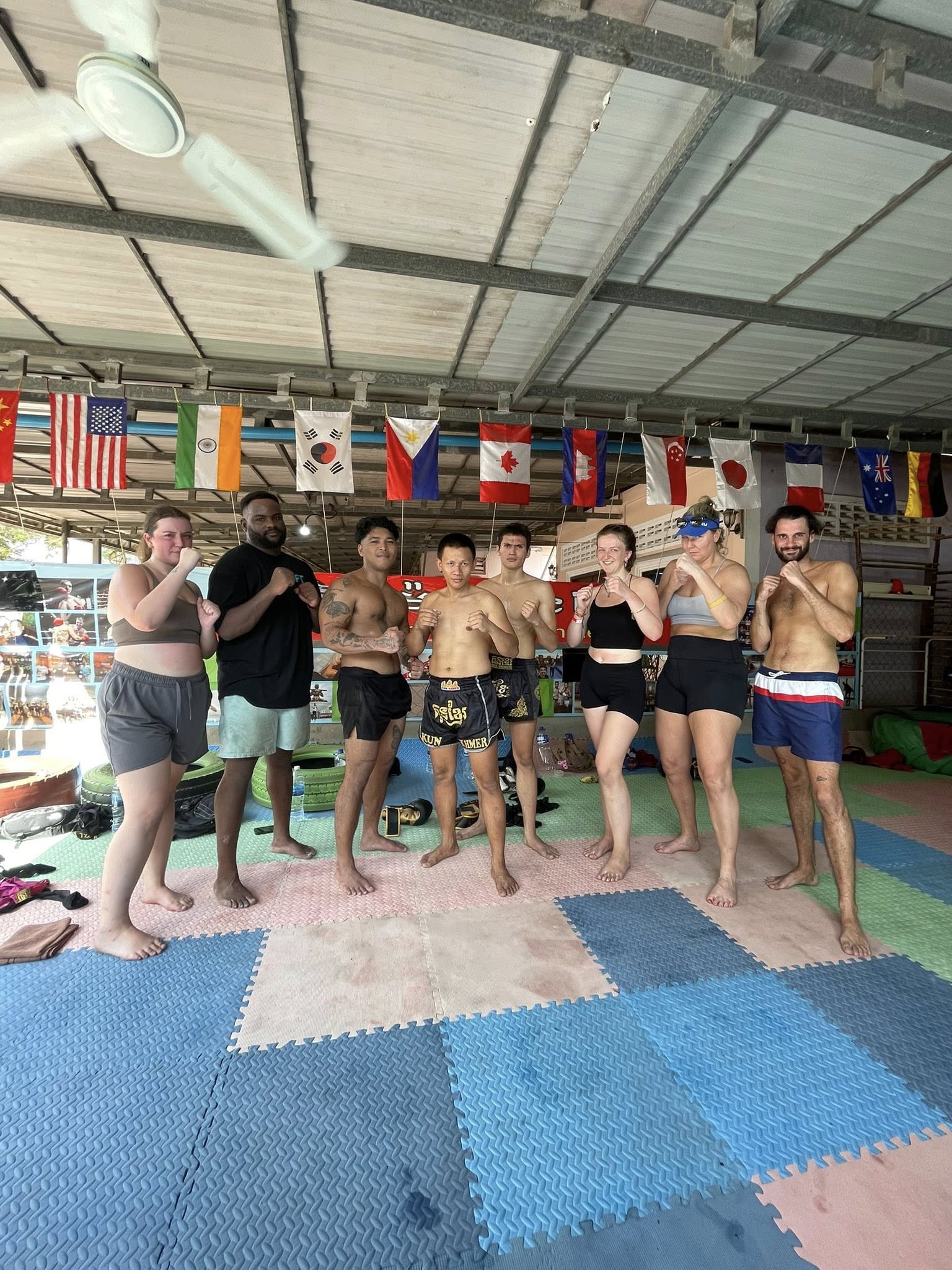
The full answer is a five-item list, and you probably own four of the items already. Kun Khmer is a striking sport built on four types of strikes — punches, kicks, elbows, and knee strikes — plus clinch fighting, so the clothing needs to survive kicking height, clinch drills, and serious sweat, which ordinary gym wear does. The one genuinely unusual rule is footwear: there is none.
- Sports shorts or leggings — anything that lets you kick to head height without yanking
- A breathable t-shirt or sports top — moisture-wicking fabric copes best with the sweat, but a plain cotton tee is fine
- Bare feet — shoes come off at the door, because training happens on mats and in a ring
- A full water bottle and a small towel — Siem Reap's heat makes both non-negotiable
- A spare shirt for the walk home — you will be soaked, and soaked cotton goes cold fast
What those items get used for is covered hour by hour in what actually happens in a beginner Kun Khmer class — the wear list maps straight onto the session's stages.
Do You Wear Shoes for Kun Khmer?
No — Kun Khmer is trained barefoot on the mats and in the ring, so shoes stay at the door. This surprises travelers packing for Cambodia more than anything else on the list: no cross-trainers, no grip socks, nothing on your feet at all. Feet do the kicking, the ring canvas stays clean, and grip comes from the mat rather than from a sole. It is the same convention across ring sports in the region, so the habit transfers directly if you have trained Muay Thai or kickboxing anywhere else.
The barefoot setup belongs to the sport's ring format, which the rules beginners compete under explains in full, and martial arts classes in Siem Reap compares how other gyms in town run the same setup.
What Does the Gym Provide vs. What Do You Bring?
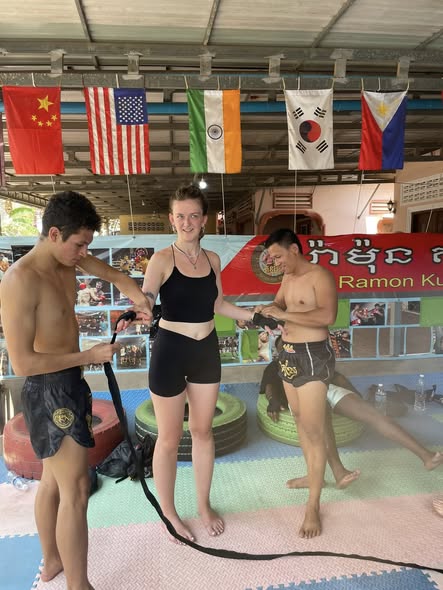
All training gear is provided free at Kun Khmer Club — gloves, hand wraps, and pads — so your side of the table is only clothing, water, and a towel. A coach fits your wraps on arrival, which matters more than it sounds, because a wrap compresses and supports the hand's bones and soft tissues, strengthening the metacarpus and reducing the likelihood of the boxer's-fracture injury. There is no gear-rental fee and no deposit at any pass tier.
The provided-vs-bring split — nothing on your side costs money at the gym
| Item | Provided at the gym | You bring |
|---|---|---|
| Gloves | Yes — free loaners | Optional, if you own your own |
| Hand wraps | Yes — a coach fits them | Optional, if you own your own |
| Pads and shields | Yes — coach equipment | — |
| Clothing | — | Shorts or leggings + breathable top |
| Water | — | A full bottle, plus more if you run hot |
If you are visiting rather than local, whether tourists can train Kun Khmer in Siem Reap covers access for short stays, including walk-in sessions.
Do You Need a Uniform or Any Special Kit?
No — there is no uniform, no gi, and no kit you must buy before your first class. Kun Khmer, also known as Pradal Serey or Khmer boxing, carries no dress code beyond ordinary sportswear, and first-timers train in exactly what they walked in wearing. The only purchase worth making early is a cheap pair of shorts, and only if you arrived in Cambodia without any.
- Sports shorts or leggings — whatever you already own
- A t-shirt or sports top — cotton is acceptable, technical fabric more comfortable
- Nothing on your feet — wraps and gloves go on your hands, never shoes on your feet
- Hand wraps, fitted by a coach — then gloves over them
For how that compares with starting any other discipline, the best martial arts for beginners ranks the entry costs honestly, and boxing classes in Siem Reap show what other gyms in town ask you to bring.
What Should Women Wear to Kun Khmer Class?
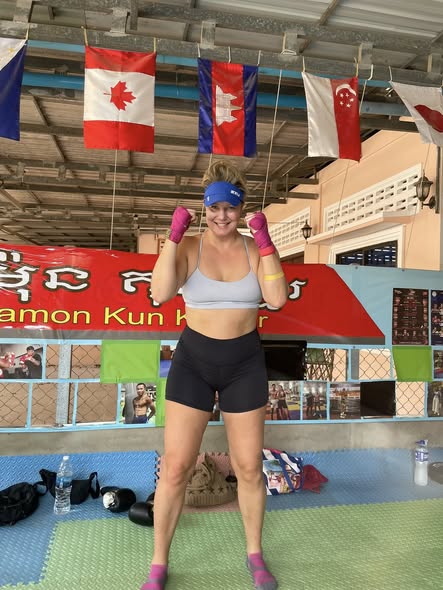
The same kit as everyone else, with two practical additions most women appreciate: a well-fitting sports bra, and leggings as a full-length alternative to shorts. Classes are mixed and the pace scales to the individual, so nothing else about the clothing changes for women — long hair goes in a tie, jewelry comes off, and that is the whole difference. First-time female visitors here tend to write about the coaching rather than the kit:
Great coach! Explains everything very well and really takes the time for you! The classes are also a good combination of cardio, strength, and technique, where you learn a lot right from lesson 1!
The fuller picture — mixed classes, pace scaling, and safety — is in whether Kun Khmer is good for women beginners.
How Does Siem Reap's Heat Change What You Wear?
Cambodia's heat is the one factor that should genuinely change your packing: light colors, light fabrics, and more water than feels reasonable. Siem Reap sits in Cambodia's tropical savanna zone, where temperatures stay fairly uniform year-round around a 25 °C annual mean, days above 32 °C are common, and relative humidity is high all year, usually exceeding 90%. The CDC notes that people who exercise on hot days are more likely to become dehydrated and get heat-related illness, and lists clothing choice among its practical prevention steps alongside scheduling workouts at cooler times, pacing activity, and staying hydrated (CDC — Heat and Athletes). The same CDC guidance names muscle cramping as an early sign of heat-related illness and tells anyone feeling faint or weak to stop all activity and get to a cool place — in class, that means telling the coach and sitting out a round, not pushing through.
Heat-driven packing swaps for training in Siem Reap
| Skip this | Pack this instead | Why |
|---|---|---|
| Heavy cotton layers | Moisture-wicking fabric | Dries far faster in year-round humidity |
| Dark colors | Light colors | Cooler on the walk to and from class |
| Long sleeves | Short sleeves | The session is indoors — sun protection matters on the walk, not on the mats |
| Nothing spare | A dry shirt in your bag | Sweat-soaked cotton goes cold on the evening walk home |
Timing helps too — the daily class starts at 5:00 PM, and the best time of day to train in Siem Reap explains why mornings and midday differ. Heat is also a safety question, not just a comfort one, and whether Kun Khmer is safe for beginners answers it beyond the clothing angle.
How Much Water Should You Bring to Class?
More than you think: arrive already hydrated, sip through the session, and rehydrate after — in this climate the bottle you finish is the minimum, not the target. Hydration sits among the CDC's core prevention steps for exercising in heat, alongside pacing and monitoring how you feel, and Siem Reap's humidity means you will sweat through a session that would feel easy back home (CDC — Heat and Athletes). Buy bottled water on the way in — it costs a fraction of the class itself.
- Drink water in the hour before class — arrive hydrated, not catching up
- Bring a full large bottle to the mats, within arm's reach
- Sip between rounds rather than gulping everything at the end
- Rehydrate after class and keep drinking through the evening
- Repeat from step one the next day — hydration resets daily in this heat
If the group pace worries you in this heat, private Kun Khmer lessons in Siem Reap let a coach set an entirely individual pace for a first session.
Which Gloves and Hand Wraps Do Beginners Actually Need?
For day one: none of your own — the gym's loaner gloves and coach-fitted wraps are included free, and they are exactly what you should use until you know you are staying. Wraps are the piece worth understanding, because hand wraps protect the hand and wrist against injuries induced by punching, padding the knuckles and supporting the wrist joint — a strip of cloth, fitted correctly, does most of the protective work.
What to buy, and when — the honest timeline
| Item | Day one | Once you're training regularly |
|---|---|---|
| Own gloves | Not needed — loaners are free | Worth buying if training 3+ days a week |
| Hand wraps | Fitted by a coach | Buy your own pair for hygiene |
| Boxing shoes | Never | Never — the sport is barefoot |
| Mouthguard | Not needed for pad work | Worth owning before any sparring |
What the upgrades cost is part of the wider money picture in the Kun Khmer class cost breakdown for Siem Reap, and the sport's other name leads to the same answer in Khmer boxing training for beginners.
What Should You NOT Wear or Bring to Class?
Three things get flagged at the door: hard objects on your hands and wrists, sharp or dangling items on your clothing, and shoes on the mats. Everything else is negotiable — the dress code is "sports clothes you can move in," and nobody is turned away for a plain t-shirt.
- Zippers, buckles, and belts — they scratch pads and training partners
- Rings, necklaces, and watches — jewelry catches during pad work and clinch drills
- Shoes and socks — barefoot on the mats, always
- Heavy layers — you will overheat long before the session ends
- Anything you would mind ruining with sweat — this is a sweat sport end to end
The habits that make a beginner improve fastest — including what to do between sessions — are collected in martial arts training tips.
What Do You Need After Class?
A dry shirt, water, and a plan for the walk home — after-class comfort in Siem Reap is about the sweat, not the sport. A soaked training top goes cold and heavy within minutes in an evening breeze, so the spare shirt in your bag earns its place on the walk back to your guesthouse. The daily class runs at 5:00 PM, which puts the finish line right at dinner time, and the after-class window is when most visitors book their next session — message the coaches on WhatsApp, Telegram, or +855 96 228 8585 if you already know you want one. Buy the water bottle before class, not after; the shops nearest the gym close early.
The single-evening version of all this — arrive, train, leave — is walked through end to end in a one-day Kun Khmer class in Siem Reap.
What Does It Cost to Show Up Dressed Right?
Nothing beyond the pass — clothing you already own and water are the only inputs, and every pass tier includes the gear. That makes the $9 day pass a complete, all-in first session: one class, gloves and wraps fitted by a coach, and nothing else to buy at the door.
Every way in, and what you need to own for each
| Option | Price | What you bring |
|---|---|---|
| Day pass | $9 | Clothes and water |
| Weekly pass | $69 | Clothes and water |
| Monthly pass | $129 | Clothes, water, your own wraps by now |
| Private 1-on-1 | $25 per hour, per person | Clothes and water |
| 6-week fight camp | $299 | Own gloves and wraps worth buying by week one |
How these tiers compare across town is in affordable martial arts training in Siem Reap, and the biggest tier has its own entry question in whether beginners can join a fight camp in Cambodia.
Trying Kun Khmer for One Day — What's the Minimum Kit?
For a single day-pass class, the minimum kit is three things you are carrying anyway: sports clothes, a water bottle, and your phone for the booking message. Even one class puts real activity on the board — the WHO counts moderate-intensity movement toward the at-least-150-minutes-per-week it recommends for adults, and a striking session clears moderate comfortably. Show up as you are; the gym covers the rest.
- Message ahead on WhatsApp, Telegram, or +855 96 228 8585 — or simply arrive before the 5:00 PM class
- Wear shorts or leggings and a t-shirt; leave your shoes at the door
- Bring a full bottle of water and a small towel
- Let a coach fit your wraps and gloves — included in the $9 day pass
- Pack a dry shirt for after, and decide on a second session from the mats, not the hotel
The no-experience question behind most one-day visits is answered in trying Kun Khmer with no experience; for filling the rest of an itinerary, see things to do in Siem Reap besides Angkor Wat, and for staying active all trip, fitness classes in Siem Reap compares the options.
FAQ
What should I wear to my first Muay Thai class?
The same answer applies to Kun Khmer, Cambodia's version of the sport: light, breathable workout clothes you don't mind sweating through, with nothing on your feet. All striking gear is provided, so there is nothing to buy before your first session.
Do you need to bring your own gear?
No — gloves, hand wraps, and pads are provided free at Kun Khmer Club, and a coach fits your wraps on arrival. You bring only sports clothes, water, and a towel.
Do I need a Muay Thai uniform?
No — there is no uniform in Kun Khmer or any equivalent striking class here. Sports shorts or leggings and a t-shirt are the whole outfit.
Can I wear leggings to Muay Thai class?
Yes — leggings are a common choice and work well, including as a full-length alternative to shorts. Anything stretchy that lets you kick freely is fine.
What shoes do you wear for Muay Thai?
None — Kun Khmer is trained barefoot on the mats and in the ring, so shoes come off at the door. This is standard across ring sports in Southeast Asia.
What gloves should I bring to class?
You don't need to bring any — loaner gloves are included free with every pass. Buy your own pair only once you are training several days a week.
Should I buy my own gloves right away or use gym loaners?
Use the gym loaners first — they're included free and are exactly what day-one training needs. Own gloves become worth buying when you know you are training regularly, not before.
Can I wear a regular cotton T shirt to Muay Thai?
Yes — cotton is acceptable, and plenty of first-timers train in one. A moisture-wicking top is simply more comfortable in Siem Reap's heat and humidity.
Key takeaways
- Wear sports shorts or leggings and a breathable top; training is barefoot on mats, so shoes stay at the door.
- Gloves, hand wraps, and pads are provided free at Kun Khmer Club — nothing to buy before your first class.
- Siem Reap's tropical heat (days above 32 °C are common, humidity usually over 90%) makes light fabrics and extra water the real packing decision.
- A $9 day pass is the complete all-in first session, with weekly ($69), monthly ($129), private ($25/hour/person), and 6-week camp ($299) options beyond it.
- Bring a spare shirt and a towel for after — the daily class runs at 5:00 PM and finishes right at dinner time.
Sources & further reading
- Wikipedia — Kun Khmer — Kun Khmer as a traditional Cambodian combat sport with four strike types (punches, kicks, elbows, knee strikes) plus clinch fighting, and the alternate names Pradal Serey and Khmer boxing (fetch-verified 2026-10-26) — source
- Wikipedia — Hand wrap — Hand wraps protect the hand and wrist against punching injuries, pad the knuckles, support the wrist, and strengthen the metacarpus against fracture (fetch-verified 2026-10-26) — source
- Wikipedia — Geography of Cambodia (Climate) — Cambodia's tropical savanna climate: temperatures fairly uniform around a ~25 °C annual mean, maximums above 32 °C common, and relative humidity high year-round usually exceeding 90% (fetch-verified 2026-10-26) — source
- CDC — Heat and Athletes — People who exercise on hot days are more likely to become dehydrated and get heat-related illness; muscle cramping as an early sign; stop-all-activity advice when faint or weak; prevention via cooler scheduling, pacing, hydration, and clothing choice (fetch-verified 2026-10-26) — source
- WHO — Physical activity fact sheet — WHO recommendation of at least 150 minutes of moderate-intensity physical activity per week for adults (fetch-verified 2026-10-26) — source
- Google Maps — Kun Khmer Club reviews — The verbatim Sanne Van den brink review quote (real review base: 8 reviews at 5.0, per docs/seo-evidence/google-reviews.md:2,7) — source
Reviewed 2026-10-26
Written by the coaches
Kun Khmer Club — Coaches Kon Phanet & Ramon
Head coaches Kon Phanet and Ramon have a combined 50+ professional Kun Khmer fights in Cambodia. We coach beginners, travelers, expats, and fighters at our gym in Siem Reap.
Ready to train in Siem Reap?
Drop in for a $9 day pass — the group class starts at 5:00 PM every day, and all gear is provided. Message us for today’s times.