
I Don't Want to Get Hit. Is Kun Khmer Contact?
No — if you don't want to get hit, a beginner Kun Khmer class is pads, bags, and technique: nobody hits you and you never hit a person. Sparring comes later, and only if you ask for it.
On this page
- Is Kun Khmer a Contact Workout?
- Will You Get Hit in a Beginner Class?
- Will You Have to Hit Anyone?
- What Contact Actually Happens in Your First Class?
- Why Is the Sport Called Full Contact if the Class Isn't?
- Where Does the Only Real Contact in a Session Come From?
- Does Sparring Ever Happen — and Who Decides?
- What if You Have Never Done Any Martial Art Before?
- Will You Hurt Yourself Hitting Pads for the First Time?
- What if You Have an Injury or Medical Condition?
- Is This Different From a Self-Defense Class?
- What Do First-Timers Who Feared the Same Thing Say?
- What Should You Do Tonight if You're Still Nervous?
- Ready to Try a Class Where Nobody Hits You?
If you don't want to get hit, the short answer to 'is Kun Khmer a contact workout?' is no at beginner level — the class is pads, bags, and technique, where you are never hit and never asked to hit a person. The $9 day pass buys a spot in the daily 5:00 PM class, where a coach holds the pads and your gloves do the hitting. Real sparring exists far down Kun Khmer's road — optional, coach-gated, and only ever if you ask for it.
Is Kun Khmer a Contact Workout?
Yes and no, and the split is the whole answer: Kun Khmer the sport is a full-contact ring fight, while a Kun Khmer class for beginners is a striking workout where contact happens between your gloves and a coach's pads. Wikipedia classifies Kun Khmer as a full-contact combat sport — that describes the professional ring, where the rules of the sport govern two trained fighters. A beginner class borrows the sport's technique without its objective: you are learning to strike, not being struck. What Kun Khmer actually is explains the sport in full, and the table below is the one-glance version of the distinction this page unpacks.
Contact, by setting — the sport vs. your first class
| Setting | What happens | Do you get hit? |
|---|---|---|
| Professional ring fight | Full contact under the official rules — five 3-minute rounds, referee, judges | Yes — that is the sport's top level |
| Sparring (optional, much later) | Controlled partner work, coach-gated, only if you ask | Light and controlled by design |
| Beginner class (this gym) | Pads, bags, and technique — a coach holds the pads | No — nobody hits you and you hit nobody |
Will You Get Hit in a Beginner Class?
No — a beginner striking class is built so the pads take every hit in the room, and ours is no exception. First sessions focus on stance, technique, and pad work, not sparring, and the fear behind the question is common enough that Thai gyms answer it in writing: Chonburi Muay Thai's FAQ carries this exact question and replies that "most drills are taught with contact made either to Thai pads or your partner's gloves" under coach-set rules. At our gym the pad is held by a coach the whole time, so the only impact on the mats is yours. What a beginner class covers walks the session end to end, and how safe Kun Khmer is for beginners takes the broader safety picture.
- The pads: a coach holds them; you strike the pads, and the coach strikes nothing
- The bag: heavy-bag rounds hit padding, not people
- Your body: the only things touching you are your own wraps and gloves
- Other students: the class is mixed-level and everyone drills their own work — beginners are not paired off to fight
Will You Have to Hit Anyone?
No — the reverse fear gets the same answer, because in a beginner session there is no person at the end of your punches. Targets are pads and bags; partners, where they appear at all in early training, are for cooperative drills, and nobody is asked to strike another student. Fundamentals are taught from scratch with no sparring for beginners, so the person you are competing against in month one is your own stance. Trying Kun Khmer with no experience answers the zero-experience question in full, and what a single class looks like end to end shows how little one evening asks of you.
The only thing you hit is a pad
At this gym the coach holds the pads and you throw the strikes — nobody hits you, and no session ever springs partner contact on you. The gentlest possible start costs one $9 day pass: see the published prices.
What Contact Actually Happens in Your First Class?
The honest inventory is short: your wrapped hands in your gloves, your gloves on the coach's pads, your feet on the mats, and sweat — every bit of it either self-inflicted or absorbed by foam. The session arc runs about 60–90 minutes and moves through hand-wrapping, a warm-up, technique drills, pad work with a coach, and conditioning, which is why knowing what to bring to your first class and how a drop-in martial arts class works covers all the logistics in one read. The steps below are that arc with the contact level of each stage named.
- Arrive about 15 minutes before 5:00 PM — check in and pay the $9 day pass
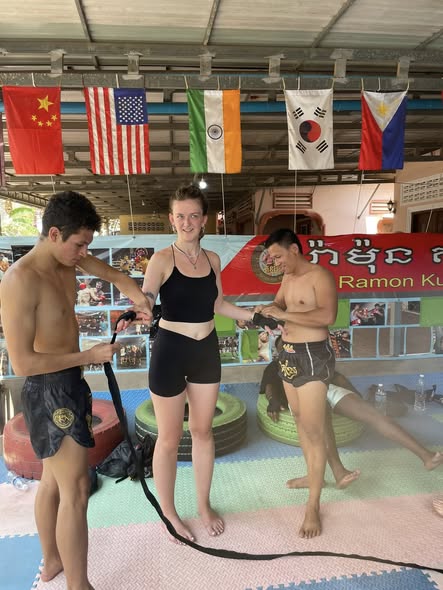
- A coach fits your hand wraps — the first contact of the night is fabric on your knuckles
- Group warm-up — footwork and mobility, all on your own square meter
- Technique drills — stance, guard, and basic strikes thrown in the air
- Pad rounds — you strike the pads the coach holds, at the pace the coach sets for you
- Conditioning and cooldown — bodyweight work to finish, done in about 60–90 minutes total
Why Is the Sport Called Full Contact if the Class Isn't?
Because the label describes the ring, and the ring is not where beginners train — the confusion is between a sport's elite end and its entry point. Here is the sport's own Wikipedia description: "The sport consists of stand up striking and clinch fighting, where the objective is to knock an opponent out, force a technical knockout, or win a match by points." Knockouts, referees, and five 3-minute rounds belong to professionals with years of pad work behind them — the same years our head coaches Kon Phanet and Ramon represent with their 50+ combined professional fights. How Kun Khmer compares with Muay Thai covers the regional rules differences; the class-level difference is simpler: no opponent, no objective beyond your own technique.
The sport consists of stand up striking and clinch fighting, where the objective is to knock an opponent out, force a technical knockout, or win a match by points.
Where Does the Only Real Contact in a Session Come From?
From your own gloves, and later — if you choose — from the clinch, which is the part of the sport that gets taught last for exactly this reason. Glove-on-pad impact is the daily "contact" of a striking class, absorbed by the pads and controlled by you; shared mats and sweat are the honest contact of any gym in any city. The clinch does exist in Kun Khmer, and how the clinch is actually taught matters here: fundamentals are introduced only once stance and striking basics are solid, as a mid-stage skill, not a day-one one. Until then the closest thing to equipment shopping is reading the beginner gear guide — which you do not need before day one, because gear is provided.
- Glove-on-pad impact — the main contact of every session, absorbed by pads, paced by the coach
- Your own wraps and gloves — the only gear touching you
- Shared mats and sweat — the universal gym contact, nobody's punches included
- The clinch — real in the sport, but taught mid-stage with cooperative drills, long after day one
Does Sparring Ever Happen — and Who Decides?
It can — and the decision is yours, gated by your fundamentals rather than by a schedule. Sparring only comes later, once stance, guard, and control are in place, and skipping it entirely for as long as you want is explicitly fine: it is never mandatory for beginners. You would know well in advance, because it is the kind of thing you ask for — the full sparring guide covers how it starts, what gear it needs, and how to say yes on your own timeline. Other gyms frame it the same way from the student side: Fitkoh in Thailand lists "Optional sparring or clinching" as a possible class ending and tells nervous newcomers that it is completely optional. The on-ramp, as our coaches run it, is the table below.
The sparring on-ramp — gated by fundamentals, opened by you
| Stage | What you are doing | Any sparring? |
|---|---|---|
| Day one | Stance, guard, pad work with a coach | No |
| First weeks | Combinations, bags, conditioning | No |
| Once stance, guard, and control are solid | Coach-gated introduction — only if you ask | Optional and controlled |
| Never | Pad work forever is a complete practice | No — never mandatory |
What if You Have Never Done Any Martial Art Before?
Then you are the routine customer, not an exception the class needs to accommodate — tourists, expats, and locals with zero striking background share the same 5:00 PM session. The gym's own reviews make the point better than this page can: the listing holds a 5.0 rating from 8 reviews (our Google reviews), including one from a reviewer whose first class here was the first martial art of their life. Kun Khmer for women beginners answers the same question with the gender angle, and training Kun Khmer as a tourist covers the visiting-beginner case specifically.
A reviewer's very first martial art, in their words
"Was the first time in my life to do any type of boxing or martial arts - will definetely do it again" (Manuel Jungwirth, Google review, 2026-10-03). Quote verbatim from the listing, including the typo.
Will You Hurt Yourself Hitting Pads for the First Time?
The realistic answer is sore muscles, not injuries — your hands are wrapped and gloved before you hit anything, the pads absorb the impact, and a coach sets your pace from the first round. Technique-first training is the whole point of the early weeks, and it is why other gyms answer this exact question with "injuries should be minimal when employing what is taught". The habits that keep it that way — pacing, form before power, honest rest — are the ordinary substance of martial arts training tips.
- Wraps and gloves go on before any striking — no bare-knuckle anything, ever
- Pads absorb impact — your knuckles meet foam, not bone
- The coach sets your pace — power comes after form, not before
- Soreness is normal on day two; sharp pain is a stop-and-tell-the-coach signal
What if You Have an Injury or Medical Condition?
Message the coaches before you come and describe it — that single WhatsApp message is the entire process, because sessions are scaled to the individual and private lessons exist for exactly this kind of situation. Coaches adjust pace and correction per person in every class, and can older beginners start Kun Khmer shows how far that scaling reaches. For anything medical, your doctor's advice comes first and the coaches work around it; if you want a session built entirely around your constraints, private Kun Khmer lessons are available by arrangement.
Tell the coaches first
Message +855 96 228 8585, describe the injury, and come to the answer before the class — pace and drills are adjusted per person, and one-on-one sessions ($25 per hour) are available by arrangement.
Is This Different From a Self-Defense Class?
In format, yes; in the promise you care about, no — and the searchers asking this question are usually comparing the two for the same reason: they want a striking workout without being anyone's target. Self-defense classes typically train scenario escapes; self-defense martial arts maps how striking arts like Kun Khmer feed that goal through fitness, composure, and fundamentals. A beginner Kun Khmer class delivers the workout and the skill-building with the same no-contact rule a self-defense class would have — nobody is hit in either room. Where the two paths diverge, and which martial arts classes in Siem Reap suit which goal, is covered in martial arts classes in Siem Reap.
- Self-defense classes: scenario-based training — escapes, awareness, de-escalation
- Kun Khmer class: a sport's striking system — stance, punches, kicks, knees, elbows, learned on pads
- Shared rule: zero person-to-person contact at beginner level in both
- The overlap: fitness, reflexes, and composure — the raw material of self-defense, built without being hit
What Do First-Timers Who Feared the Same Thing Say?
They say the class was the best part of their trip — the pattern across the gym's reviews is first-timers surprised by how quickly the fear became irrelevant. One reviewer called it "Really good coach, what a pleasure for a first session of Kun Khmer" (Hamari Camara, Google review, 2026-09-12), and another wrote of a trial class: "He explained all the basic techniques for our first class, it was awesome!" (Margaux, Google review, 2026-09-26). The room is mixed — Kun Khmer classes for locals and expats describes who trains alongside you — and the gym is easy to reach on a Siem Reap evening, as finding a Kun Khmer gym near you covers.
Really good coach, what a pleasure for a first session of Kun Khmer. I recommand it
What Should You Do Tonight if You're Still Nervous?
Do the smallest version of the thing: send one message, pack one bag, and let tomorrow's class stay small in your head. The nerves are so universal that entire forum threads exist for them — "Terrified to start Muay Thai" is a real thread title, and first-class nerves are among the most repeated question patterns in the communities we surveyed. If part of the nerves is not knowing whether a gym will treat beginners well, how to know if a martial arts gym is good gives you the checklist, and the best gyms in Siem Reap, ranked lets you compare before you commit a single evening. Then run the five steps below.
- Message the coaches on WhatsApp (+855 96 228 8585) — say it is your first class, so a coach knows to expect you
- Pack the three-item bag: sports clothes, water, a small towel
- Eat light, one to two hours before the 5:00 PM class
- Arrive around 4:45 PM — wraps fitted, a quick word about your level, warm-up at 5:00 PM
- Decide afterward — one $9 day pass, no contract, nothing to cancel
Ready to Try a Class Where Nobody Hits You?
Then the logistics are deliberately boring: one $9 day pass at the door, the daily 5:00 PM class, gear provided, no booking system and no contract — and the full beginner-training hub collects every other first-timer question if you want more reassurance first. If money is the next question after fear, the full cost breakdown shows every tier against how long you are staying. One evening is the entire experiment — and the reviewer who ran it as their first-ever martial art wrote that they will "definetely do it again".
Book a beginner-friendly Kun Khmer class in Siem Reap
The full answer to 'will I get hit?' is one evening long: see the full price card — $9 day pass, $69 weekly, $129 monthly, $25 per hour private, $299 6-week fight camp — message the coaches on WhatsApp (+855 96 228 8585), and join the daily 5:00 PM class.
FAQ
I don't want to get hit. Is this a contact workout?
Not at beginner level. A first class here is stance, technique, and pad work with a coach holding the pads — you are never hit and never asked to hit a person. Sparring exists only much later as an option you would have to ask for, and staying on pads permanently is a completely normal way to train.
Is sparring included in Muay Thai classes?
Policies differ by gym. Fitkoh, a Thai gym, ends some classes with optional sparring and tells newcomers it is completely optional; at our gym, sparring is not part of beginner classes at all — first sessions are stance, technique, and pads. If sparring ever enters your training here, it is because you asked for it once your fundamentals were solid.
What if I have never done muay Thai or any type of martial art?
That is the normal starting point here, not an edge case. Fundamentals are taught from scratch, the class is mixed-level, and total beginners share the same daily 5:00 PM session as everyone else. One reviewer's first-ever martial arts experience here: "Was the first time in my life to do any type of boxing or martial arts - will definetely do it again" (Manuel Jungwirth, Google review, 2026-10-03).
I've never hit anything before. Will I hurt myself?
Your hands are wrapped and gloved before you hit anything, the pads absorb the impact, and a coach sets your pace from the first round — power comes after form. Technique-first training is exactly why other gyms answer the same question by noting that injuries should be minimal when proper technique is employed. Expect sore muscles the next day, not injuries.
What if I have an injury or medical condition?
Message the coaches first on WhatsApp (+855 96 228 8585) and describe it — sessions are scaled to the individual, and private one-on-one lessons ($25 per hour) are available by arrangement if you want a pace built entirely around you. For anything medical, your doctor's advice comes first; the coaches' job is adjusting the training around it.
When can i start sparring or join the competition team?
Only when your stance, guard, and control are solid, and only if you ask — nobody is drafted into sparring here. The documented path toward fighting is the 6-week fight camp ($299), and even that paces a true beginner away from hard sparring in week one. Pad work forever is equally respected as a complete practice.
I'm new to Muay Thai – will I be okay?
Yes — mixed-level classes are the norm here, and the coaches are used to walking someone through their very first jab from a dead stop. Beginners, tourists, expats, and locals train side by side in the same 5:00 PM class. The gym's rating is 5.0 from 8 reviews, including several reviewers describing their very first session.
Key takeaways
- A beginner Kun Khmer class is not a contact workout: pads, bags, and technique only — you are never hit and never asked to hit a person.
- The full-contact label belongs to the professional ring — five 3-minute rounds under the official rules — not to the 5:00 PM class where a coach holds every pad you strike.
- Sparring is never required, never sprung on you, and starts only once stance, guard, and control are solid, if you ask; opting out forever is fine.
- Total beginners are the routine customer: the gym holds 5.0 from 8 reviews, including a reviewer whose class here was the first martial art of their life.
- One $9 day pass, daily at 5:00 PM, about 60–90 minutes, gear provided — message +855 96 228 8585 or just walk in.
Sources & further reading
- Chonburi Muay Thai — FAQ — The verbatim PAA question ("I don't want to get hit. Is this a contact workout?") and the cross-gym answers quoted for comparison: "most drills are taught with contact made either to Thai pads or your partner's gloves" and "injuries should be minimal when employing what is taught" (live-fetched 2026-10-26; cited as another gym's published guidance, not ours). — source
- Fitkoh — FAQ — Sparring-optional framing at another gym: class structure lists "Optional sparring or clinching" and the newcomer answer states "you're welcome to join if you're ready, but it's completely optional!" (live-fetched 2026-10-26; cited as another gym's published guidance, not ours). — source
- Wikipedia — Kun Khmer — The sport-vs-class distinction: Kun Khmer classified as a full-contact combat sport of stand-up striking and clinch fighting, five 3-minute professional rounds, and the quoted description "The sport consists of stand up striking and clinch fighting, where the objective is to knock an opponent out, force a technical knockout, or win a match by points." (live-fetched 2026-10-26). — source
- Google Maps — Kun Khmer Club reviews — 5.0 rating from 8 reviews; the Manuel Jungwirth (2026-10-03), Hamari Camara (2026-09-12), and Margaux (2026-09-26) reviews quoted verbatim with author and date (evidence pulled 2026-10-25, docs/seo-evidence/google-reviews.md). — source
- Reddit — r/MuayThai, "Terrified to start Muay Thai" — Fear of starting as a real, repeated question pattern (thread title; docs/seo-evidence/phase1-community.md row 29, cluster E with 9 sightings — title-level evidence only, per that doc's method note). — source
- Kun Khmer Club — published prices, schedule, and contact — First-party basis of every figure: $9 day pass (plus $69 / $129 / $25 per hour / $299 tiers), the daily 5:00 PM class, gear provided, privates by arrangement, and the WhatsApp contact +855 96 228 8585 (lib/business.ts). No-contact beginner claims per lib/blogContent/booking.ts:417, commercial.ts:71/123/369/398, authority.ts:105/156, wellness.ts:111/199/651, local.ts:323-327. Payment method is deliberately not stated — not published first-party. — source
Reviewed 2026-10-26
Written by the coaches
Kun Khmer Club — Coaches Kon Phanet & Ramon
Head coaches Kon Phanet and Ramon have a combined 50+ professional Kun Khmer fights in Cambodia. We coach beginners, travelers, expats, and fighters at our gym in Siem Reap.
Ready to train in Siem Reap?
Drop in for a $9 day pass — the group class starts at 5:00 PM every day, and all gear is provided. Message us for today’s times.