
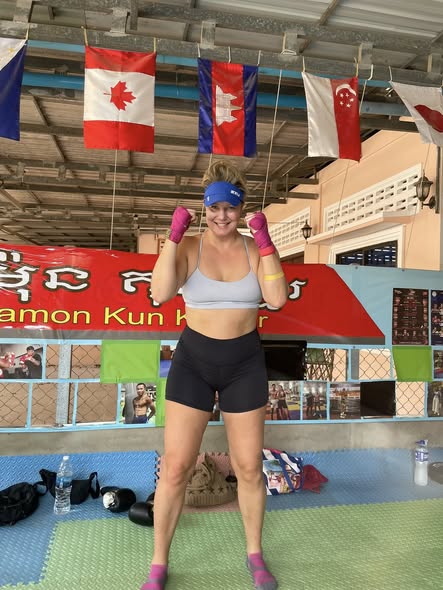
What Is Cambodia Boxing? Sport, Scene, and Stars
Cambodia boxing is Kun Khmer — Cambodia's national ring sport of punches, kicks, knees, and elbows, televised live weekly on TV5, CTN, and Bayon. This guide covers the rules, the famous fighters, the televised fight scene, and how visitors can train it in Siem Reap from a $9 day pass.
On this page
- What Is Cambodia Boxing?
- What Names Does Cambodia Boxing Go By?
- How Is a Cambodia Boxing Match Fought and Won?
- What Makes Cambodia Boxing's Style Distinctive?
- How Old Is Cambodia Boxing — and How Did It Survive?
- Who Are Cambodia Boxing's Most Famous Fighters?
- Where Does the Fight Scene Air: TV5, CTN, and Bayon?
- How Big Is Cambodia Boxing Today?
- Why Did the 2023 SEA Games Become a Naming Battle?
- Can You Watch Cambodia Boxing Live in Siem Reap?
- How Can a Visitor Train Cambodia Boxing in Siem Reap?
- Is Cambodia Boxing the Same as Muay Thai?
- What Should You Expect in Your First Class?
- Where Do You Go From Here?
Cambodia boxing is Kun Khmer — Cambodia's national ring sport, also called Pradal Serey, Khmer boxing, or Cambodian boxing — fought with punches, kicks, knees, and elbows across five three-minute rounds in a 6.1-meter square ring. The fight scene is genuinely national: TV5, CTN, Bayon TV, TV3, and Apsara TV screen live tournaments across the week, and stars such as Eh Phouthong, Thun Sophea, and Keo Rumchong built the sport's fame on that screen. Visitors do not have to stay in the stands: a beginner-friendly daily class in Siem Reap starts from a $9 day pass, with all gear provided.
What Is Cambodia Boxing?
Cambodia boxing is the English name for Kun Khmer, a full-contact stand-up ring sport built on four types of strikes — punches, kicks, elbows, and knee strikes — plus clinch fighting, where the objective is to knock an opponent out, force a technical knockout, or win on points (per Wikipedia's Kun Khmer entry). A Siem Reap attraction listing for the sport describes it bluntly as "Cambodia's national sport". It is a sport, not a rehearsal: matches are contested, judged, and sanctioned, which is what separates it from Cambodia's older ceremonial arts. If the name "Kun Khmer" itself is new to you, what Kun Khmer is gives the one-page definition; this page is the sport-and-scene overview on top of it.
- What it is: a full-contact ring sport — punches, kicks, knees, elbows, and a live clinch
- Where it lives: Cambodia, fought nationwide and televised weekly
- How it is decided: knockout, technical knockout, or judges' points
- Who runs it: the Cambodian Boxing Federation licenses the sport's referees, judges, and fighters
What Names Does Cambodia Boxing Go By?
At least four names point at this one sport. Wikipedia's entry lists the alternates as "Pradal, Pradal Serey, Khmer boxing, Cambodian boxing," gives the official Khmer name as Kbach Kun Pradal Khmer, and translates the older name Pradal Serey literally as "free fighting." In practice the split is generational and official: Pradal Serey is the older, French-era label, Kun Khmer is the name the government and tourism bodies promote today, and travelers use "Cambodia boxing" or "Khmer boxing" as the English shorthand — one longtime commenter even framed it as a correction: "Don't call it Muay Thai in Cambodia. It's called Pradal Serey or Kun Khmer here." (community-reported wording, recorded in docs/seo-evidence/phase1-community.md). Kun Khmer vs Pradal Serey untangles the naming history in full.
One sport, several names
| Name | What it is |
|---|---|
| Kun Khmer | The modern promoted name — "Khmer art/boxing" — used by government and tourism today |
| Pradal Serey | The older French-era name, literally "free fighting" |
| Khmer boxing / Cambodian boxing | The English shorthand travelers use |
| Kbach Kun Pradal Khmer | The sport's official name in Khmer, per Wikipedia |
How Is a Cambodia Boxing Match Fought and Won?
A match is five three-minute rounds fought in a 6.1-meter square ring, with a one-and-a-half to two-minute break between rounds; a downed fighter gets a ten-second count, and if nobody finishes the fight, judges' points decide it — with a draw called if the cards are level (all per Wikipedia — Kun Khmer). The sport is administered in Cambodia by the Cambodian Boxing Federation (CBF), formerly the Cambodian Amateur Boxing Federation, under which referees, judges, and fighters are licensed. Fouls are explicit: no biting, no blows to the back, no striking a downed opponent, no holding the ropes, and no blows to the genitals — and the scoring rules police passivity too, since kicking a downed opponent or constantly retreating costs a fighter points. The complete rulebook is unpacked in how Kun Khmer's rules work, and the divisions fighters compete in are laid out in Kun Khmer weight classes.
- Five three-minute rounds, 6.1-meter square ring, 1.5–2-minute breaks
- Ten-second count for a downed fighter; knockouts and technical knockouts end it early
- Otherwise judges score it — level cards produce a draw
- Fouls: biting, back-of-the-body blows, downed-opponent strikes, rope-holding, and groin blows are out; retreating constantly loses points
- Referees, judges, and fighters all operate under federation licensing
What Makes Cambodia Boxing's Style Distinctive?
Elbows first — that is the documented signature. Wikipedia states that in Kun Khmer more victories come by way of an elbow technique than any other strike, and that Cambodian fighters tend to utilize more elbow strikes than other martial arts in the region. Around that weapon sit the four strikes, a clinch used to wear the opponent down, and a ceremonial frame every bout carries: the kun kru pre-fight ritual in 17 variations drawn mostly from the Reamker story, honoring the fighter's spirit trainer, fought to live music — sampho drum, sralai klang khek oboe, and chhing — that accelerates as the rounds progress (all per Wikipedia — Kun Khmer). A practitioner who trained both arts in Siem Reap put the contrast the same way: "very similar but Kun Khmer is more elbow oriented" (community-reported; r/MuayThai thread, recorded in docs/seo-evidence/phase1-community.md). Go weapon-by-weapon in the Kun Khmer techniques guide, and phase-by-phase in the Kun Khmer clinch explained.
In Kun Khmer, more victories come by way of an elbow technique than any other strikes.
How Old Is Cambodia Boxing — and How Did It Survive?
The record runs deep and it runs through fire. Wikipedia dates the martial arts of Cambodia to the 1st century AD, depicted in Angkor-period bas-reliefs — archaeologist Phoeung Dara's list ties surviving carvings at Angkor Wat, Bayon, Ta Prohm, Banteay Samre, Preah Khan, and Prei temples to the sport, including a 12th-century Ta Prohm carving of two men clinch fighting with a knee strike and an elbow-strike relief at Angkor Wat (per Wikipedia — Kun Khmer). The ring version was codified under the French administration: matches originally fought in dirt pits with rope-wrapped hands — from 1920 to 1930 it was common for bouts to end in deaths — were given gloves, time limits, rest periods, and prohibited techniques. Then came the near-death: traditional arts including martial arts were banned under the Khmer Rouge, many boxers were executed, worked to death, or fled, and four years of suppression until 1979 nearly ended the sport. The parent art it was codified from is Bokator — Bokator vs Kun Khmer separates the two cleanly, and what Bokator is covers the temple-era system itself.
- 1st century AD — the dating Wikipedia gives Cambodia's martial arts, carved in Angkor-period bas-reliefs
- 12th century — Ta Prohm carving of a clinch and knee strike; elbow relief at Angkor Wat
- Early 20th century — French-era codification: gloves, time limits, rest periods, prohibited techniques after the rope-wrap pit-fight era
- 1975–1979 — Khmer Rouge ban; boxers executed, worked to death, or fled; the sport nearly dies
- 1980s onward — surviving coaches rebuild; the televised era follows
Who Are Cambodia Boxing's Most Famous Fighters?
Three names open every conversation: Eh Phouthong, Thun Sophea, and Keo Rumchong — and Wikipedia's Kun Khmer infobox adds Prom Samnang and Thoeun Theara as the sport's famous practitioners. Eh Phouthong is "the most famous kickboxer from Cambodia," whom the Phnom Penh Post called the greatest Cambodia has produced and the AFP called "Cambodia's Muhammad Ali"; Thun Sophea collected championship belts from three television stations; Keo Rumchong carried the sport onto THAI FIGHT cards abroad. The deepest cut: on August 28, 2008, Vorn Viva and Meas Chantha won ISKA world titles in Phnom Penh — the first time a Cambodian held a kickboxing world title. Records below are published exactly as each fighter's Wikipedia entry lists them; Cambodia's famous Kun Khmer fighters profiles each in depth.
Cambodia boxing's famous names — records exactly as listed on each fighter's Wikipedia entry (fetched October 2026)
| Fighter | Known for (per Wikipedia) | Wikipedia-listed record |
|---|---|---|
| Eh Phouthong | "Most famous kickboxer from Cambodia"; AFP's "Cambodia's Muhammad Ali"; 2009 SEA Games bronze (81 kg western boxing) | 178 wins, 9 losses, 5 draws, 1 no contest |
| Thun Sophea | "Once considered Cambodia's best kickboxer"; TV3 (2000), TV5 (2002), and CTN (2006) champion | 80 wins, 8 losses, 5 draws |
| Keo Rumchong | "Tiger of Battambang"; multiple-time Bayon TV champion (67 kg 2011, Kubota 70 kg 2014); 68 KOs | 160 wins, 13 losses, 4 draws |
| Vorn Viva & Meas Chantha | ISKA Middleweight and Welterweight world titles, Phnom Penh, August 28, 2008 — Cambodia's first | Not listed on the Kun Khmer page |
Where Does the Fight Scene Air: TV5, CTN, and Bayon?
On television — that is what made the scene national. Wikipedia records that Kun Khmer tournaments are screened live across the week: TV5 Cambodia on Friday and Sunday, CTN on Friday, Saturday, and Sunday, Bayon on Saturday and Sunday, TV3 with a single Sunday tournament, and Apsara TV adding a Thursday slot. The small screen also built the stars: in 2008 CTN screened the Kun Khmer Champion reality series, produced by Ma Serey and Aaron Leverton and co-hosted by Ma Serey and "Cambodia's most famous kickboxer," Eh Phouthong, with a second season in 2009 and a third in 2010 co-hosted by Vorn Viva (all per Wikipedia — Kun Khmer). The televised scene and the live one connect on the ground too — the Siem Reap martial arts scene shows how the city fits into it.
- TV5 Cambodia — live tournaments Friday and Sunday
- CTN — live tournaments Friday, Saturday, and Sunday
- Bayon TV — live tournaments Saturday and Sunday
- TV3 — a single Sunday tournament; Apsara TV — a Thursday tournament
- Kun Khmer Champion — the CTN reality series (2008–2010) that made Eh Phouthong and Vorn Viva primetime names
How Big Is Cambodia Boxing Today?
Big enough to be infrastructure, not nostalgia: Wikipedia counts approximately 70 boxing clubs nationwide, records 1,000 registered boxers across 78 martial arts schools in 2011, and notes that as of 2012 more than 50 Kun Khmer fights were held every week in the Phnom Penh region alone, with roughly 17 to 20 weekly programs currently (figures as published on Wikipedia — Kun Khmer). The economics are scaled to the domestic scene rather than international promotion: purses run from about US$25 per fight up to $75, "brand name" fighters can earn over $100 a night, and international broadcast tournaments pay purses of up to $1,000, sometimes higher — one reason top kickboxers can accumulate 200–300 career fights. The local half of that scene, and how visitors fit into classes built for it, is covered in Kun Khmer classes for locals.
- ~70 boxing clubs nationwide (Wikipedia, as published)
- 2011 — 1,000 registered boxers across 78 martial arts schools
- 2012 — over 50 fights every week in the Phnom Penh region; ~17–20 weekly programs currently
- Purses — from ~US$25 up to $75 per fight; over $100 for brand-name fighters; up to $1,000, sometimes higher, for the biggest names
- Career shape — top kickboxers can reach 200–300 fights
Why Did the 2023 SEA Games Become a Naming Battle?
Because the sport's name is a flag. At a 1995 ASEAN meeting Cambodia petitioned — unsuccessfully — to rename the sport "Sovannaphum Boxing" or "SEA Boxing," with Thailand replying that each Southeast Asian country has its own boxing style; in 2005 Cambodia refused to send its team in protest that the Games event was called Muay Thai (per Radio Free Asia). When Phnom Penh hosted the 2023 Southeast Asian Games, Cambodia staged the event under its own name — Kun Khmer — and Thai athletes decided not to take part under it, while insisting it "was not a boycott," as the South China Morning Post reported. The compromise that lets everyone compete is quoted below. The full naming politics run in Pradal Serey vs Muay Thai.
When competing in Cambodia, we call it Kun Khmer; when competing in Thailand, we call it Muay Thai…
Can You Watch Cambodia Boxing Live in Siem Reap?
Yes — Siem Reap has both a stadium history and a champion pedigree. The CTN Angkor Arena ran weekly Kun Khmer fight nights, with Tripadvisor reviewers reporting tickets around $15 — "The tickets cost $15, you can get them ahead of time in town or buy them at the arena," one wrote, and another called it "a little pricey at $15 for just over an hour" (community-reported; reviews archived via a 2015 snapshot of the CTN Angkor Arena listing, with the same archive noting "3 nights a week it's a show, 3 it's real"). The shorter tourist-format option was recorded at "$10 per person" for "about 45-60 minutes" at the Khmer Kickboxing show listing (reviewer, Sep 2015). The city has hosted the sport's biggest stage too: Wikipedia records the 5th Kun Khmer World Championship in Siem Reap, with Cambodia finishing first ahead of Kyrgyzstan, Afghanistan, Russia, and France. For tonight's options, where to find Kun Khmer near you and things to do in Siem Reap besides Angkor Wat both cover fight nights.
Ways to watch Cambodia boxing in Siem Reap (figures community-reported or archived, as labeled)
| Where | What you get | Cost |
|---|---|---|
| CTN Angkor Arena | Weekly Kun Khmer fight nights; archived review: "3 nights a week it's a show, 3 it's real" | ~$15 entry (community-reported) |
| Khmer Kickboxing show, Angkor Arena | 45–60-minute spectator event (2015 review) | $10 per person (community-reported) |
| TV5, CTN, Bayon, TV3, Apsara TV | Live tournaments screened weekly | Free-to-air |
| The ring itself, 5:00 PM daily | The sport coached from the inside, gear included | $9 day pass |
How Can a Visitor Train Cambodia Boxing in Siem Reap?
Straightforwardly — the sport is taught to visitors daily, and you can start with one class. Tourists train alongside locals at our gym: the group class runs at 5:00 PM every day, takes total beginners, and provides gloves, wraps, and pads, under head coaches Kon Phanet and Ramon, who bring a combined 50+ professional Kun Khmer fights in Cambodia (per our published prices and schedule; see also can tourists train Kun Khmer in Siem Reap). The ladder from single session to fight camp is short, and every rung is priced publicly — a one-day Kun Khmer class shows what the first rung feels like, and what a Kun Khmer class costs in Siem Reap breaks the numbers down against the current live price list.
- $9 day pass — the daily 5:00 PM group class, gear included
- $69 weekly pass — a week of consistent training
- $129 monthly training — the long-weekend-to-month-long stay
- $25 private session — per hour, per person, by arrangement with the coaches
- $299 6-week fight camp — the structured path for committed students
Is Cambodia Boxing the Same as Muay Thai?
No — close cousins, not the same sport. Both are stand-up striking arts that use the eight weapons and a live clinch (in Muay Thai, "the Art of Eight Limbs," the fighters are not separated when they clinch, per Wikipedia — Muay Thai); Kun Khmer's documented difference is the elbow-heavy finishing pattern and its own federation, name, ritual, and calendar — including its own SEA Games event since 2023. The dimension table keeps the comparison fair, the full breakdown lives in the Kun Khmer vs Muay Thai comparison, and if you came here asking about gloves-on "kickboxing" as a category, is Kun Khmer the same as kickboxing settles the umbrella-term question. This page is the scene-and-sport overview; for a technique-first introduction to the Cambodian style, Cambodian kickboxing: the techniques walks the weapons one by one.
Cambodia boxing (Kun Khmer) vs Muay Thai — the load-bearing differences
| Dimension | Kun Khmer (Cambodia boxing) | Muay Thai |
|---|---|---|
| Identity | Cambodia's national ring sport, per its own listing and federation | Thailand's Art of Eight Limbs |
| Signature | Elbows finish more fights than any other strike (Wikipedia) | Technical kicking and clinch craft |
| Stage | Weekly live tournaments on TV5, CTN, Bayon, TV3, Apsara TV | The region's globally established circuit |
| Ritual | Kun kru — 17 variations honoring the spirit trainer | Wai khru ram muay — saluting the teacher |
| Rules reality | 5 × 3-minute rounds, 6.1 m ring, judged points | Same eight weapons; clinch stays live |
What Should You Expect in Your First Class?
A structured, beginner-safe session — not a tryout. You show up in sports clothes; gloves, hand wraps, and pads are provided; the class opens with a warm-up and shadowwork, moves through pad drills on the four weapons, and finishes with conditioning, and there is no day-one sparring — live contact enters later, staged and supervised, once your fundamentals are consistent (first-party practice at our gym; see sparring in Kun Khmer for when that switch happens). Expect to be sore in new places the next day and to be treated as a guest, not a prospect. Pack list and etiquette are in what to bring to your first class, and the full structure of a coached beginner progression is in beginner Kun Khmer classes.
- Arrive in sports clothes — everything that hits something is provided
- Warm-up, technique, pad work on punches, kicks, knees, elbows, then conditioning
- No sparring on day one — contact is staged under coach supervision
- Daily 5:00 PM start; total beginners welcome every day
Where Do You Go From Here?
Three paths, in increasing commitment: watch the scene live (fight nights, or the daily class from the inside at $9), train for a stretch (a week or a month on the published prices), or commit to the 6-week fight camp at $299 — beginners are welcome on that last rung too. If the trip is still on paper, how to plan a Kun Khmer training trip assembles the whole itinerary, and the older layers beneath the ring sport — the temple-carved arts in the kbach kun boran family — are the deep end of the same tradition. Every guide in this cluster lives in the Kun Khmer culture hub.
Start this week
The daily group class runs at 5:00 PM, takes total beginners, and provides all gear — a $9 day pass covers the first session, and private sessions at $25 per hour per person are available by arrangement with the coaches.
FAQ
Is Kun Khmer the same as Muay Thai?
No — they are close cousins, not the same sport. Both use punches, kicks, knees, elbows, and a live clinch, but Kun Khmer is Cambodia's ring sport with its own federation, name, ritual, and SEA Games event, and its documented difference is the elbow-heavy finishing pattern: more Kun Khmer victories come by elbow than by any other strike.
What is the difference between Kun Khmer and Muay Thai?
Nation, name, ritual, and emphasis rather than basic toolkit. Kun Khmer opens bouts with the kun kru ritual (17 variations honoring the fighter's spirit trainer), is fought over five three-minute rounds in a 6.1-meter ring, and is televised weekly on TV5, CTN, Bayon, TV3, and Apsara TV. Muay Thai is Thailand's Art of Eight Limbs with its own wai khru ritual and international circuit.
What are the distinctive characteristics of Kun Khmer and Muay Thai?
Kun Khmer's documented characteristics are the four strikes plus clinch, with elbows finishing more fights than any other weapon — Wikipedia notes Cambodian fighters tend to use more elbow strikes than the region's other martial arts. Muay Thai's identity is technical kicking and clinch work inside the eight-limb framework.
Why do Muay Thai and Lethwei have big tournaments but Kun Khmer doesn't?
Because the sport spent 1975 to 1979 nearly destroyed — the Khmer Rouge banned traditional arts and many boxers were executed, worked to death, or fled — so the decades after went into rebuilding a domestic base. Its international milestones are newer: the 2023 SEA Games staged Kun Khmer under its own name, and the 5th Kun Khmer World Championship was held in Siem Reap with Cambodia finishing first.
What is the difference between Muay Thai and Pradal Serey?
Nothing but the name's era and nationality: Pradal Serey — literally "free fighting" — is the older, French-era name for the same Cambodian sport Wikipedia titles Kun Khmer, which also lists "Cambodian boxing" and "Khmer boxing" among its names. The famous fighters in this guide competed under both labels.
Where to watch Khun Khmer in Siem Reap?
Siem Reap's CTN Angkor Arena has run weekly Kun Khmer fight nights, with archived Tripadvisor reviews reporting tickets around $15 (community-reported — confirm on the door), and TV5, CTN, Bayon TV, TV3, and Apsara TV screen live tournaments weekly. A $9 day-pass class at 5:00 PM shows you the sport from inside its techniques.
Where can I watch a fight?
In Siem Reap, ask at the fight gyms and check the weekly schedule at the arenas — archived reviews describe CTN Angkor Arena as running fights several nights a week ("3 nights a week it's a show, 3 it's real"). Short tourist-format fight shows have been recorded at $10 per person for 45–60 minutes (community-reported).
Key takeaways
- Cambodia boxing is Kun Khmer — also Pradal Serey, Khmer boxing, or Cambodian boxing — a full-contact ring sport of punches, kicks, knees, and elbows over five three-minute rounds in a 6.1-meter ring.
- The style's documented signature is the elbow: more victories come by elbow technique than any other strike, and Cambodian fighters use more elbow strikes than the region's other arts.
- The fight scene is televised nationally — TV5 (Fri/Sun), CTN (Fri/Sat/Sun), Bayon (Sat/Sun), TV3 (Sun), and Apsara TV (Thu) — under the Cambodian Boxing Federation.
- Eh Phouthong, Thun Sophea, and Keo Rumchong built the TV-era fame; Vorn Viva and Meas Chantha won Cambodia's first kickboxing world titles in 2008, and Kun Khmer debuted at the 2023 SEA Games under its own name.
- The scene is deep (~70 boxing clubs; 50+ fights weekly in Phnom Penh as of 2012) and open to visitors — train it daily at 5:00 PM in Siem Reap from a $9 day pass, all gear provided.
Sources & further reading
- Wikipedia — Kun Khmer — Alternate names (Pradal, Pradal Serey, Khmer boxing, Cambodian boxing), official name Kbach Kun Pradal Khmer, Pradal Serey lit. "free fighting"; four strikes + clinch, KO/TKO/points; five three-minute rounds, 6.1 m ring, 1.5–2-minute breaks, ten-second count, judges/draw; fouls list including points lost for kicking a downed opponent and constant retreating; elbow-victory claim and regional elbow-tendency claim; kun kru 17 variations (Reamker, spirit trainer); sampho/sralai klang khek/chhing music, "vung phleng pradall", acceleration with rounds; TV schedule (TV5 Fri+Sun, CTN Fri+Sat+Sun, Bayon Sat+Sun, TV3 Sun, Apsara Thu); Cambodian Boxing Federation (CBF, formerly CABF) licensing of referees, judges, and fighters; Khmer Rouge ban 1975–1979 with boxers executed, worked to death, or fled; ~70 boxing clubs; 2011: 1,000 registered boxers/78 schools; 2012: 50+ weekly fights in Phnom Penh region; ~17–20 weekly programs currently; purses US$25–$75, $100+, up to $1,000 sometimes higher; 200–300 career fights; French-era codification after dirt-pit rope-wrap era with 1920–1930 deaths; 1st-century AD dating and Phoeung Dara's temple list (Angkor Wat, Bayon, Ta Prohm, Banteay Samre, Preah Khan, Prei), 12th-century Ta Prohm clinch-and-knee carving, Angkor Wat elbow relief; 1995 naming petition and Thailand's stance, 2005 protest; famous practitioners (Keo Rumchong, Eh Phouthong, Prom Samnang, Thun Sophea, Thoeun Theara); Vorn Viva + Meas Chantha ISKA titles August 28, 2008; Bun Sothea's S1 win before 30,000; 5th Kun Khmer World Championship in Siem Reap (Cambodia first); Kun Khmer Champion series (Ma Serey, Aaron Leverton, Eh Phouthong 2008; Vorn Viva 2009–2010); descent from Bokator; Oumry Ban 1964 first national title and 1987 Long Beach school. Fetched curl-200 (docs/seo-evidence/phase3b1-citations.md:15, phase3b2-citations.md:17, phase3b4-citations.md:31, phase4w1-citations.md:29). — source
- Wikipedia — Eh Phouthong — "He is the most famous kickboxer from Cambodia"; Phnom Penh Post's "greatest kickboxer that Cambodia has ever produced"; AFP's "Cambodia's Muhammad Ali"; born Koh Kong 1975, training at 12, Phnom Penh at 16 under Chhit Sarim at the Ministry of Defence Boxing Club, debut at 17; 2009 SEA Games Vientiane BRONZE in the 81 kg western boxing division; trainer of Thoeun Theara; co-host of CTN's Kun Khmer Champion; record 178-9-5 with 1 no contest. Fetched curl-200 (docs/seo-evidence/phase3b4-citations.md:78-96). — source
- Wikipedia — Thun Sophea — "Thun Sophea was once considered Cambodia's best kickboxer"; born 1979, Svay Rieng; TV3 belt 2000 (def. Nuon Sorya), TV5 belt 2002 (def. Chey Kosal), CTN belt 2006 (def. Meas Chantha); now a pradal serey referee and Ministry of National Defense head coach training 50 students daily; 2011 highest-paid Cambodian athlete at US$30,000 (along with Chhunly Pagenburg); record 80-8-5. Fetched curl-200 (docs/seo-evidence/phase3b4-citations.md:98-110). — source
- Wikipedia — Keo Rumchong — Born Battambang 1988, began Kun Khmer at age five; "Tiger of Battambang"; multiple-time Bayon TV Kun Khmer champion (2011 67 kg, 2014 Kubota 70 kg); THAI FIGHT 2015 and 2018; 2019 MTGP 31 Bataclan Paris title fight; 2023 left off the 81 kg national team in favor of Prom Samnang; assistant coach to Kan Meng Hong; record 160-13-4 with 68 KOs. Fetched curl-200 (docs/seo-evidence/phase3b4-citations.md:112-127). — source
- Wikipedia — Kun Khmer at the 2023 Southeast Asian Games — The sport marked its SEA Games debut in 2023; Thai athletes decided not to take part in the games under the name "Kun Khmer". Fetched curl-200 (docs/seo-evidence/phase3b4-citations.md:35,281-282). — source
- Radio Free Asia — SEA Games Kun Khmer naming dispute — 1995 ASEAN petition to rename the sport "Sovannaphum Boxing" / "SEA Boxing"; 2005 refusal to send a team in protest that the kickboxing event was called Muay Thai; IFMA warning reported January 2023. Fetched curl-200 (docs/seo-evidence/phase3b4-citations.md:54,275-280). — source
- South China Morning Post — Mekong boxing SEA Games — Thai fighters "said they would not take part, while insisting it 'was not a boycott'". Fetched curl-200 (docs/seo-evidence/phase3b4-citations.md:53,273-274). — source
- Wikipedia — Muay Thai — "Art of Eight Limbs" referring to fists, elbows, knees, and shins; "In Western boxing, the two fighters are separated when they clinch; in muay Thai, however, they are not." Fetched curl-200 (docs/seo-evidence/phase3b1-citations.md:17, phase3b3-citations.md:20). — source
- Tripadvisor — Khmer Kickboxing Siem Reap listing — Reviewer robin338, Sep 2015: "IT costs USD$10 per person and the show lasts about 45-60 minutes" (quoted in past tense in body); About text: "CTN opened its brand new Angkor Arena in Siem Reap on the road to Angkor Wat … square ring for five rounds of one of the toughest stand-up contact sports in the world … Kun Khmer is Cambodia's national sport" — the verified basis for the national-sport phrasing. Live 403 to curl, recovered via Exa (docs/seo-evidence/phase3b2-citations.md:42, phase3b3-citations.md:47). — source
- Tripadvisor — CTN Angkor Arena listing (community-reported figures) — Archived (Wayback 2015-12-02) reviewer quotes: "The tickets cost $15, you can get them ahead of time in town or buy them at the arena"; "Although a little pricey at $15 for just over an hour I thought it was great."; "3 nights a week it's a show, 3 it's real" — the basis for the ~$15 entry figure, labeled community-reported wherever used. Live 403 to curl/WebFetch (docs/seo-evidence/phase3b2-citations.md:43, phase3b3-citations.md:48, phase4w1-citations.md:39). — source
- Reddit r/MuayThai — "Muay Thai vs Pradal Serey?" (community-reported) — "very similar but Kun Khmer is more elbow oriented" — title-verified live; comment text not refetchable from the research environment, recorded verbatim in docs/seo-evidence/phase1-community.md:20 and labeled community-reported in body. — source
- Kun Khmer Club — price list and schedule — $9 day pass, $69 weekly pass, $129 monthly training, $25 private session per hour per person, $299 6-week fight camp; group class at 5:00 PM every day with privates and off-schedule times by arrangement; head coaches Kon Phanet and Ramon with a combined 50+ professional Kun Khmer fights in Cambodia (lib/business.ts:18-36). — source
Reviewed 2026-10-26
Written by the coaches
Kun Khmer Club — Coaches Kon Phanet & Ramon
Head coaches Kon Phanet and Ramon have a combined 50+ professional Kun Khmer fights in Cambodia. We coach beginners, travelers, expats, and fighters at our gym in Siem Reap.

Ready to train in Siem Reap?
Drop in for a $9 day pass — the group class starts at 5:00 PM every day, and all gear is provided. Message us for today’s times.