
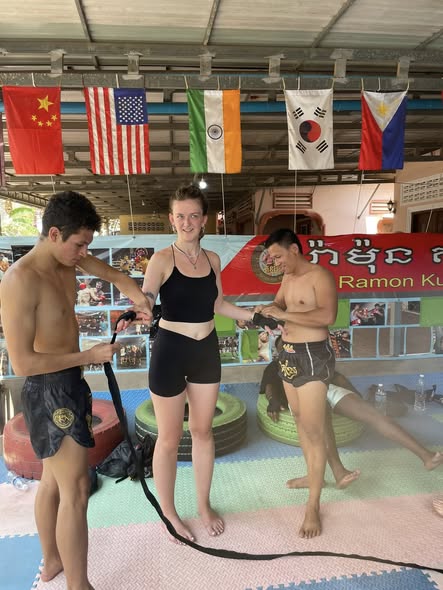
What Is Cambodian Kickboxing? Rules & Training
Cambodian kickboxing is Kun Khmer — Cambodia's full-contact sport of punches, kicks, scored elbows, knees, and clinch over five 3-minute rounds. Here is how its rules differ from Dutch and American kickboxing, and how to train it in Siem Reap for $9.
On this page
- What Is Cambodian Kickboxing, and What Do Locals Call It?
- How Do the Rules Differ From Dutch and American Kickboxing?
- What Strikes Are Legal in the Ring?
- Why Is the Sport Known for Its Elbows?
- What Does the Clinch Actually Do in a Fight?
- What Happens in a Cambodian Kickboxing Fight?
- Where Did Cambodian Kickboxing Come From?
- How Big Is the Sport Inside Cambodia?
- Who Are Cambodia's Most Famous Kickboxers?
- Where to Watch Khun Khmer in Siem Reap?
- Is Cambodian Kickboxing a Good Workout for a Traveler?
- Is It Full Contact — and Is Trying It Safe?
- Can a Beginner Learn Cambodian Kickboxing in Siem Reap?
Cambodian kickboxing is Kun Khmer: Cambodia's full-contact striking sport, fought over five three-minute rounds with punches, kicks, and scored elbow and knee strikes plus live clinch fighting — a wider legal toolkit than American or Dutch kickboxing rules allow. Locals call it Pradal Serey or Khmer boxing; "cambodian kickboxing" is the international label for the same ring sport. You can learn it pads-first in Siem Reap for the price of a $9 day pass at the daily 5:00 PM class.
What Is Cambodian Kickboxing, and What Do Locals Call It?
It is one sport wearing several labels: Wikipedia's entry for Cambodia's kickboxing lists the alternate names "Pradal, Pradal Serey, Khmer boxing, Cambodian boxing" for the same traditional full-contact combat sport. The word "kickboxing" is the umbrella — an umbrella term for different styles of full-contact hybrid boxing, combat sports, and martial arts based on punching and kicking(https://en.wikipedia.org/wiki/Kickboxing) — and Cambodia's branch of that family has its own name, rulebook, and history behind the English description. A Tripadvisor listing for the Siem Reap fight scene puts it plainly in its About text: "Kun Khmer is Cambodia's national sport." What Kun Khmer is explains the sport from the Khmer name inward, the Cambodian boxing page takes the "boxing" label, and Kun Khmer vs Pradal Serey shows why those two names are not different sports.
- Kun Khmer — the sport's Khmer name, lit. "Khmer martial art of boxing"
- Pradal Serey — lit. "free fighting," the French-era name still heard at fight nights
- Khmer boxing — the common English shorthand
- Cambodian boxing / Cambodian kickboxing — the international labels this page explains
How Do the Rules Differ From Dutch and American Kickboxing?
The rules line up on one axis — what strikes are legal — and Cambodian kickboxing sits at the permissive end. American full-contact kickboxing is the strict case: fighters hit each other with punches and kicks above the waist, and elbows and knees are forbidden. Dutch rules, formalized in the Netherlands in the 1970s when Japanese kickboxing and Muay Thai arrived there, prohibit elbow strikes and limit knees to the body, though elbows can be allowed if both fighters agree. Kun Khmer scores all four strike types with no such prohibition — which is the whole difference in one sentence. The head-to-head kickboxing ruleset duel goes deeper on every clause, the full Kun Khmer rulebook covers the ring law itself, and the Siem Reap kickboxing class page shows how a tourist class teaches the shared base.
Dutch vs American kickboxing vs Cambodian kickboxing — the legal-strike table
| Rule | American full-contact | Dutch rules | Kun Khmer |
|---|---|---|---|
| Punches | Allowed | Allowed | Scored core strike |
| Kicks | Allowed above the waist | Allowed | Scored core strike |
| Elbows | Forbidden | Illegal — allowed only if both fighters agree | Scored; the sport's most decisive weapon |
| Knees | Forbidden | To the body only — not the head | Scored strike |
| Rounds | Set by the promotion | Up to 3, three minutes each | Five three-minute rounds |
What Strikes Are Legal in the Ring?
Four strike types, all scored: Kun Khmer consists of punches, kicks, elbows, and knee strikes, fought as stand-up striking and clinch fighting with the objective of a knockout, a technical knockout, or a points win. The kicks carry their own technique notes — the roundhouse generates power from hip rotation rather than snapping the leg, and the straight push kick has its own Khmer name, sniet theak trang. Every weapon on this list is scored in the professional ring — and every one of them is also taught on pads to beginners who will never take a professional bout. How each technique is drilled breaks the four strikes down, and whether the full toolkit holds up under pressure tests it honestly.
- Punches — the boxing base all three rulesets share
- Kicks — roundhouses powered by hip rotation, plus the sniet theak trang push kick
- Elbows — scored in full; the fight-ending weapon that separates this ruleset from Dutch and American kickboxing
- Knees — scored to the body and legs, unrestricted by Dutch-style limits
- Clinch fighting — a live scoring arena rather than a restart
Why Is the Sport Known for Its Elbows?
Because the scoreboard says so: in Kun Khmer, more victories come by way of an elbow technique than any other strikes. The sport is most well known for its kicking and elbows technique, and Cambodian fighters tend to utilize more elbow strikes than other martial arts in the region. Travelers who have trained both sports say the same thing from the gym side — one month-long Siem Reap trainee's review, recorded in a Muay Thai forum thread, described the sport as very similar to Muay Thai but more elbow oriented (community-reported, as forum quotes are). Set that next to the rules table above: where Dutch and American rules price elbows out of the sport entirely, Cambodian kickboxing makes them its main path to victory. How the elbow game is built for beginners starts on pads, not people.
The one-stat summary
More Kun Khmer victories come by way of elbow technique than by any other strike — the decisive weapon that American rules ban outright and Dutch rules permit only by mutual agreement.
What Does the Clinch Actually Do in a Fight?
The clinch is where the elbows and knees land: the clinch is used to wear down the opponent, with both fighters battling for a dominant position rather than being separated by the referee. That makes it a scoring arena — striking range, not a stalemate — and it is why the rules comparison above treats "clench/clinching" as a ruleset decision in itself. Clinch striking is a recognized weapon across the striking arts: it is sometimes called "dirty boxing" and counts as an important aspect of Muay Thai and mixed martial arts, among others. In a beginner class the clinch arrives much later than the pads — how the clinch is actually taught walks the cooperative-drills path, and when sparring enters the picture draws the contact line.
Punching, elbows, and knee strikes in the clinch, also sometimes referred to as 'dirty boxing', are an important aspect of Muay Thai, Bajiquan, Wing Chun, Lethwei and mixed martial arts.
What Happens in a Cambodian Kickboxing Fight?
A professional-boxing format with Khmer furniture around it: five three-minute rounds in a 6.1-meter square ring, with one-and-a-half to two-minute breaks between rounds, a 10-second count for a downed fighter, and judges' points deciding the fights that go the distance — with a draw called if they cannot be separated. Around the fighting sit two rituals no Western kickboxing card has: the pre-fight kun kru, a praying ritual with 17 documented variations, and a live band playing traditional music on sampho drum, sralai oboe, and chhing cymbals — the music of Khmer boxing is called vung phleng pradall, and it accelerates as the rounds progress. Retreating is itself penalized: constantly backing away when the opponent advances costs a fighter points. The complete rulebook lists every clause and foul, and the ring vocabulary translates the rest.
A fight night from drums to decision
| Stage | What happens |
|---|---|
| Pre-fight | The kun kru praying ritual — 17 documented variations, mostly drawing on Reamker characters |
| Live score | A band plays vung phleng pradall on sampho, sralai, and chhing — accelerating each round |
| Rounds | Five three-minute rounds in a 6.1-meter square ring; 1.5–2 minute breaks between |
| Knockdown | A 10-second count on the downed fighter |
| Decision | Knockout, technical knockout, or judges' points — a draw if level |
| Style rule | Constant retreating from the advancing opponent costs points |
Where Did Cambodian Kickboxing Come From?
From one of the oldest fighting traditions on record, rebuilt twice. The root is ancient: martial arts in Cambodia date back to the 1st century AD and appear in the bas-reliefs of the Angkor period, including a 12th-century Ta Prohm carving of two men clinch fighting, and the underlying system — Bokator — is dated to the first century and was inscribed on UNESCO's Intangible Cultural Heritage list in 2022. The modern ring sport arrived with French colonial codification in the early 20th century, when new rules mandated gloves, imposed time limits, instituted rest periods, and prohibited certain techniques to mitigate risks to life. Then came the near-fatal break: traditional martial arts were banned under the Khmer Rouge, many boxers were executed or fled, and the suppression lasted four years until 1979 — the regime held power from 1975 to 1979. The full history of Kun Khmer in Cambodia walks the whole arc, and what Bokator is explains the root system.
- 1st century AD — martial arts depicted in Angkor-period bas-reliefs; Bokator takes root
- Early 1900s — French codification: gloves, time limits, rest periods, prohibited techniques
- 1964 — Oumry Ban holds the sport's first national title, at 61 kilograms
- 1975–1979 — the Khmer Rouge ban nearly kills the tradition; boxers are executed or flee
- 1987 — one of the first overseas schools opens in Cambodia Town, Long Beach
- 2008 — Vorn Viva and Meas Chantha win ISKA world titles, Cambodia's first
- 2022 — UNESCO inscribes Kun Lbokator as Intangible Cultural Heritage of Humanity
How Big Is the Sport Inside Cambodia?
Deep enough to be a weekly habit rather than an event: the sport counts approximately 70 boxing clubs nationwide, had 1,000 registered boxers across 78 martial arts schools as of 2011, and as of 2012 saw over 50 Kun Khmer fights held every week in the Phnom Penh region, across roughly 17 to 20 weekly programs. Television carries it five channels wide — TV5 live on Friday and Sunday, CTN on Friday, Saturday and Sunday, Bayon on Saturday and Sunday, TV3 on Sunday, and Apsara on Thursday. Careers are built on volume — top kickboxers can have as many as 200–300 fights — and purses scale with fame, from about $25 per fight to $75, over $100 for brand names, and up to $1,000 or higher at international broadcast tournaments. Where the weight divisions sit sorts the fight cards, and the fighters who rose through them are profiled in full.
The scale in one paragraph
Per the sport's recorded figures: roughly 70 boxing clubs nationwide; 1,000 registered boxers across 78 schools as of 2011; over 50 fights every week in the Phnom Penh region as of 2012, across 17–20 weekly programs; live tournaments on five TV channels, Thursday through Sunday; careers of up to 200–300 fights; purses from about $25 to $1,000 or higher at the very top.
Who Are Cambodia's Most Famous Kickboxers?
Three record-verified names answer most searches, and one date marks the sport's arrival on the world scene. Eh Phouthong is called the most famous kickboxer from Cambodia — the AFP described him as "Cambodia's Muhammad Ali," and he retired at 178 wins, 9 losses, and 5 draws. Thun Sophea was once considered Cambodia's best kickboxer, taking the TV3 belt in 2000, the TV5 belt in 2002, and the CTN belt in 2006, finishing 80-8-5. Keo Rumchong, the "Tiger of Battambang," built a 160-13-4 record with 68 knockouts and fought in Thailand's THAI FIGHT. And on August 28, 2008, Vorn Viva and Meas Chantha won ISKA middleweight and welterweight world titles in Phnom Penh — the first time Cambodians held kickboxing world titles. The full fighters guide profiles each career in detail.
Record-verified names in Cambodian kickboxing
| Fighter | Verified record | Known for |
|---|---|---|
| Eh Phouthong | 178-9-5 (+1 no contest) | "Cambodia's Muhammad Ali" (AFP); the sport's most famous name |
| Thun Sophea | 80-8-5 | TV3 (2000), TV5 (2002), CTN (2006) belt winner; later a referee and coach |
| Keo Rumchong | 160-13-4, 68 by knockout | Bayon TV champion; THAI FIGHT veteran; "Tiger of Battambang" |
| Vorn Viva & Meas Chantha | ISKA world titles | Cambodia's first kickboxing world titles, August 28, 2008 |
Where to Watch Khun Khmer in Siem Reap?
At the arenas behind the TV schedule, most conveniently CTN Angkor Arena on the road to Angkor Wat. Archived Tripadvisor reviews of the arena record weekly fight nights — "3 nights a week it's a show, 3 it's real" — with tickets at $15, while the listing for Khmer Kickboxing Siem Reap recorded a $10, 45–60 minute event as of 2015 — both figures are reviewer-reported, not posted rates. That is the fastest way to see the full format above — the kun kru, the band, five rounds — in one evening. Finding Kun Khmer fights and gyms near you maps the current options for watching and training in one place.
- CTN Angkor Arena — weekly Kun Khmer fight nights; archived reviews record $15 tickets
- Khmer Kickboxing Siem Reap — a $10, 45–60 minute arena event was recorded there in 2015
- Prices are reviewer-reported, not posted rates — expect to buy at the door or in town
- National TV carries tournaments Friday through Sunday if you would rather watch from a cafe
Is Cambodian Kickboxing a Good Workout for a Traveler?
The sport sits at the top of the standard calories-burned tables: Harvard Health's listing gives martial arts ("judo, karate, kickbox") 300, 360, and 420 calories per 30 minutes for 125-, 155-, and 185-pound people, with boxing sparring at 270, 324, and 378 — estimates, not measurements, but at the high end of common activities. It also clears the public-health bar in one session: the WHO recommends at least 150 minutes of moderate-intensity physical activity per week, notes that 31% of adults worldwide do not meet that level — and a single pad session in a 5:00 PM Siem Reap class covers a third of the weekly target before dinner. For travelers, a $9 day pass makes the estimate testable — the full price card has every tier, and one session settles the arithmetic.
Harvard Health's calories-burned table (per 30 minutes)
| Activity | 125-lb person | 155-lb person | 185-lb person |
|---|---|---|---|
| Martial arts (judo, karate, kickbox) | 300 cal | 360 cal | 420 cal |
| Boxing: sparring | 270 cal | 324 cal | 378 cal |
Is It Full Contact — and Is Trying It Safe?
As a sport, yes — Kun Khmer is listed as full-contact, and its objective includes knocking the opponent out; that is what the professionals on the TV channels are doing. But the sport and the class are different contact levels, and visitors train the class: first sessions run on pads and bags at your own pace, with no sparring, exactly as a beginner class should. The distinction matters enough that what full contact actually means for a visitor workout gets its own page, and how beginner classes keep first-timers safe covers the coaching-side protections.
Professional ring vs. your first class
Full contact describes the professional sport — five scored rounds with elbows and clinch. A beginner class teaches the same techniques on pads, at your pace, with no sparring unless you later ask for it.
Can a Beginner Learn Cambodian Kickboxing in Siem Reap?
Yes, and the on-ramp is deliberately short. First classes at Kun Khmer Club focus on stance, technique, and pad work rather than sparring — the clinch arrives only later, as a mid-stage skill built on solid striking basics, and head coaches Kon Phanet and Ramon hold a combined 50+ professional Kun Khmer fights between them. The entry price is a $9 day pass at the daily 5:00 PM class, $69 covers a full week, and $25 buys a private hour if you want the elbow and clinch mechanics explained one-to-one. What a beginner class actually covers runs a session end to end, how dropping into a class works removes the sign-up friction, and what to bring to your first class packs the bag.
- Walk in or message +855 96 228 8585 — no booking system, no minimum group
- Pay the $9 day pass; wraps and gloves are provided
- 5:00 PM class: stance, punches, and kicks drilled on pads — no sparring
- Watch the coaches demo elbows and knees — the scored weapons, taught on pads
- Come back tomorrow: $69 covers a full week of daily classes
New here? The Kun Khmer culture hub collects the history, technique, and comparison pages around this one, and Kun Khmer vs MMA is the cage-side version of the same rules question this page answered from the ring side.
Book a beginner-friendly Kun Khmer class in Siem Reap
Learn Cambodia's kickboxing pads-first: see the price card — $9 day pass, $69 weekly, $129 monthly, $25 per hour private, $299 6-week fight camp — or message the coaches on WhatsApp (+855 96 228 8585) about the daily 5:00 PM class.
FAQ
Is Cambodian boxing similar to Muay Thai?
Yes — closely. Both score punches, kicks, elbows, and knees with clinch fighting, and the weapon sets cover the same ground. The differences sit around the ring: Kun Khmer carries its own name, pre-fight kun kru ritual, live traditional music, and a history that runs through French codification and a Khmer Rouge-era ban. A month-long Siem Reap trainee's forum comparison put it as "very similar but more elbow oriented" — community-reported, like all forum quotes.
Do they call it Muay Thai in Cambodia?
No — the recurring correction in traveler forums is that the sport here is called Pradal Serey or Kun Khmer, not Muay Thai. "Cambodian kickboxing" is the international umbrella phrasing for the same sport. The distinction is about name and national identity, not a different ruleset.
Where to watch Khun Khmer in Siem Reap?
CTN Angkor Arena on the road to Angkor Wat hosts the fight nights — archived Tripadvisor reviews record weekly cards ("3 nights a week it's a show, 3 it's real") with $15 tickets. A smaller $10, 45–60 minute arena event was also recorded in 2015. Five national TV channels carry live tournaments across the week as well.
Do I need any experience to start?
No — first classes teach from zero: stance, then punches and kicks on pads, with the coach demonstrating each technique before you throw it. Elbows, knees, and clinch enter the program progressively, never on day one, and there is no sparring in beginner classes.
Can beginners drop in?
Yes — a $9 day pass covers a single group class at the daily 5:00 PM session, with no booking system and no minimum group size. Wraps and gloves are provided, so a first visit needs nothing but clothes you can move in and water.
What to expect for first class?
Expect pads, not people: a warm-up, stance work, then punches and kicks drilled on pads while the coach corrects your form one correction at a time. The traditional weapons — elbows, knees, clinch — are demonstrated by the coaches and saved for later sessions. Most first-timers leave surprised at how structured it is.
Can beginners join a class?
Yes — beginner-friendly group classes run every day at 5:00 PM, and total beginners join them constantly; the class is built around pad work at your own pace. If you would rather start one-to-one, a $25 private hour gets you the coach's full attention.
Key takeaways
- Cambodian kickboxing is Kun Khmer — also called Pradal Serey, Khmer boxing, or Cambodian boxing — Cambodia's full-contact striking sport and national sport.
- The rules gap is the weapon list: American full-contact bans elbows and knees, Dutch rules allow body-only knees and elbows by agreement, and Kun Khmer scores all four strikes plus the clinch.
- Elbows decide it: more Kun Khmer victories come by elbow technique than by any other strike.
- The sport is deep at home — ~70 clubs, 50+ weekly fights in Phnom Penh as of 2012, five TV channels, careers of 200–300 fights, and purses from about $25 to $1,000+.
- Visitors train it pads-first: a $9 day pass at the daily 5:00 PM class in Siem Reap, no sparring, gear provided.
Sources & further reading
- Wikipedia — Kun Khmer — Alternate names "Pradal, Pradal Serey, Khmer boxing, Cambodian boxing"; full-contact infobox rating; four strike types (punches, kicks, elbows, knee strikes); stand-up striking and clinch fighting with KO/TKO/points objective; five 3-minute rounds, 6.1-meter ring, 1.5–2 minute breaks, 10-second count, judges' points and draws; the retreating penalty and other fouls; more victories by elbow than any other strike; "most well known for its kicking and elbows technique" and the regional elbow tendency; roundhouse power from hip rotation; sniet theak trang push kick; the clinch used to wear the opponent down; kun kru with 17 variations; vung phleng pradall music on sampho/sralai/chhing accelerating by round; ~70 boxing clubs; 1,000 registered boxers from 78 schools (2011); 50+ weekly Phnom Penh fights and 17–20 weekly programs (2012); five-channel TV schedule; purses $25→$75→$100+→up to $1,000+; 200–300-fight careers; Oumry Ban's 1964 first national title and 1987 Long Beach school; Vorn Viva and Meas Chantha's ISKA titles on August 28, 2008; French codification ("mandated gloves, imposed time limits, instituted rest periods, and prohibited certain techniques to mitigate risks to life"); the Khmer Rouge ban until 1979; 1st-century bas-relief dating and the 12th-century Ta Prohm clinch carving. (Live-fetched 2026-10-26; phase3b1-citations.md:15, phase3b2-citations.md:22, phase3b4-citations.md §5, phase4w1-citations.md:29.) — source
- Wikipedia — Kickboxing — Kickboxing as an umbrella term for punching-and-kicking full-contact combat sports; the term coined in the 1960s by Japanese promoter Osamu Noguchi; American full-contact rules ("punches and kicks, striking above the waist. Elbows and knees are forbidden"); rules varying by governing body; K-1 founded under "special kickboxing rules (no elbow and neck wrestling)"; the Dutch-rules sentences used in the comparison table — origin "when Japanese kickboxing and Muay Thai were first introduced in Holland in the 1970s," "the prohibition of elbow strikes and the limited knees strikes (only to the body)," elbows "allowed when both parties agree," rounds "up to 3 and they last 3 minutes," "Knees are illegal when they're striking the head, but are legal when they're striking the body," and Dutch rules as "instrumental to the development of the K-1 rules"; American kickboxing as "a style originating in the United States, created in 1970s." (Umbrella/full-contact/K-1 claims: live-fetched 2026-10-26, phase3b2-citations.md:20/23, phase3b4-citations.md:38. Dutch specifics: fresh-fetched this run — curl HTTP 200, 607,515 bytes, quotes cut from the fetched page text, 2026-10-26.) — source
- Wikipedia — Clinch fighting — The quoted "dirty boxing" passage: punching, elbows, and knee strikes in the clinch as an important aspect of Muay Thai and mixed martial arts, among others. (Live-fetched 2026-10-26; phase3b3-citations.md:22, phase3b4-citations.md:288-295.) — source
- Wikipedia — Khmer Rouge — The 1975–1979 regime dates only (the suppression claims are cited to the Kun Khmer article, where the ban sentence is verified verbatim). (Live-fetched 2026-10-26; phase3b1-citations.md:18.) — source
- UNESCO — Kun Lbokator, traditional martial arts in Cambodia — Kun Lbokator as "a martial art dating back to the first century," inscribed in 2022 (17.COM) on the Representative List of the Intangible Cultural Heritage of Humanity. (Live-fetched 2026-10-26; phase3b1-citations.md:37, phase3b4-citations.md:314-319.) — source
- Wikipedia — Eh Phouthong — "The most famous kickboxer from Cambodia"; the AFP's "Cambodia's Muhammad Ali"; the Phnom Penh Post's greatest-Cambodian-kickboxer line; record 178 wins, 9 losses, 5 draws (+1 no contest). (Live-fetched 2026-10-26; phase3b4-citations.md:32/79-97.) — source
- Wikipedia — Thun Sophea — "Once considered Cambodia's best kickboxer"; TV3 belt 2000, TV5 belt 2002, CTN belt 2006; record 80-8-5; later a referee and Ministry of National Defense gym coach. (Live-fetched 2026-10-26; phase3b4-citations.md:33/99-110.) — source
- Wikipedia — Keo Rumchong — Record 160-13-4 with 68 wins by knockout; Bayon TV Kun Khmer champion; THAI FIGHT veteran; "Tiger of Battambang" nickname. (Live-fetched 2026-10-26; phase3b4-citations.md:34/112-128.) — source
- Harvard Health — Calories burned in 30 minutes — The live table rows "Boxing: sparring 270 324 378" and "Martial Arts: judo, karate, kickbox 300 360 420" for 125-, 155-, and 185-pound people, per 30 minutes — reproduced exactly, per 30 minutes, as estimates. (Live-fetched 2026-10-26; phase3b3-citations.md:34.) — source
- WHO — Physical activity fact sheet — "At least 150 minutes of moderate-intensity physical activity per week" and "31% of adults … do not meet the recommended levels of physical activity." (Live-fetched 2026-10-26; phase3b2-citations.md:25, phase3b4-citations.md:174-178.) — source
- Tripadvisor — CTN Angkor Arena (Siem Reap) — Weekly Kun Khmer fight nights at the arena — archived reviewer text "3 nights a week it's a show, 3 it's real" and "The tickets cost $15." Arena seating is deliberately not claimed: no fetchable citation exists for the seating figure that circulates in community posts. (Verified via Wayback 2015-12-02 snapshot; phase4w1-citations.md:39, phase3b2-citations.md:43.) — source
- Tripadvisor — Khmer Kickboxing Siem Reap — Reviewer robin338, Sep 2015: "IT costs USD$10 per person and the show lasts about 45-60 minutes" (stated in past tense as recorded); the listing's About text "Kun Khmer is Cambodia's national sport." (Live-fetched via Exa 2026-10-26; phase3b1-citations.md:42, phase3b3-citations.md:47.) — source
- Kun Khmer Club — published prices, schedule, and coaching — First-party basis of every own-gym figure: $9 day pass, $69 weekly, $129 monthly, $25 per hour per person private, $299 6-week fight camp (lib/business.ts:28-36); the daily 5:00 PM class (lib/business.ts:18-20); coaches Kon Phanet and Ramon with a combined 50+ professional Kun Khmer fights (lib/business.ts:21-26); contact +855 96 228 8585 (lib/business.ts:10-13); first classes = stance, technique, and pad work, not sparring (lib/blogContent/booking.ts:415-419); clinch introduced mid-stage (lib/blogContent/authority.ts:271). — source
Reviewed 2026-10-26
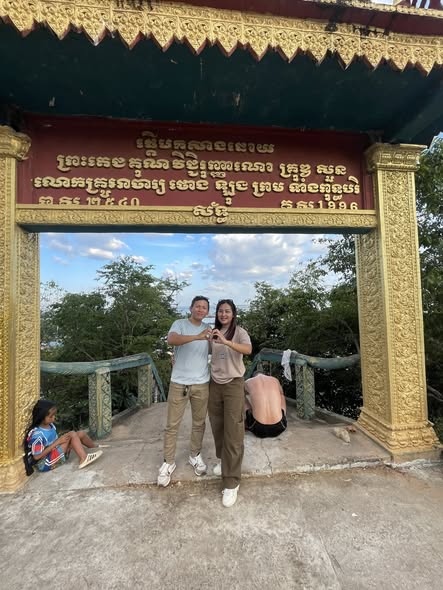
Written by the coaches
Kun Khmer Club — Coaches Kon Phanet & Ramon
Head coaches Kon Phanet and Ramon have a combined 50+ professional Kun Khmer fights in Cambodia. We coach beginners, travelers, expats, and fighters at our gym in Siem Reap.
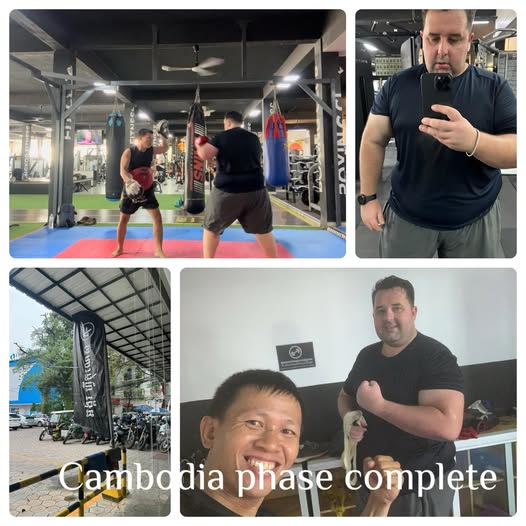
Ready to train in Siem Reap?
Drop in for a $9 day pass — the group class starts at 5:00 PM every day, and all gear is provided. Message us for today’s times.