
Kun Khmer vs Kickboxing: Which Ruleset Wins?
Yes — Kun Khmer is Cambodia's own kickboxing tradition, adding scored elbows, knees, and clinch fighting to the punches-and-kicks core many kickboxing rulesets stop at. Here is exactly where the rulesets differ.
On this page
- Is Kun Khmer a Type of Kickboxing?
- Which Weapons Are Legal in Each Ruleset?
- Why Is the Clinch a Weapon in Kun Khmer and a Break in Other Rules?
- Why Do Elbows Decide So Many Kun Khmer Fights?
- How Is a Kun Khmer Match Structured and Won?
- What Counts as a Foul Under Kun Khmer Rules?
- Where Did Each Ruleset Come From?
- Do Kun Khmer and Muay Thai Fight Under the Same Rules?
- Where Can You Watch These Rules in Action?
- Who Has Proven the Ruleset at the Top Level?
- How Long Is a Career Under These Rules — and What Does It Pay?
- Does the Style Hold Up Outside Its Own Ruleset?
- Ready to Feel the Ruleset on the Pads?
Yes — Kun Khmer is Cambodia's kickboxing tradition: a full-contact striking sport built on punches and kicks plus scored elbow strikes, knee strikes, and clinch fighting, which is a wider toolkit than the strictest international kickboxing rulesets allow. "Kickboxing" itself is an umbrella term for combat sports based on punching and kicking, and Kun Khmer is Cambodia's member of that family with its own name, history, and rulebook. You can feel the difference on the pads in Siem Reap for the price of a $9 day pass at the daily 5:00 PM class.
Is Kun Khmer a Type of Kickboxing?
Yes — Kun Khmer belongs to the kickboxing family, and it is the Cambodian branch of it with a bigger legal toolkit than most. Wikipedia defines kickboxing as an umbrella term for combat sports and martial arts based on punching and kicking, and its entry for Cambodia's sport lists "Pradal, Pradal Serey, Khmer boxing, Cambodian boxing" among Kun Khmer's alternate names — the same sport wearing both labels. What makes Kun Khmer its own ruleset rather than a copy is the weapon list: where punches-and-kicks formats stop scoring, Kun Khmer is only warming up. What Kun Khmer is covers the sport from the ground up, the Cambodian kickboxing guide stays on this exact overlap, and the same-as-kickboxing page takes the identity debate head-on.
Kun Khmer vs. punches-and-kicks kickboxing at a glance
| Element | Kun Khmer | Punches-and-kicks kickboxing |
|---|---|---|
| Punches | Scored core strike | Core technique |
| Kicks | Scored core strike | Core technique |
| Elbows | Scored — the sport's most common fight-ender | Forbidden under full-contact rules |
| Knees | Scored strike | Varies by governing body |
| Clinch fighting | Part of the sport's own definition | Restricted or broken up; some rules allow it |
Which Weapons Are Legal in Each Ruleset?
The legal-weapon list is the sharpest line between these sports, because Kun Khmer scores all four strike types plus the clinch while classic kickboxing rulebooks cut the list down. Kun Khmer consists of four types of strikes — punches, kicks, elbows, and knee strikes — fought as stand-up striking and clinch fighting. American full-contact kickboxing draws the opposite line: opponents hit each other with punches and kicks above the waist, and elbows and knees are forbidden. Other rulebooks sit in between — bouts under different governing bodies apply different rules, such as allowing knees or clinching, and K-1 was founded on special kickboxing rules with no elbows and no neck wrestling. Muay Thai, the "Art of Eight Limbs," combines fists, elbows, knees and shins — the same weapons Kun Khmer scores under its own name. How each technique is trained breaks the four strike types down, and whether the full toolkit holds up under pressure tests it honestly.
- Kun Khmer: punches, kicks, elbows, and knees — all scored — plus live clinch fighting
- American full-contact kickboxing: punches and kicks above the waist; elbows and knees forbidden
- K-1 rules: knees in, elbows out, no neck wrestling
- Muay Thai: fists, elbows, knees, and shins with clinching — the Art of Eight Limbs
Why Is the Clinch a Weapon in Kun Khmer and a Break in Other Rules?
Because the clinch is where elbows and knees land, rulesets that ban those weapons have no reason to let fighters hold on. Kun Khmer's own definition writes clinch fighting into the sport, and the clinch is used to wear the opponent down — it is a scoring arena, not a stalemate. In Western boxing the two fighters are separated when they clinch; in muay Thai, however, they are not, and Kun Khmer's rules keep that range live the same way. How the clinch is actually taught shows the cooperative-drills path to it.
Punching, elbows, and knee strikes in the clinch, also sometimes referred to as 'dirty boxing', are an important aspect of Muay Thai, Bajiquan, Wing Chun, Lethwei and mixed martial arts.
Why Do Elbows Decide So Many Kun Khmer Fights?
Because the ruleset prices them highest: in Kun Khmer, more victories come by way of an elbow technique than any other strikes. The sport is most well known for its kicking and elbows technique, and Cambodian fighters tend to utilize more elbow strikes than other martial arts in the region. Set that next to the weapons table above and the logic closes: ban elbows, and you delete the sport's single most common path to victory — which is precisely why Kun Khmer is its own ruleset and not just kickboxing with a Khmer name. How beginners build toward that elbow game starts on pads, not people.
The scoreboard fact
More Kun Khmer victories come by way of elbow technique than by any other strike, per the sport's recorded record — the decisive weapon that elbows-banned kickboxing rules switch off entirely.
How Is a Kun Khmer Match Structured and Won?
Professional-boxing shape with Khmer furniture: a match consists of five three-minute rounds in a 6.1-meter square ring, with a one-and-a-half to two-minute break between rounds. The objective is to knock the opponent out, force a technical knockout, or win on points, a downed fighter faces a 10-second count, and when nobody finishes the job the judges' points decide — with a draw called if they cannot separate the fighters. The full rulebook covers every clause, and what the Khmer ring terms mean translates the rest.
- Pre-fight: the kun kru ritual — 17 documented variations, most drawing on Reamker characters
- Rounds: five three-minute rounds in a 6.1-meter square ring
- Between rounds: a one-and-a-half to two-minute break
- Knockdown: a 10-second count
- The decision: knockout, technical knockout, or judges' points — a draw if even
What Counts as a Foul Under Kun Khmer Rules?
The foul list matches any regulated striking sport, plus one rule that says a lot about the style: constantly retreating when the opponent tries to approach costs a fighter points — this is a sport that rewards moving forward. The rest is standard protection, summarized in the table below from the sport's recorded rules. Ring rules are ring rules; a beginner class is a different contact story entirely, and sparring enters only later and by request.
Fouls and their consequences under Kun Khmer rules
| Action in the ring | Ruling |
|---|---|
| Striking a downed opponent | Prohibited |
| Kicking a downed opponent | Costs the fighter points |
| Biting | Prohibited |
| Blows to the back | Not allowed |
| Holding on to the ropes | Not allowed |
| Blows to the genitals | Prohibited |
| Constantly retreating from the advancing opponent | Costs the fighter points |
Where Did Each Ruleset Come From?
From different centuries and different motivations. The word kickboxing is young: the term was introduced in the 1960s as a Japanese anglicism by Japanese boxing promoter Osamu Noguchi. Kun Khmer's ring sport is older: it was codified by the French colonial administration in the early 20th century, derived from centuries-old traditions — namely Bokator, the close-quarter combat system of the Khmer empire, with French rules that mandated gloves, imposed time limits, instituted rest periods, and prohibited certain techniques to mitigate risks to life — the same safety logic every modern ruleset shares. The tradition beneath the codification nearly died: traditional Cambodian martial arts were banned under the Khmer Rouge, with many boxers executed or fled, a suppression that lasted four years until 1979 — the regime's dates were 1975 to 1979 (Wikipedia's Khmer Rouge chronology). The deeper root survived to be honored: Kun Lbokator, a martial art dating back to the first century, was inscribed on UNESCO's Intangible Cultural Heritage list in 2022.
- First century AD — Cambodian martial arts depicted in Angkor-period bas-reliefs, per the sport's record and UNESCO's citation of a first-century art
- Early 20th century — the French colonial administration codifies the ring sport: gloves, time limits, rest periods, prohibited techniques
- 1960s — Japan coins the word "kickboxing" (promoter Osamu Noguchi)
- 1975–1979 — the Khmer Rouge ban nearly kills the tradition
- 2022 — UNESCO inscribes Kun Lbokator as Intangible Cultural Heritage of Humanity
For the long version of that arc, the history of Kun Khmer in Cambodia walks it century by century, what Bokator is explains the root system, and Cambodian boxing covers the sport's modern identity.
Do Kun Khmer and Muay Thai Fight Under the Same Rules?
Close enough that the weapon sets cover the same ground, different enough that each sport answers to its own name and history: Kun Khmer scores four strike types — punches, kicks, elbows, knees — plus clinch fighting, and Muay Thai is the "Art of Eight Limbs" combining fists, elbows, knees and shins with clinching. The differences sit in the furniture around the rules: Kun Khmer opens with the kun kru, whose 17 documented variations mostly draw on Reamker characters, while Muay Thai's pre-fight dance is the wai kru ram muay, literally the "war-dance saluting the teacher", and Khmer matches run to traditional music on sampho drum, sralai oboe and chhing cymbals, accelerating as the rounds progress. Politics reaches the ring too: when the sport made its debut at the 2023 SEA Games as Kun Khmer, Thai athletes chose not to take part under that name. The full Kun Khmer vs Muay Thai comparison, Pradal Serey vs Muay Thai, and Kun Khmer vs Pradal Serey each take a slice of this.
In Western boxing, the two fighters are separated when they clinch; in muay Thai, however, they are not.
Where Can You Watch These Rules in Action?
Nearly any night of the week, on Cambodian television and in the arenas behind it. The broadcast calendar alone is dense: TV5 holds live tournaments on Friday and Sunday, CTN on Friday, Saturday and Sunday, Bayon on Saturday and Sunday, TV3 a single Sunday tournament, and Apsara added a Thursday tournament. The fighter base under that schedule is real: approximately 70 boxing clubs nationwide, 1,000 registered boxers across 78 schools as of 2011, and over 50 Kun Khmer fights held every week in the Phnom Penh region as of 2012. In Siem Reap specifically, Tripadvisor reviews of CTN Angkor Arena describe weekly fight nights within reach of anywhere a traveler stays. Finding Kun Khmer fights and gyms near you maps the local options.
- TV5 — live tournaments Friday and Sunday
- CTN — live tournaments Friday, Saturday, and Sunday
- Bayon — live tournaments Saturday and Sunday
- TV3 — a single Sunday tournament
- Apsara — a single Thursday tournament
Who Has Proven the Ruleset at the Top Level?
A short list of record-verified names answers it. Eh Phouthong — called "Cambodia's Muhammad Ali" by the AFP and recognized by the Phnom Penh Post as the greatest kickboxer Cambodia has produced — finished at 178 wins, 9 losses, and 5 draws, known for his powerful right kick and for training champion Thoeun Theara. Thun Sophea won the TV3 belt in 2000, the TV5 belt in 2002, and the CTN belt in 2006, retiring at 80-8-5. Keo Rumchong, the "Tiger of Battambang," built a 160-13-4 record with 68 knockouts and took his kicks into Thailand's THAI FIGHT. And the lineage went international on August 28, 2008, when Vorn Viva and Meas Chantha won ISKA world titles in Phnom Penh — the first time Cambodians held kickboxing world titles. The full fighters guide profiles each career.
Record-verified champions of the ruleset
| Fighter | Verified record | Known for |
|---|---|---|
| Eh Phouthong | 178-9-5 (plus 1 no contest) | "Cambodia's Muhammad Ali" (AFP); powerful right kick; trainer of Thoeun Theara |
| Thun Sophea | 80-8-5 | TV3 (2000), TV5 (2002), CTN (2006) belt winner; later a referee and gym coach |
| Keo Rumchong | 160-13-4, 68 by knockout | Bayon TV champion; THAI FIGHT veteran; "Tiger of Battambang" |
How Long Is a Career Under These Rules — and What Does It Pay?
Careers run long and pay modestly by Western standards: top kickboxers can have as many as 200–300 fights in their careers, a volume only a weekly fight culture produces. The money scales with fame: base purses run around US$25 per fight and reach $75, brand-name kickboxers earn over $100, and international broadcast tournaments pay purses up to $1,000 or higher. That economics is exactly why travelers who want the sport's technique without the 200-fight apprenticeship train it as a practice instead — a beginner can join a fight camp in Cambodia without ever taking a professional bout.
The purse ladder — and the tourist alternative
Per the sport's record: roughly $25 opens a fight card, established fighters reach $75, brand names pass $100, and international tournaments have paid $1,000 or higher. A 6-week fight camp at this gym costs $299 — a fraction of one top-tier purse, with zero mandatory bouts.
Does the Style Hold Up Outside Its Own Ruleset?
Yes — modern MMA is built partly from this material. Mixed martial arts is a full-contact combat sport based on striking and grappling, incorporating techniques from various combat sports, and its common disciplines include kickboxing — with Muay Thai alongside it — and Western boxing. Kun Khmer's toolkit maps straight onto that striking half, elbows and clinch included, which is why Siem Reap gyms train them side by side: Ground Zero's own listing describes expert-led training in "Brazilian Jiu-Jitsu (BJJ), Kun Khmer (Muay Thai), MMA, Boxing, and Yoga".
- Punches and kicks — the shared base of every striking ruleset
- Elbows — Kun Khmer's signature finisher, prized in the MMA clinch too
- Knees and clinch control — the bridge between striking and grappling range
- The half Kun Khmer's rulebook does not cover: ground grappling, which comes from wrestling and jiu-jitsu
Where the two sports fully part ways — the cage, the ground, the rulebook — is the Kun Khmer vs MMA comparison, and what Kun Khmer offers MMA fighters specifically is its own deep-dive.
Ready to Feel the Ruleset on the Pads?
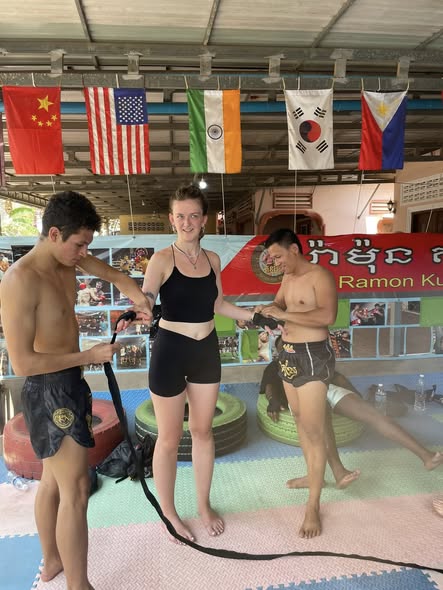
You do not need a ring, a record, or a ring name to learn the system — every weapon in the tables above is taught on pads from day one. First classes here focus on stance, technique, and pad work rather than sparring, and the clinch is introduced later as a mid-stage skill once your striking basics are solid. The on-ramp is deliberately boring: one $9 day pass at the door, the daily 5:00 PM class, all gear provided, and head coaches Kon Phanet and Ramon behind the pads with a combined 50+ professional Kun Khmer fights. What a beginner class actually covers runs the session end to end, the full cost breakdown prices every tier, and the Kun Khmer culture hub collects the history, technique, and comparison pages around this one.
- Message +855 96 228 8585 or just walk in — no booking system, no minimum group
- Pay the $9 day pass; wraps and gloves are provided
- 5:00 PM class: stance, punches, and kicks drilled on pads
- Watch the coaches demo elbows and knees — the scored weapons, taught on pads, never on people
- Come back tomorrow: $69 covers a full week of daily classes
Book a beginner-friendly Kun Khmer class in Siem Reap
Learn Cambodia's own kickboxing ruleset pads-first: see the price card — $9 day pass, $69 weekly, $129 monthly, $25 per hour private, $299 6-week fight camp — or message the coaches on WhatsApp (+855 96 228 8585) about the daily 5:00 PM class.
FAQ
What is the difference between Muay Thai & Kickboxing?
Under classic kickboxing rules — American full contact is the strict case — fighters use punches and kicks above the waist, with elbows and knees forbidden. Muay Thai adds elbows, knees, and clinch fighting to the weapon set. Kun Khmer sits on the Muay Thai side of that line: four scored strike types plus live clinch work.
Is Kun Khmer the same as Muay Thai?
No — they are cousin rulesets, not the same sport. Both score fists, elbows, knees, and clinch work, but Kun Khmer is Cambodia's own ring sport with its own pre-fight kun kru ritual, live traditional music, and history. The 2023 SEA Games treated them as distinct enough to compete under the Kun Khmer name alone.
What is the difference between Kun Khmer and Muay Thai?
The weapon sets overlap almost fully; the differences sit around the rules. Kun Khmer opens with the kun kru — 17 documented variations — and fights to live sralai-and-sampho music, while Muay Thai's ritual is the wai kru ram muay. Their histories diverge too: French codification and a Khmer Rouge-era ban for Kun Khmer, Thailand's own ring lineage for Muay Thai.
What is the difference between Muay Thai and Pradal Serey?
Pradal Serey is Kun Khmer — it is listed among the sport's alternate names and translates as "free fighting." So the question is really Muay Thai versus Kun Khmer: matching weapon sets, different countries, names, rituals, and ring history. Nothing about the name implies a different sport.
What are the distinctive characteristics of Kun Khmer and Muay Thai?
Both fight with the same four strike types — punches, kicks, elbows, and knees — plus clinch work. Kun Khmer's distinguishing traits are its elbow-heavy finishing record, the kun kru ritual with its 17 variations, and five three-minute rounds scored to accelerating traditional music.
Why do Muay Thai and Lethwei have big tournaments but Kun Khmer doesn't?
Kun Khmer's scene is big at home rather than abroad: as of 2012 there were over 50 fights every week in the Phnom Penh region, and five national channels carry live tournaments across the week. International promotion money and naming disputes — including Thai athletes declining to fight under the Kun Khmer name at the 2023 SEA Games — have so far kept the sport's biggest stage domestic.
Is sparring included in Muay Thai classes?
It depends on the gym and the class — some Thai gyms end sessions with optional sparring. At our gym, beginner classes never include sparring: first sessions are stance, technique, and pad work, and sparring only enters later, gated by fundamentals and only if you ask for it.
Key takeaways
- Kun Khmer is Cambodia's kickboxing: a member of the punching-and-kicking family with its own rulebook — punches, kicks, elbows, knees, and clinch all scored.
- The decisive difference is legal, not cosmetic: more Kun Khmer victories come by elbow than by any other strike, and elbows-banned kickboxing rules switch that weapon off.
- The format: five three-minute rounds in a 6.1-meter ring, won by knockout, technical knockout, or judges' points — with constant retreating itself penalized.
- The scene is deep: roughly 70 clubs, live tournaments across five TV channels, careers of 200–300 fights, and purses from about $25 to $1,000 or higher.
- You can learn the system pads-first: one $9 day pass, the daily 5:00 PM class, gear provided, and no sparring for beginners.
Sources & further reading
- Wikipedia — Kun Khmer — Alternate names "Pradal, Pradal Serey, Khmer boxing, Cambodian boxing" and the "free fighting" gloss; four strike types (punches, kicks, elbows, knees) plus stand-up striking and clinch fighting; the clinch used to wear the opponent down; more victories by elbow than any other strike and elbow-heavy regional tendency; five 3-minute rounds, 6.1-meter ring, 1.5–2 minute breaks, 10-second count, judges' points and draws; the foul list (downed opponents, biting, back blows, ropes, groin strikes, point-loss for kicking downed opponents and retreating); kun kru with 17 variations; sampho/sralai/chhing music accelerating by round; TV5/CTN/Bayon/TV3/Apsara tournament schedule; ~70 boxing clubs; 1,000 registered boxers from 78 schools (2011) and 50+ weekly fights in Phnom Penh (2012); purses $25→$75→$100+→up to $1,000+; 200–300-fight careers; Vorn Viva and Meas Chantha's ISKA titles on August 28, 2008; French codification with gloves, time limits, rest periods, and prohibited techniques; the Khmer Rouge ban until 1979; first-century bas-relief dating. (Live-fetched 2026-10-26; phase3b1-citations.md:15, phase3b2-citations.md:17, phase3b4-citations.md:31/197-272.) — source
- Wikipedia — Kickboxing — Kickboxing as an umbrella term for punching-and-kicking combat sports; the term coined in the 1960s by Japanese promoter Osamu Noguchi; American full-contact rules ("punches and kicks, striking above the waist. Elbows and knees are forbidden"); rules varying by governing body ("allowing the use of knees or clinching"); K-1 founded under special rules with no elbows and no neck wrestling. (Live-fetched 2026-10-26; phase3b2-citations.md:20, phase3b4-citations.md:38.) — source
- Wikipedia — Muay Thai — The "Art of Eight Limbs" combining fists, elbows, knees and shins with stand-up striking, sweeps, and clinching; the quoted clinch contrast "In Western boxing, the two fighters are separated when they clinch; in muay Thai, however, they are not." (Live-fetched 2026-10-26; phase3b1-citations.md:17, phase3b2-citations.md:21, phase3b4-citations.md:36.) — source
- Wikipedia — Clinch fighting — The quoted "dirty boxing" passage: punching, elbows, and knee strikes in the clinch as an important aspect of Muay Thai and mixed martial arts, among others. (Live-fetched 2026-10-26; phase3b3-citations.md:22, phase3b4-citations.md:37.) — source
- Wikipedia — Wai khru ram muay — Muay Thai's pre-fight dance as the "war-dance saluting the teacher" — the contrast term for Kun Khmer's kun kru. (Live-fetched 2026-10-26; phase3b1-citations.md:22.) — source
- Wikipedia — Khmer Rouge — The 1975–1979 regime dates only (the suppression claims are cited to the Kun Khmer article, where the ban sentence is verified). (Live-fetched 2026-10-26; phase3b1-citations.md:18.) — source
- UNESCO — Kun Lbokator, traditional martial arts in Cambodia — Kun Lbokator as "a martial art dating back to the first century," inscribed in 2022 (17.COM) on the Representative List of the Intangible Cultural Heritage of Humanity. (Live-fetched 2026-10-26; phase3b1-citations.md:37, phase3b4-citations.md:45.) — source
- Wikipedia — Eh Phouthong — "The most famous kickboxer from Cambodia"; the Phnom Penh Post's greatest-Cambodian-kickboxer line; the AFP's "Cambodia's Muhammad Ali"; record 178 wins, 9 losses, 5 draws (+1 no contest); powerful right kick; trainer of Thoeun Theara. (Live-fetched 2026-10-26; phase3b4-citations.md:32/79-97.) — source
- Wikipedia — Thun Sophea — TV3 belt 2000, TV5 belt 2002, CTN belt 2006; record 80-8-5; later a referee and coach at the Ministry of National Defense gym. (Live-fetched 2026-10-26; phase3b4-citations.md:33/99-110.) — source
- Wikipedia — Keo Rumchong — Record 160-13-4 with 68 wins by knockout; Bayon TV Kun Khmer champion (67 kg 2011, Kubota 70 kg 2014); THAI FIGHT veteran; "Tiger of Battambang" nickname. (Live-fetched 2026-10-26; phase3b4-citations.md:34/112-128.) — source
- Wikipedia — Kun Khmer at the 2023 Southeast Asian Games — The sport's SEA Games debut under the Kun Khmer name and Thai athletes choosing not to take part under that name. (Live-fetched 2026-10-26; phase3b4-citations.md:35/281-282.) — source
- Wikipedia — Mixed martial arts — MMA as "a full-contact combat sport based on striking and grappling, incorporating techniques from various combat sports," with kickboxing (and Muay Thai under it) and boxing among its common disciplines. (Live-fetched 2026-10-26; phase3b1-citations.md:23, phase3b3-citations.md:21, phase3b4-citations.md:39.) — source
- Tripadvisor — CTN Angkor Arena (Siem Reap) — Weekly Kun Khmer fight nights at the arena (archived reviewer text: "3 nights a week it's a show, 3 it's real"; ). Arena seating is deliberately not claimed — no fetchable citation exists for the seating figure that circulates in community posts. (Verified via Wayback 2015-12-02 snapshot; phase4w1-citations.md:39.) — source
- Tripadvisor — Ground Zero Martial Arts and Yoga Cafe (Siem Reap) — The gym's About text: "offering expert-led training in Brazilian Jiu-Jitsu (BJJ), Kun Khmer (Muay Thai), MMA, Boxing, and Yoga" — Kun Khmer trained alongside MMA in Siem Reap. (Live-fetched 2026-10-26 via Exa; phase3b1-citations.md:41, phase3b2-citations.md:41, phase4w1-citations.md:37.) — source
- Kun Khmer Club — published prices, schedule, and coaching — First-party basis of every own-gym figure: $9 day pass, $69 weekly, $129 monthly, $25 per hour per person private, $299 6-week fight camp (lib/business.ts:28-36); the daily 5:00 PM class (lib/business.ts:18-20); coaches Kon Phanet and Ramon with a combined 50+ professional Kun Khmer fights (lib/business.ts:21-26); contact +855 96 228 8585 (lib/business.ts:10-13); first classes = "stance, technique, and pad work, not sparring" (lib/blogContent/booking.ts:417); clinch introduced mid-stage (lib/blogContent/authority.ts:271). — source
Reviewed 2026-10-26
Written by the coaches
Kun Khmer Club — Coaches Kon Phanet & Ramon
Head coaches Kon Phanet and Ramon have a combined 50+ professional Kun Khmer fights in Cambodia. We coach beginners, travelers, expats, and fighters at our gym in Siem Reap.

Ready to train in Siem Reap?
Drop in for a $9 day pass — the group class starts at 5:00 PM every day, and all gear is provided. Message us for today’s times.