

What Kun Khmer Vocabulary Do Foreigners Need?
Foreigners training Kun Khmer in Siem Reap need a starter set, not a phrasebook: eight courtesy phrases, the numbers one to ten, and the sport's own terms — kru, achar, kun kru — every word cited to its source.
On this page
- Why Does Kun Khmer Vocabulary Pay Off for Foreigners?
- What Should You Say Walking In and Out of the Gym?
- Who Are the Kru and the Achar?
- How Do Coaches Count Rounds and Reps in Khmer?
- Which Words Name the Sport Itself?
- What Is the Kun Kru Ritual You'll See Before a Fight?
- How Many Words Do You Actually Need Before Day One?
- What If You Speak No Khmer at All?
- What Etiquette Words and Habits Does a Khmer Gym Expect?
- How Does Fight-Night Vocabulary Differ From Class Vocabulary?
- How Fast Can a Foreigner Pick Up Gym Khmer?
- What Does Training Here Cost While You Learn the Words?
You don't need to speak Khmer to train Kun Khmer in Siem Reap, but about twenty words change the experience: the greetings that open and close a session, the numbers coaches count pads with, and the sport's own terms — kru, achar, kun kru. Khmer is not a tonal language, so the romanizations here are pronounceable as written. Every claim on this page is cited, and every word on it is one you'll hear inside a gym.
Why Does Kun Khmer Vocabulary Pay Off for Foreigners?
A small set of Khmer words buys you three concrete things in a Siem Reap gym: you follow the coach's counting, you greet the room the way Cambodian gym culture expects, and you understand the sport's own terms instead of nodding along. Khmer is an Austroasiatic language and the official and national language of Cambodia (Khmer language — Wikipedia), and unlike Thai, Lao, Vietnamese, or Burmese, it is not tonal — so an English speaker can produce recognizable words without learning pitch (Khmer language — Wikipedia). Counting, greetings, and the names for the sport and its people cover nearly every routine moment of a training week. If you're still deciding what the sport even is, start with what Kun Khmer actually is; everything else in this cluster sits in the Kun Khmer culture hub.
- Follow the count during pad rounds and conditioning instead of mirroring your neighbor
- Greet coaches and training partners with chum reap suor — the courtesy a Cambodian gym expects
- Recognize the sport's own names: Kun Khmer, Pradal Serey, Kbach Kun Pradal Khmer
- Understand fight-night ritual words — kru, achar, kun kru — instead of watching blind
- Walk away with words that work all over Cambodia, not just inside the gym
What Should You Say Walking In and Out of the Gym?
Eight phrases — formal and informal hello, thank you, yes and no, excuse me, goodbye, and a reply to "how are you" — cover the whole entrance-and-exit ritual of a gym visit. Khmer marks formality and gender in exactly the places beginners trip: chum reap suor is the formal hello while sous-dey is the informal one, men say baht for yes and women say jah, and thank you is aw khun (Khmer phrasebook — Wikivoyage). None of these needs to be perfect; arriving with them is what counts. A first no-experience visit walks through where they fit in the session, and what to wear to a Kun Khmer class answers the packing half of the same question.
The eight phrases that cover a full gym visit
| Khmer script | Romanization | Use it for |
|---|---|---|
| ជម្រាបសួរ | chum reap suor | Formal hello, walking in |
| សួស្តី | sous-dey | Informal hello with training partners |
| អរគុណ | aw khun | Thank you — after pads, after corrections |
| បាទ | baht | Yes — said by male speakers |
| ច៎ា | jah | Yes — said by female speakers |
| អត់ទេ | ot teh | No |
| សូមទោស | soum toh | Excuse me / sorry |
| ជម្រាបលា | chum reap leah | Formal goodbye, heading out |
Who Are the Kru and the Achar?
The kru is your coach — Cambodian boxers train in a gym under a Kun Khmer kru — and the achar are the grandmasters responsible for preserving the sport's traditions (Kun Khmer — Wikipedia). Both words are in constant circulation once you can hear them: the person holding pads for you is a kru, and the elders you'll see honored at ceremonies and fights carry the achar title. Knowing which is which changes how a gym visit reads — you're no longer guessing at the hierarchy, you're watching it work. The role these figures play over centuries is told in our history of Kun Khmer in Cambodia, and each weapon they teach has its own Khmer name, collected in the full Kun Khmer techniques guide.
The grandmasters that are responsible for preserving traditions are known as achar.
How Do Coaches Count Rounds and Reps in Khmer?
Khmer numerals are a decimal positional system derived from Hindu numerals, in use since at least the early 7th century (Khmer numerals — Wikipedia), and they are the highest-value ten words on this list because coaches here often call pad combinations in Khmer. The pattern does most of the work for you: six through nine are built as five-plus-one through five-plus-four, so learning one through five plus dop for ten covers the whole set (Khmer numerals — Wikipedia). Recognize them and the rhythm of a round becomes legible; learn to say them and you can hold the count yourself. How Kun Khmer rules structure the rounds pairs with this list, and a first day at the gym shows where the count actually happens.
Khmer numerals one to ten
| Number | Khmer script | Say it |
|---|---|---|
| 1 | ១ | muoy |
| 2 | ២ | pii |
| 3 | ៣ | bei |
| 4 | ៤ | buon |
| 5 | ៥ | pram |
| 6 | ៦ | pram muoy |
| 7 | ៧ | pram pii |
| 8 | ៨ | pram bei |
| 9 | ៩ | pram buon |
| 10 | ១០ | dop |
Which Words Name the Sport Itself?
Three names and one ancestor cover it: Kun Khmer — literally "Khmer martial arts" — is the current name, Pradal Serey is the older one, Kbach Kun Pradal Khmer is the full official Khmer name meaning "Khmer Martial Art of Boxing," and the lineage traces back to Bokator (Kun Khmer — Wikipedia). Bokator itself is, according to oral tradition, an ancient Cambodian battlefield martial art — the close-quarter combat system of Cambodia's pre-Angkor armies, inscribed by UNESCO in 2022 on the Representative List of the Intangible Cultural Heritage of Humanity as "Kun L'Bokator, traditional martial arts in Cambodia" (Bokator — Wikipedia). The modern ring sport was codified by the French colonial administration in the early 20th century from those older traditions (Kun Khmer — Wikipedia). The two current names trip up almost every visitor — our Kun Khmer vs Pradal Serey guide untangles them, and what Bokator is covers the ancestor art.
- Bokator — the ancient close-quarter battlefield system behind it all
- Early 20th century — the French colonial administration codifies the ring sport from older Khmer traditions
- Pradal Serey — the older name for the ring sport, still in everyday use
- Kun Khmer — the currently promoted name; its full official form is Kbach Kun Pradal Khmer
What Is the Kun Kru Ritual You'll See Before a Fight?
The kun kru is the praying ritual performed at the beginning of each match — Wikipedia notes it is considered a real dance, and that it pays homage to the fighter's spirit trainer (Kun Khmer — Wikipedia). To an uninformed eye it looks like warm-up; once you have the word, you know you're watching the most traditional moment the sport has. The same page also names the elders you'll see around it — the achar — so a handful of vocabulary turns fight night from noise into story. The fighters worth studying gives you names to attach to the ritual.
If you learn one fight-night word, make it kun kru
It names the kneeling praying ritual before the bell — the moment most first-time spectators misread as stretching.
How Many Words Do You Actually Need Before Day One?
About twenty: the eight courtesy phrases, the ten numerals, and two or three sport terms are enough to handle every routine moment of a first week. That's the whole beginner load — a phrasebook is unnecessary and a language course is beside the point, because the gym itself supplies the repetition that makes words stick. Learn the set above and you'll spend your first sessions on the training, not on translation. Beginner Kun Khmer classes assumes no Khmer at all, and Khmer boxing training for beginners covers the same ground for people arriving from other gyms.
- 8 courtesy phrases — hello (formal and informal), thank you, yes and no, excuse me, goodbye
- 10 numerals — one through ten, for rounds, reps, and combinations
- 3 sport terms — kru (coach), achar (tradition-keeper), kun kru (the pre-fight ritual)
What If You Speak No Khmer at All?
You can start with zero words — instruction at this gym works in English and by demonstration, and the coaches are used to students who arrive knowing nothing. The class structure carries you: the coach explains wraps and stance in English, demonstrates each movement, and corrects by touch and by showing rather than by long explanations. The vocabulary above then arrives on its own schedule, one number and one greeting at a time. How a mixed room sounds in practice is covered in our guide to the Kun Khmer classes locals join in Siem Reap, and whether tourists can train Kun Khmer in Siem Reap answers the visitor version of the same question.
- Coach explains wraps, stance, and drills in English before anything starts
- Each movement is demonstrated — you copy what you see, not what you translate
- The Khmer count arrives through repetition on the pads, not through study
- Corrections come by touch and demonstration, so no shared language is required
What Etiquette Words and Habits Does a Khmer Gym Expect?
Cambodian gym culture places real value on respect toward coaches, and it is expressed through the words above more than through any formal code: greet the kru on arrival, thank the pad holder every round, and leave with a goodbye rather than a silent exit. The rest is standard training-room hygiene — barefoot on the mats, with gloves, wraps, and pads provided, so sports clothes are all you bring. Use the phrases consistently and they stop being performance and become habit by the end of a week. What to wear to a Kun Khmer class covers the clothing question in full, and the best time of day to train in Siem Reap handles the other half of showing up well.
- Greet the kru with chum reap suor when you arrive
- Barefoot on the mats — gear is provided, sports clothes are your only kit
- Say aw khun to your pad holder at the end of each round
- Close the session with chum reap leah instead of slipping out
How Does Fight-Night Vocabulary Differ From Class Vocabulary?
In class you live on counting and corrections; on fight night you add the ritual and naming words — the kru in each corner, the achar behind the traditions, the kun kru dance before the first bell. The numbers are the bridge between the two settings: Khmer numerals are used more widely in Cambodia than Western numerals (Khmer language — Wikipedia), so the count you drilled on the pads is the same system you'll recognize around the sport elsewhere. A week of training vocabulary makes you a better spectator, not just a better student. The naming tangle between Cambodian and Thai terms is sorted in our Muay Thai in Siem Reap guide.
What you see on fight night — and what it's called
| At the fight you see | What it's called | Why it matters |
|---|---|---|
| A fighter kneeling before the bout | kun kru | The praying ritual, honoring the fighter's spirit trainer |
| The coach in the corner | kru | The teacher the ritual pays homage to |
| Elders around the sport | achar | The grandmasters preserving the traditions |
| "Khmer martial arts" on the poster | Kun Khmer | The promoted name; Pradal Serey is the older one |
How Fast Can a Foreigner Pick Up Gym Khmer?
The numerals are the fastest win — ten words repeated across pad rounds by a coach who counts in Khmer are learnable in a single session — and the courtesy set settles in over a first week. Nothing here requires study outside the gym: the repetition that trains your body trains your ears on the same schedule. Give it a deliberate structure and the vocabulary is settled before a short trip ends. How to plan a Kun Khmer training trip to Siem Reap sets the itinerary frame, and how Kun Khmer builds discipline and focus explains why the repetition transfers.
- Session one: learn the hello and goodbye, and copy the coach's count on the pads
- Session three: use aw khun, baht or jah, and ot teh without prompting
- End of week one: recognize kru, achar, and kun kru at a live fight or on television
What Does Training Here Cost While You Learn the Words?
The vocabulary comes free with training, and training here is priced plainly: $9 for a day pass, $69 for a weekly pass, $129 for a month, $25 per hour per person for private lessons, and $299 for the 6-week fight camp. The daily group class runs at 5:00 PM, and privates are arranged with the coaches — the usual route if you want dedicated pad time to drill the count. Every option, side by side, is in our Kun Khmer class cost breakdown, booking a class in advance covers messaging and confirmation, and private Kun Khmer lessons in Siem Reap explains how one-on-one sessions run.
Training options and exact prices
| Option | Price | What it includes |
|---|---|---|
| Day pass | $9 | One daily group class |
| Weekly pass | $69 | Group classes for a week |
| Monthly training | $129 | Group classes for a month |
| Private lesson | $25/hour/person | 1-on-1 work on request |
| 6-week fight camp | $299 | Structured camp for committed students |
FAQ
Do you need to bring your own gear?
No — gloves, hand wraps, and pads are provided, and training is barefoot on the mats, so sports clothes and water are all you carry. That also means there's no shopping list standing between you and your first session.
Can beginners join a class?
Yes — the daily group class at 5:00 PM takes total beginners, the coach explains everything from hand wraps onward, and no Khmer is required. A $9 day pass covers the first class.
What Is a Typical Class Like?
Wraps on, warm-up, stance and guard, basic strikes, then pad rounds — with the coach counting reps in Khmer so the numerals settle in through repetition. Partner contact is cooperative and supervised throughout.
Is Sparring Required?
No. Beginners work pads and cooperative drills first, and live rounds only come once your basics are consistent — you control that pace with the coach.
Can I drop in for a class?
Yes — the day pass at $9 is built for drop-ins and the group class starts at 5:00 PM daily. A quick message ahead to the club secures the spot if you want certainty.
Muay Thai vs Pradal Serey?
In Cambodia they're two names in one family: Pradal Serey is the older name for the ring sport and Kun Khmer is the currently promoted one, with Kbach Kun Pradal Khmer as the full official form. The vocabulary above — kru, achar, kun kru — belongs to the same sport under any of the names.
Key takeaways
- About twenty Khmer words — eight courtesy phrases, ten numerals, and a few sport terms — cover a foreigner's first weeks on the mats.
- Khmer is not a tonal language, so the romanizations here are pronounceable as written.
- Kru means coach, achar names the grandmasters preserving the sport's traditions, and kun kru is the pre-fight praying ritual.
- Khmer numerals are decimal, derived from Hindu numerals, and in use since at least the early 7th century — you'll count reps with them from day one.
- Training costs $9 day pass, $69 weekly, $129 monthly, $25 per hour for privates, and $299 for the 6-week fight camp, with the daily class at 5:00 PM.
Sources & further reading
- Kun Khmer — Wikipedia — Sport names (Kun Khmer "Khmer martial arts", Pradal Serey, official Kbach Kun Pradal Khmer "Khmer Martial Art of Boxing"); boxers train under a Kun Khmer kru; grandmasters preserving traditions are achar; the kun kru praying ritual at the start of each match, considered a real dance, paying homage to the fighter's spirit trainer; codification by the French colonial administration in the early 20th century derived from Bokator — source
- Khmer numerals — Wikipedia — Forms for 1–10 (muoy, pii, bei, buon, pram; 6–9 as pram plus unit; dop); decimal positional system derived from Hindu numerals; in use since at least the early 7th century; earliest material evidence of zero — source
- Khmer language — Wikipedia — Austroasiatic language, official and national language of Cambodia; not a tonal language; written in the Khmer script, an abugida; Khmer numerals used more widely than Western numerals — source
- Khmer phrasebook — Wikivoyage — Chum reap suor (formal hello), sous-dey (informal hello), aw khun (thank you), baht said by men and jah by women (yes), ot teh (no), soum toh (excuse me / sorry), chum reap leah (formal goodbye), sok sabai (fine) — source
- Bokator — Wikipedia — Ancient Cambodian battlefield martial art; close-quarter combat system of Cambodia's pre-Angkor armies; inscribed by UNESCO in 2022 on the Representative List of the Intangible Cultural Heritage of Humanity as "Kun L'Bokator, traditional martial arts in Cambodia" — source
Reviewed 2026-10-26
Written by the coaches
Kun Khmer Club — Coaches Kon Phanet & Ramon
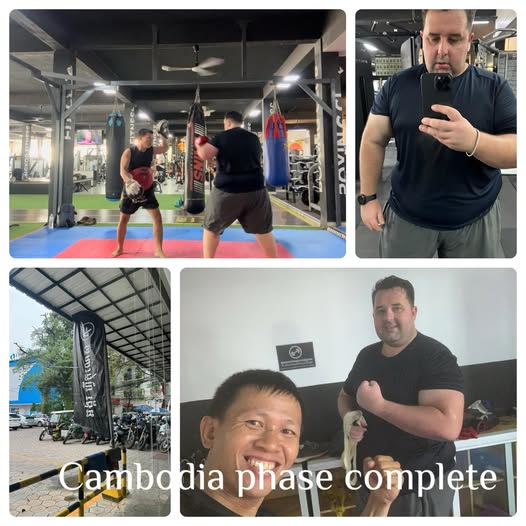
Head coaches Kon Phanet and Ramon have a combined 50+ professional Kun Khmer fights in Cambodia. We coach beginners, travelers, expats, and fighters at our gym in Siem Reap.
Ready to train in Siem Reap?
Drop in for a $9 day pass — the group class starts at 5:00 PM every day, and all gear is provided. Message us for today’s times.