

Fight Camp for Beginners: Can You Do One?
Yes — a fight camp for beginners assumes no fitness and no experience: the same daily class scales to whoever walks in, gear is included, and a $9 day pass tests the format before the $299 six weeks. What camps assume, how training scales, and when a camp is the wrong choice.
On this page
- What Does a Fight Camp for Beginners Actually Assume?
- Do You Need to Be Fit to Start a Fight Camp?
- What Does Scaling Actually Mean in a Beginner Camp?
- What Does the Beginner Path Look Like at Kun Khmer Club?
- How Hard Is Camp Training Compared With a Normal Class?
- What About the Nerves Everyone Feels Before a First Camp?
- What Should You Do in the Weeks Before a Camp Starts?
- What Does the First Week of a Beginner Camp Feel Like?
- Do Beginners Have to Spar in a Fight Camp?
- How Many Days a Week Does a Beginner Camp Run?
- When Is a Fight Camp the Wrong Choice?
- How Do You Test a Camp Before Committing to Six Weeks?
- What Happens if You Fall Behind Mid-Camp?
- Is a Fight Camp Only for Aspiring Fighters?
Yes — a fight camp for beginners works, because a beginner camp assumes no fitness and no experience: the same daily class scales to whoever walks in, and the only real entry requirements are showing up every day and telling the coaches the truth about your body. At Kun Khmer Club the camp is six weeks for $299, wrapped around the daily 5:00 PM group class, and a $9 day pass lets you test the format before committing to any of it. This page covers what beginner camps assume, how the training scales, what the first weeks actually feel like — and the honest cases where a camp is the wrong choice.
What Does a Fight Camp for Beginners Actually Assume?
Almost nothing — a beginner camp assumes you have never thrown a punch, cannot touch your toes, and have no idea what a pad round is, because that describes most of the people who join. What it does assume is time and consistency: a camp is a commitment to train through a structured block (six weeks here) rather than dropping in whenever, so the real prerequisites are calendar space and a coach who scales the work. Technique starts from zero on day one — what a typical class looks like shows the session you would actually be joining, and our Siem Reap fight camp guide covers the camp itself. The comparison worth killing early:
What people assume a beginner camp requires vs. what it actually requires
| Common assumption | What the camp actually assumes |
|---|---|
| You already train | You have never trained — technique is taught from zero |
| You are already fit | You are not — conditioning is built inside the camp, not before it |
| You own gear | Nothing — gloves, wraps, and pads are provided |
| You want to fight | Fighting is optional; most camp students never take a bout |
| Nothing at all is required | Six weeks of showing up, and honesty with the coaches about injuries |
Do You Need to Be Fit to Start a Fight Camp?
No — you do not need to be fit, and waiting until you are is the most common way people talk themselves out of a camp entirely. The health authorities phrase the floor the same way: the CDC's guidelines open with some physical activity is better than none, and the WHO notes that any amount of physical activity is better than none — a benchmark most people miss, with 31% of adults worldwide not meeting the recommendation of at least 150 minutes of moderate-intensity physical activity per week. Fitness is the output of the camp, not the entry ticket: the daily class builds the conditioning week by week, scaled to the person in front of the coach. The honest floor is smaller than people fear — sports clothes, water, and the willingness to be visibly new at something. Whether beginners can join a fight camp in Cambodia specifically is answered in detail in the country-level guide, and trying Kun Khmer with no experience at all covers the very first session.
- Fitness you need on day one: enough to walk in and move for an hour — the camp supplies the rest
- Fitness you do not need: any boxing, kickboxing, or gym background whatsoever
- What replaces fitness as an entry requirement: consistency, because the camp's compounding only works if you keep showing up
- What to say in week one: injuries, medications, and anything that hurts — the coaches scale from there
What Does Scaling Actually Mean in a Beginner Camp?
Scaling means everyone in the room does the same class skeleton with different depth: the same warm-up, the same techniques demonstrated, but rounds, pace, and resistance adjusted person by person. A beginner's pad round is slower and shorter; an experienced student's is live and hard — same drill, different dose. That is why a mixed room works rather than leaving beginners behind, and it is why how beginner Kun Khmer classes are structured and how beginners train safely both read as variations of the same answer: the coach adjusts the dose, not the class.
- Rounds scale by time — a first-week round is shorter and the rest between rounds longer
- Intensity scales by pace — pad combinations at half speed before full speed
- Resistance scales by partner — pads before clinch, and walking-pace clinch before live clinch
- Contact scales by readiness — sparring arrives late, controlled, and only for those who opt in
What Does the Beginner Path Look Like at Kun Khmer Club?
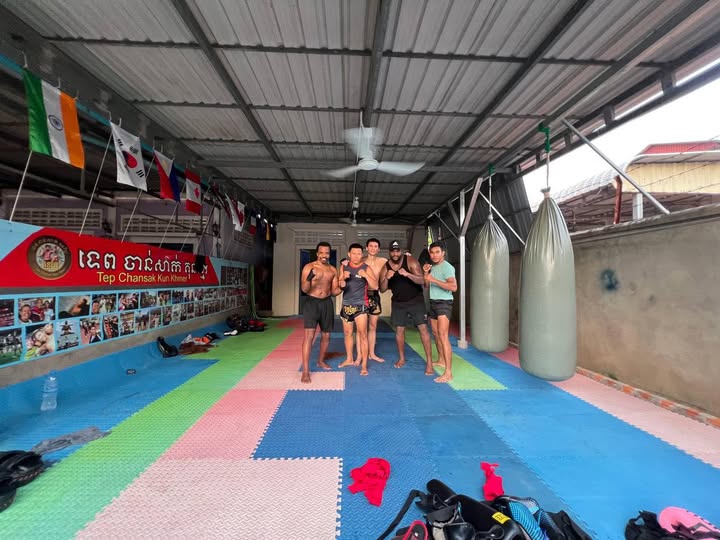
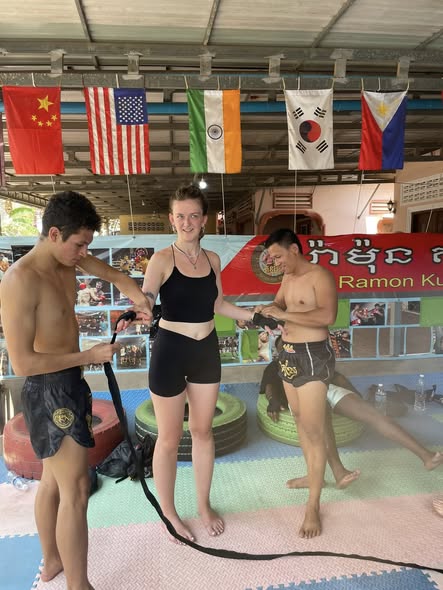
Our beginner path is deliberately boring: one daily anchor — the group class at 5:00 PM every day, classes that run about an hour — with the six-week camp ($299) wrapping a coaching structure around it, taught by head coaches Kon Phanet and Ramon, who have a combined 50+ professional Kun Khmer fights. You start by booking the first class in advance or walking in with a $9 day pass, tell the coaches where your body actually is, and the first week is technique from zero with rounds scaled down. If one area needs extra work, private sessions at $25 per hour, per person slot in beside the group class. The first-timer experience is the norm here, not the exception:
We took the trial boxing class with My Phanith, it was great! He explained all the basic techniques for our first class, it was awesome!
How Hard Is Camp Training Compared With a Normal Class?
A camp day is not a mysteriously more brutal session — the same class runs at 5:00 PM whether you are on a day pass or in week four of camp; what changes is the structure wrapped around it and the accumulation. The camp commitment here adds a fixed daily routine — run, training, stretching, ice bath, with massage from a professional therapist a couple of times a week — so recovery is scheduled instead of improvised. The honest answer to "how hard" is therefore about volume, not session difficulty: five or six consecutive training days ask more of an untrained body than any single class does, which is exactly why week one is scaled and why how often you should train deserves its own planning.
What actually changes between a single class and a camp commitment
| Element | Single class | Camp commitment |
|---|---|---|
| Session itself | Warm-up, technique, pads, conditioning finisher | The same class — campers train inside it |
| Schedule | Whenever you drop in | Daily 5:00 PM, every day of the block |
| Recovery | Self-managed | Structured: stretching, ice baths, massage twice a week |
| Progression | Starts over each visit | Week-on-week curriculum that compounds |
What About the Nerves Everyone Feels Before a First Camp?
The nerves are the default setting, not a sign you are unsuited — r/MuayThai alone runs a repeating genre of them, with threads titled "Nervous about starting tomorrow" and "Terrified to start Muay Thai" appearing again and again (nine-plus sightings of the first-class-nerves pattern, recorded in phase1-community.md rows 25–33; Reddit blocks direct fetching, so these are title-level records). The useful fact is that first-timers are the majority in a tourist-town beginner class, not a tolerated minority — coaches explain every technique from zero, as the review above shows, and nobody is expected to know the vocabulary in week one. Solo travelers wondering about the room itself can read whether Kun Khmer is good for women beginners; the short version is that the class is mixed and the coaching is verbal and step-by-step.
- What the nerves get right: the first week is new, sore, and outside your comfort zone
- What the nerves get wrong: that the room is full of experts — tourist-town beginner classes are mostly first-timers
- What actually happens: every technique is explained from zero, and nobody is thrown into contact in week one
- The fixed point: the 5:00 PM class starts whether you feel ready or not, which is the entire trick
What Should You Do in the Weeks Before a Camp Starts?
Move a bit, sleep, and buy nothing specialized — the counterintuitive advice is that crash-training right before a camp does more harm than good, because it arrives as fatigue and soreness on day one rather than fitness. Anything is better than the couch: the WHO is explicit that regular physical activity provides significant physical and mental health benefits, and the CDC notes activity helps you immediately feel better, function better, and sleep better — the sleep part matters most in a camp's first week. Walking, easy jogging, or a few gym sessions in the fortnight before you fly is enough to soften the shock.
- Two to three weeks out — add daily walking or light cardio; gather the ordinary sports kit, since gloves and pads are provided
- One to two weeks out — prioritize sleep over extra training; pack quick-dry clothes per what to wear to class
- The final week — go easier, not harder; arrive rested, because the camp itself will do the loading
- Before you fly — message the coaches on WhatsApp (+855 96 228 8585) so the first class is expecting you
What Does the First Week of a Beginner Camp Feel Like?
The honest answer is that week one feels like soreness with technique on top: everything is new, so delayed-onset muscle soreness is near-universal — the Cleveland Clinic describes DOMS as soreness that sets in one to three days after intense exercise and usually happens when you try a new activity or a workout more intense than you're used to, adding that it is usually nothing to worry about and goes away in a few days. On top of that, Siem Reap's heat taxes beginners more than the pads do — the CDC's heat guidance for anyone exercising here is to drink more water than usual and not wait until you're thirsty, and to treat muscle cramping as an early warning sign. By the end of week one most beginners report the same two things: the soreness peaked around days two and three, and the 5:00 PM class time — chosen deliberately for this climate — made the days predictable.
First-week verdicts — normal vs. not normal
| What you feel | Normal? | What to do |
|---|---|---|
| Deep muscle soreness, days 1–3 | Yes — DOMS, peaks early | Keep moving gently; it fades in a few days |
| Tired by 8 PM | Yes — new daily volume | Sleep; the body banks recovery at night |
| Sweating more than at home | Yes — tropical climate | Drink more water than usual, before you're thirsty |
| Sharp joint pain | No — tell the coach immediately | Rounds get scaled; privates exist for targeted work |
| Faint, weak, or cramping badly | No — stop | CDC guidance: stop all activity and get to a cool place |
Do Beginners Have to Spar in a Fight Camp?
No — sparring is not a beginner requirement, and in a properly run camp it arrives late, controlled, and always optional. The default progression is pads before partners: beginners spend their early weeks hitting pads and bags, where the mistakes cost nothing, and controlled sparring is introduced only once fundamentals and control are solid — if at all. Kun Khmer's reputation for elbows and knees makes people imagine week-one sparring; the reality is the opposite, precisely because those weapons demand control before contact. How sparring works in Kun Khmer covers the full picture, and how much contact a class actually involves separates the sport's full-contact matches from what a beginner session contains.
- The early weeks: pads and bags only — your opponent is a coach-held mitt, and mistakes cost nothing
- Later weeks: controlled, opt-in sparring for those who want it — never a graduation requirement
- The clinch: taught at walking pace first, then progressively live
- Declining sparring changes nothing about your camp, your progress, or your coach's attitude
How Many Days a Week Does a Beginner Camp Run?
The class runs every day at 5:00 PM, so a camp week offers seven training days — but beginners are not expected to take all seven at full dose, and the smarter first week treats rest as part of the program. For scale: a class a day already clears the WHO's benchmark of at least 150 minutes of moderate-intensity physical activity per week several times over, so there is no health argument for stacking extra volume on an untrained body. A sane beginner camp week trains hard five days and takes one or two deliberately lighter days — what a Muay Thai camp week in Cambodia looks like shows the rhythm in full.
- Days 1–2 — train at the pace the coach sets; resist the urge to prove anything
- Day 3 — the soreness peak; attend, move, and let the class be lighter if it needs to be
- Days 4–5 — technique consolidation; this is where the week's learning actually sticks
- Day 6 or 7 — take a deliberate lighter day or rest day; recovery is when adaptation happens
When Is a Fight Camp the Wrong Choice?
A camp is the wrong choice in three honest cases, and the passes and privates exist for exactly these situations. Wrong if you cannot give the block six consecutive weeks of presence — a camp's value is accumulation, so five scattered days is money spent on a structure you are not using; how long a training camp should be covers that arithmetic. Wrong if what you actually want is occasional training while traveling — a $9 day pass or $69 weekly pass buys the same class without the commitment (the full cost breakdown compares every tier). Wrong if you are training through an active injury or untreated medical condition — clear it with a health care provider first, per the CDC's standing advice to talk with your health care provider before changing a routine, and let the coaches scale around what they know about.
- Wrong choice: you have less than the full block available — take passes instead and train well within them
- Wrong choice: you want casual, no-schedule training — the $9/$69/$129 passes are the honest product
- Wrong choice: an injury or condition you have not mentioned — say it first, then train scaled, or wait
- Right choice: you want structure, daily rhythm, and a coach who scales the work — the camp is built for exactly that
How Do You Test a Camp Before Committing to Six Weeks?
Test it with the pass ladder — this is what the shorter passes are for, and it converts the fitness question from anxiety into data. One $9 day pass answers "can I do a single class"; a $69 weekly pass answers "can I do this daily"; a $129 month answers "do I actually want six weeks of it". Nobody at this gym needs you to skip the ladder — what a training camp costs covers the full economics, and planning the trip end to end walks the booking order for travelers.
The test-before-commit ladder, from lib/business.ts
| Step | What it proves | Price |
|---|---|---|
| Day pass | You can finish one full class | $9 |
| Weekly pass | Your body handles daily training | $69 |
| Monthly | You want the routine, not just the holiday | $129 |
| 6-week fight camp | You are committing to the whole block | $299 |
What Happens if You Fall Behind Mid-Camp?
Nothing dramatic — falling behind mid-camp is handled by scaling harder, resting deliberately, and telling the coach, not by quitting. The line to watch is the difference between normal soreness (which fades in days, per the DOMS guidance above) and the overtraining signal: overtraining occurs when a person exceeds their body's ability to recover from strenuous exercise, and the marker is performance dropping or plateauing despite continued work. If a week goes sideways — illness, travel days, a bad night's sleep — take the lighter day, then return; the camp's week-on-week structure absorbs a missed session far better than a missed week hidden by pride. Private lessons in Siem Reap are the catch-up mechanism: one $25 hour of targeted work can repair what a group class could not stop to fix.
- Tell the coach first — scaled rounds exist precisely for this, and hiding fatigue is what turns a bad week into a plateau
- Sort the signal: soreness that fades in a few days is normal; performance dropping despite continued work is the overtraining marker
- Take the deliberate lighter day instead of skipping — the class runs daily, so one easy session beats a lost week
- Book a private hour if one technique is holding you back — $25/hour of targeted repair
Is a Fight Camp Only for Aspiring Fighters?
No — the camp format is a structure, and structure serves goals other than fighting: fitness that finally compounds, a daily rhythm that outlasts the holiday, and a skill that keeps improving the way training builds discipline. Nobody at a beginner camp is being scouted; the fight track exists for the minority who ask for it, and the coaches decide readiness only after weeks of watching someone train. The three most common non-fight goals people bring are plain fitness with a deadline, confidence from being new at something hard, and weight management — where the weight-loss math of this training applies the same honest estimates. Age is not the barrier people expect either: starting later in life is covered directly, and scaled rounds are scaled rounds whatever the birth year.
- Fitness with a deadline — six weeks of daily, structured work beats six months of unscheduled gym intentions
- Confidence — the kind that comes from being visibly new at something hard and staying anyway
- A repeatable routine — a fixed daily 5:00 PM anchor that makes showing up the default, not a daily decision
- The skill itself — strikes, clinch, and ring literacy, for anyone who wants to understand the sport they watch
FAQ
Do I Need to Be in Shape?
No — a beginner fight camp builds the fitness it needs rather than requiring it in advance. The CDC's own floor applies: some physical activity is better than none. Arrive with ordinary mobility and honesty about your body, and the first week's rounds are scaled to match.
What Makes a Muay Thai Camp Good for Beginners?
Three things: coaches who scale every round to the person, a curriculum that starts from zero, and contact that arrives late and optionally. If a camp's first answer to "I'm a beginner" is a harder workout instead of scaled technique, that is the wrong camp.
Do I Need Experience Before Going to a Training Camp?
No — camps exist to teach the sport from the ground up, and beginners training alongside regulars in one mixed class is the normal arrangement. Gear is provided; the only preparation worth doing is light daily movement and decent sleep in the weeks before you fly.
Wanting to Start Muay Thai but Nervous, What to Expect?
Expect to be one of several first-timers in the room, to have every technique explained from zero, and to be sore for two or three days after the first sessions — all normal. Nerves are the most common feeling in first-class discussions; showing up is the only part that requires courage.
How Long Should Beginners Train?
For a working foundation, plan a block measured in weeks, not days: a $69 weekly pass tests the habit, and the 6-week camp at Kun Khmer Club is the full structured version. One class a day already exceeds the WHO's 150-minute weekly activity benchmark several times over.
What if I Can't Keep Up in Fitness Classes?
You scale — rounds get shorter, pace drops, and the coach adjusts the dose while you stay in the same class as everyone else. "Keeping up" is not the metric in a beginner camp; consistent attendance at a pace you can repeat tomorrow is.
How Long Should You Go For?
It depends on the goal: a week proves you like it, a month builds a habit, and six weeks — the camp length here at $299 — builds a genuine foundation in technique and conditioning. Anything shorter is holiday training, which the day and weekly passes handle more honestly.
Key takeaways
- A fight camp for beginners assumes no fitness and no experience — the real entry requirements are showing up daily and telling the coaches the truth about your body.
- The authorities agree the floor is low: the CDC opens with "some physical activity is better than none", and 31% of adults worldwide miss the WHO's at-least-150-minutes benchmark that a single daily class clears several times over.
- Scaling is the mechanism that makes mixed rooms work — same class skeleton, shorter and slower rounds for beginners, sparring late, controlled, and always optional.
- Test before committing: $9 day pass → $69 week → $129 month → $299 six-week camp, all wrapped around the daily 5:00 PM class with coaches Kon Phanet and Ramon (50+ combined professional fights).
- A camp is the wrong choice if you cannot give the full block, want casual training, or are training through an undisclosed injury — the passes, privates, and a word with a health care provider cover those cases honestly.
Sources & further reading
- CDC — Physical Activity Guidelines for Adults — "Some physical activity is better than none"; adults need at least 150 minutes of moderate-intensity activity a week (or 75 minutes of vigorous-intensity or an equivalent combination) plus 2 days of muscle-strengthening. — source
- WHO — Physical activity fact sheet — The page-supported wording "at least 150 minutes of moderate-intensity physical activity per week"; 31% of adults do not meet recommended levels; any amount of physical activity is better than none; regular activity provides significant physical and mental health benefits. — source
- CDC — Benefits of Physical Activity — Physical activity helps you immediately feel better, function better, and sleep better; reduced short-term feelings of anxiety for adults. — source
- Cleveland Clinic — Delayed Onset Muscle Soreness (DOMS) — Soreness sets in one to three days after intense exercise, typically after a new activity or harder-than-usual workout; usually nothing to worry about; goes away in a few days. — source
- CDC — Heat and Athletes — Drink more water than usual and don't wait until you're thirsty; muscle cramping may be an early sign of heat-related illness; if you feel faint or weak, stop all activity and get to a cool place. — source
- CDC — Steps for Losing Weight — Standing advice to talk with your health care provider before changing a routine (cited for the injury/medical-condition check, scoped to that advice). — source
- Wikipedia — Overtraining — Overtraining occurs when a person exceeds the body's ability to recover from strenuous exercise; the result is a decrease in performance or a plateau. — source
- r/MuayThai — "Nervous about starting tomorrow" / "Terrified to start Muay Thai" — Thread titles evidencing the recurring first-class-nerves pattern (Cluster E, 9 sightings recorded in docs/seo-evidence/phase1-community.md rows 25–33; Reddit blocks direct fetching — title-level record, quoted as recorded). — source
- Kun Khmer Club — Google Business reviews — 8 reviews at 5.0 (pulled 2026-10-25, docs/seo-evidence/google-reviews.md); Margaux's September 26, 2026 review quoted verbatim on first-class technique instruction. — source
Reviewed 2026-10-27

Written by the coaches
Kun Khmer Club — Coaches Kon Phanet & Ramon
Head coaches Kon Phanet and Ramon have a combined 50+ professional Kun Khmer fights in Cambodia. We coach beginners, travelers, expats, and fighters at our gym in Siem Reap.

Ready to train in Siem Reap?
Drop in for a $9 day pass — the group class starts at 5:00 PM every day, and all gear is provided. Message us for today’s times.