
What to Expect After Your First Martial Arts Class
Soreness sets in one to three days after class, sits in the muscles you trained, and fades within days — what helps, the normal-versus-worrying checklist, and why the second class is the hump.
On this page
- Why Are You Sore a Day or Two After Your First Class?
- How Long Will the Soreness Last?
- What Actually Helps Day-After Soreness?
- What Should You Eat and Drink After Class?
- Should You Train Tomorrow or Take a Rest Day?
- When Is Soreness Normal — and When Is It a Warning Sign?
- Why Are Your Shins and Forearms Bruised?
- Is the Second Class the Hardest One?
- What Does the First Class Do to Your Sleep and Mood?
- What Does Coming Back Cost?
What to expect after your first martial arts class is mostly a one-to-three-day project: soreness that sets in one to three days after the work, sits in the exact muscles you trained, and fades within a few days — the Cleveland Clinic's delayed-onset muscle soreness (DOMS) picture, and per the Clinic it is usually nothing to worry about. What helps is unglamorous — rest or gentle movement, water, a meal with carbohydrates and protein within two hours, and real sleep. The beginners in our own review record tend to end up in the same place after a first-ever session: "will definetely do it again." The rest of the first-timer path is mapped in the beginner training hub.
Why Are You Sore a Day or Two After Your First Class?
Because the class asked your muscles to do something new: the ache that arrives a day or two later is delayed-onset muscle soreness — DOMS — "a common side effect of challenging your muscles," which "usually happens after you try a new activity, kind of training or a workout that's more intense than you're used to," per the Cleveland Clinic. Two of its timing facts matter for a first class. You will not feel it in the room — "You won't feel pain during exercise. DOMS builds over several hours" — and it is local to the work: "You'll feel soreness in the exact muscles you worked," which for a first striking class means stance, hips, core, and shins from pad work. What a first session actually contains is walked through in what a typical class is like, the full safety picture is in is Kun Khmer safe for beginners, and the reason none of this involves being hit is the subject of is Kun Khmer a contact workout.
- Dull, spread across a muscle group — thighs, hips, core, shins after a first pad session (our first-week checklist, below)
- Tender to touch, with stiffness or a reduced range of motion (Cleveland Clinic's symptom list)
- Absent during the class itself — DOMS "builds over several hours" afterward (Cleveland Clinic)
- Not sharp, not stabbing, and not at a joint — those are different signals, covered in the warning-sign section below
How Long Will the Soreness Last?
One to three days in, a few days out — that is the whole window for a typical first class. The Cleveland Clinic's clock reads the same at both ends: "Muscle pain sets in one to three days after intense exercise," and "DOMS usually lasts a few days after the exercise that started it," with the plain close that "DOMS should go away in a few days." The edge of the window is where it stops being DOMS: "If it lasts for a week or more, you might have an injury like a muscle strain" (all Cleveland Clinic). Against our own schedule, the session you are recovering from runs about 60–90 minutes — the walkthrough in how long the class itself runs — and if you are weighing whether one visit justifies the soreness, the one-day class question takes that honestly.
The day-after timeline, day by day — Cleveland Clinic wording plus our schedule
| When | What happens | Source |
|---|---|---|
| Class night | No pain during the session; DOMS "builds over several hours" | Cleveland Clinic |
| Days 1–3 | Soreness sets in and peaks, in the muscles you worked | Cleveland Clinic |
| Around days 3–5 | Fades — "DOMS should go away in a few days" | Cleveland Clinic |
| A week or more | Not DOMS territory — "you might have an injury like a muscle strain"; get it checked | Cleveland Clinic |
What Actually Helps Day-After Soreness?
"Rest is usually the best treatment for DOMS," the Cleveland Clinic opens its treatment section — and everything else on its list is as boring as it is effective. Everyday movement is fine: "Moving and using your sore muscles in your everyday routine should be OK. But try to avoid using those muscles for intense exercise while they're sore." Heat and cold split the jobs — "Cold reduces pain and inflammation. Heat increases blood flow and relieves stiffness" — and massage needs no professional: "Foam rolling is a great option you can do on yourself at home." The Clinic names hydration too: "Drinking the right amount of water each day is great for your overall health. But it can also help your muscles recover" (Cleveland Clinic). Add the two levers outside the Clinic's list — a post-workout meal and real sleep, both covered below — and the day-after plan is complete; what to bring to your first class already gets you the water bottle, and practical martial arts training tips covers how the first weeks progress.
- Rest the sore muscles from intense work — "Rest is usually the best treatment" (Cleveland Clinic)
- Keep everyday moving — light movement "can help loosen them up. But don't work them out hard" (Cleveland Clinic)
- Cold for pain and inflammation; heat for blood flow and stiffness (Cleveland Clinic)
- Gentle self-massage or foam rolling (Cleveland Clinic)
- Water all day — "it can also help your muscles recover" (Cleveland Clinic)
- Food within two hours and a real night of sleep — Mayo Clinic and CDC, covered below
What Should You Eat and Drink After Class?
Mayo Clinic's post-workout rule is the one to copy: "Eat a meal that has both carbohydrates and protein in it within two hours of your workout if possible. Eating after you work out can help muscles recover and replace their glycogen stores" (Mayo Clinic). Fluids are the other half, and in Siem Reap they carry more weight than the timing does: "You need to have enough fluids before, during and after exercise to help prevent dehydration" (Mayo), while the WHO's heat guidance is to drink water regularly — about a cup per hour and at least 2–3 litres per day in hot conditions. The CDC's athlete page adds the two signals to respect: "Muscle cramping may be an early sign of heat-related illness," and "don't wait until you're thirsty to drink more" (CDC). Why the 5:00 PM class slot is the cooler end of the day here is the subject of the best time of day to train in Siem Reap.
Post-class fuel and fluids — the published guidance, verbatim-sourced
| When | The guidance | Source |
|---|---|---|
| Within 2 hours after class | A meal with carbohydrates and protein, if possible | Mayo Clinic |
| Right after class | Enough fluids to replace what you sweated out | Mayo Clinic |
| All day, in this heat | At least 2–3 litres of water; roughly a cup per hour | WHO heat guidance |
| Never | Wait until thirst — "don't wait until you're thirsty to drink more" | CDC Heat and Athletes |
Should You Train Tomorrow or Take a Rest Day?
Both are defensible, and the Cleveland Clinic's own line splits them for you: everyday movement is fine, another hard session on sore muscles is not — "But try to avoid using those muscles for intense exercise while they're sore" — and for daily trainers specifically, "ease up on the intensity" (Cleveland Clinic). Our schedule makes the decision unusually simple: one fixed class a day at 5:00 PM (lib/business.ts:18-20), so class two is a single 24-hour decision, not a timetable problem. Beginners who come back sore usually take a lighter second class — same drills, lower pad pace — which is exactly the "ease up on the intensity" version; how to space sessions across a week is worked out in how often you should train. The commitment stays zero either way: a day pass is decided at the door each visit, and if the soreness wins the argument, plans flex through booking changes and cancellations.
The 24-hour rule this schedule hands you
One class a day at 5:00 PM means tomorrow's decision is binary and reversible: show up on a $9 day pass at whatever pace your legs allow, or rest and come the day after. Nothing auto-renews, so resting never costs more than deciding later.
When Is Soreness Normal — and When Is It a Warning Sign?
Sore is normal; sharp is not. The Cleveland Clinic's reassurance and its exception sit in the same breath: "It's usually nothing to worry about. But see a healthcare provider if you have severe pain or notice DOMS after most of your workouts" — and its provider list is specific: pain that "lasts more than a week," pain that "feels sharp and constant," "severe swelling around a muscle," or urine that is "unusually dark" or has blood in it (Cleveland Clinic). Two local additions: our first-week rule teaches beginners to stop and tell the coach at sharp, pinpoint, or joint-level pain rather than train through it, and in this heat the CDC's stop signal is unambiguous — "If you feel faint or weak, STOP all activity and get to a cool place" (CDC). Anything you already manage — an old knee, a shoulder — belongs in the conversation before class, the playbook in training with injuries.
Normal versus worrying, signal by signal
| What you feel | What it usually is | What to do |
|---|---|---|
| Dull ache across a muscle group, arriving 1–3 days after class | DOMS — normal adaptation | Light movement, rest, the checklist above |
| Sharp, stabbing, or pinpoint pain during a movement | Not DOMS — a stop signal | Stop the drill, tell the coach |
| Pain at a joint rather than in muscle | Not DOMS | Do not push through; get it looked at |
| Pain past a week, severe swelling, unusually dark urine | Cleveland Clinic's see-a-provider list | See a healthcare provider |
| Faint or weak mid-session in the heat | Possible heat illness (CDC) | STOP all activity, get to a cool place |
Why Are Your Shins and Forearms Bruised?
Light bruising on the shins and forearms is a normal artifact of a first striking class — and it comes from holding pads, not from being hit. That is exactly how another gym's student FAQ frames it, and their answer survives scrutiny because it matches the mechanics of pad work itself (Chonburi Muay Thai's FAQ, quoted in full below). Here, beginners hold pads the coach demonstrates on and check techniques they have just been shown — the mechanics are in the techniques you drilled — and nothing is thrown at you at speed.
What can I expect the following day(s)? As with any exercise regimen, students should expect to be sore in accordance with their baseline physical ability. What might be unexpected, and different from non-contact exercises, is some light bruising. Bruises are typically observed on the shins and forearms and are caused by holding pads. The bruising is minimally painful, if at all.
Is the Second Class the Hardest One?
Usually, yes — for a reason the calendar makes visible: class two lands on day one or two after class one, exactly inside the DOMS window, so you walk in sore and the session feels heavier than the first one did. It is also where adaptation starts: a long-running Thailand camp guide puts it as "Your body adapts in the first week. The second week is where the real improvement happens" (Supa Phat's training camp guide, fetched 200, 2026-10-27), and the habit research agrees the early days are the fragile ones — missing an occasional session "did not seriously impair the habit" in the study data (Gardner et al., PMC3505409). The honest ceiling is real though: soreness that never resolves across sessions points at overtraining, where the body's ability to recover is exceeded. The proof this hump gets cleared is in the review record — a first-ever session of any martial art here closed with "will definetely do it again" (Manuel Jungwirth, October 2026, his spelling). What beginners actually cover across those early sessions is in what beginner classes cover, and the nerves side is answered in starting with zero experience.
- Day 0 — the first class: pads, technique, conditioning; no pain in the room
- Days 1–2 — DOMS arrives; this is where class two lands, so book it lighter or rest it
- Days 3–4 — the fade; a second class here usually feels easier than the first did
- End of week one — movement patterns stop being new; the hump is behind you
- If soreness instead accumulates session over session — that is the overtraining signal, not weakness
What Does the First Class Do to Your Sleep and Mood?
The same-day effects run the right way per the CDC: "Physical activity helps you immediately feel better, function better, and sleep better," and among the benefits it lists for adults is "reduced short-term feelings of anxiety" (CDC benefits). The recovery side has a number: adults aged 18–60 need "7 or more hours" of sleep (CDC) — and an evening class ends with the whole evening still ahead of you, which is the practical perk of a 5:00 PM start. What the first session feels like in the room is on the record too: "Really good coach, what a pleasure for a first session of Kun Khmer. I recommand it" (Hamari Camara, Google review, September 2026, his spelling). Where sleep and recovery become the training itself — rest days as load-bearing — is the over-decades version of this page: the over-40 recovery guide and the over-50 guide.
Really good coach, what a pleasure for a first session of Kun Khmer. I recommand it
What Does Coming Back Cost?
Class two costs $9 and nothing else — the day pass is one coached class with all gear included, decided at the door, with no contract behind it. If the comeback becomes a habit, the tiers step up from there: $69 buys unlimited group classes for seven days (seven day passes would be $63 — six dollars for zero per-visit decisions), $129 covers a month, and a stuck technique is what the $25-per-hour private is for. The full price list carries every number. Where the soreness question turns into a trip-planning question, the costs are mapped in what a class costs in Siem Reap, the one-on-one format in a private lesson, and the weeks-long version in planning a training trip.
Passes and prices, exactly as published (lib/business.ts:28-36)
| Option | Price | What it buys for the day-after question |
|---|---|---|
| Day pass | $9 | One class, gear included — the class-two decision at the door |
| Weekly pass | $69 | Unlimited classes for 7 days — rest days included, nothing wasted |
| Monthly training | $129 | Unlimited classes for 30 days |
| Private lesson | $25/hour/person | One coach, your pace — the sore-proof option |
| 6-week fight camp | $299 | The structured program, recovery days built in |
FAQ
What can I expect the following day(s)?
Soreness that sets in one to three days after the class, in the muscles you worked, and fades within a few days — the Cleveland Clinic's DOMS window, and it is usually nothing to worry about. Some light bruising on the shins and forearms from holding pads is also normal in a striking class; anything sharp, constant, or past a week belongs with a healthcare provider instead.
Is There Risk of Injury?
Beginner training here is pads, not partners — you throw techniques at pads a coach holds, so day-one risk is the muscular kind (DOMS), not impact. The Cleveland Clinic's normal-versus-worrying line is the practical one: soreness is dull, spread out, and gone in a few days; sharp, constant, or joint-level pain is a stop signal to raise with the coach.
I've never hit anything before. Will I hurt myself?
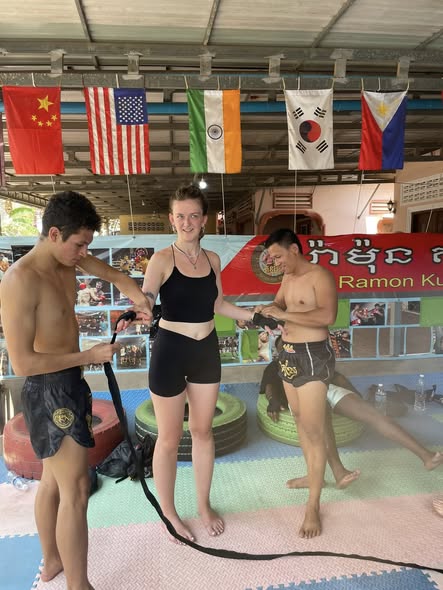
Not from the training itself — nothing is thrown at you at speed, and your hands are wrapped and gloved before you hit anything. What you will feel is ordinary muscle soreness a day or two later, from stance work and holding pads, and it fades within a few days.
How often should I come?
Two to three classes a week with rest days between them is the honest beginner band — enough stimulus, enough recovery for the soreness to actually resolve between sessions. Our schedule runs one class a day at 5:00 PM, so the spacing decision is built in; the cadence is worked through in the frequency guide.
What if I can't keep up in fitness classes?
The coach sets your tempo round by round, so "keeping up" is not the test — pad pace scales to the person holding the gloves. A harder-than-expected first week is normal; easing intensity while sore is exactly what the Cleveland Clinic recommends for daily trainers.
What was your first day at Muay Thai training like?
On the record from first-timers here: "Was the first time in my life to do any type of boxing or martial arts - will definetely do it again" (Manuel Jungwirth, October 2026), and "He explained all the basic techniques for our first class, it was awesome!" (Margaux, September 2026). Wraps fitted, techniques from zero, coach-set pace — and soreness the next day or two.
Key takeaways
- Soreness after a first class is DOMS: it sets in one to three days later, peaks in the muscles you worked, and fades within a few days (Cleveland Clinic).
- What helps: rest from intense work, light everyday movement, cold for pain or heat for stiffness, gentle self-massage, water, a carbs-and-protein meal within two hours (Mayo Clinic), and 7+ hours of sleep (CDC).
- Warning signs are specific: pain past a week, sharp constant pain, severe swelling, unusually dark urine — Cleveland's provider list; in the heat, faint or weak means STOP.
- The second class is the hump because it lands inside the soreness window — a lighter class two at an honest pace is how beginners clear it.
- Class two costs $9 with gear included; $69 covers a week of unlimited classes; nothing auto-renews, so a rest day never costs more than deciding later.
Sources & further reading
- Cleveland Clinic — Delayed Onset Muscle Soreness (DOMS) — Every DOMS fact on this page: "Muscle pain sets in one to three days after intense exercise"; "DOMS usually happens after you try a new activity…"; "You won't feel pain during exercise. DOMS builds over several hours."; "You'll feel soreness in the exact muscles you worked"; "usually nothing to worry about"; "should go away in a few days… you might have an injury like a muscle strain"; "Rest is usually the best treatment"; light movement/heat-cold/foam-rolling/hydration treatment wording; the see-a-provider list (week-plus, sharp and constant, severe swelling, unusually dark urine). Fetched fresh 2026-10-27, curl 200 (docs/seo-evidence/tmp-w4-doms-cleveland.html; corroborates phase3b2-citations.md:28). — source
- Mayo Clinic — Eating and exercise: 5 tips to maximize your workouts — "Eat a meal that has both carbohydrates and protein in it within two hours of your workout if possible. Eating after you work out can help muscles recover and replace their glycogen stores."; "You need to have enough fluids before, during and after exercise to help prevent dehydration." (Exa fetch 200 this session; pre-exercise half verified phase4w1-citations.md:33.) — source
- Chonburi Muay Thai — Student FAQ — The following-day answer: soreness per baseline ability, plus light shin/forearm bruising "caused by holding pads", "minimally painful, if at all" (live curl 200, phase4w3-citations.md:52; quote grep-verified in docs/seo-evidence/tmp-w3-class-chonburi-faq.html). — source
- Supa Phat — Thailand Muay Thai camp guide — "Your body adapts in the first week. The second week is where the real improvement happens." (live curl 200, phase4w3-citations.md:58; only the live-verified sentences used). — source
- WHO — Climate change: Heat and health fact sheet — "Drink water regularly (1 cup of water per hour and at least 2–3 litres per day)" in heat (phase3b2-citations.md:23). — source
- CDC — Heat and Athletes — "If you feel faint or weak, STOP all activity and get to a cool place."; "Muscle cramping may be an early sign of heat-related illness."; "don't wait until you're thirsty to drink more" (phase3b2-citations.md:24). — source
- CDC — Benefits of Physical Activity — "Physical activity helps you immediately feel better, function better, and sleep better."; "reduced short-term feelings of anxiety for adults" (phase3b1-citations.md:35; phase3b2-citations.md:26). — source
- CDC — About Sleep — Sleep-duration table row: "Adult | 18–60 years | 7 or more hours" (phase3b1-citations.md:36). — source
- Wikipedia — Overtraining — "Overtraining occurs when a person exceeds their body's ability to recover from strenuous exercise," with decreased performance or plateau (phase3b1-citations.md:32; refetched 200, phase4w3-citations.md:37). — source
- Gardner et al. — Making health habitual (PMC3505409) — Habit formation data behind "missing a session isn't fatal": "an initial acceleration that slowed to a plateau after an average of 66 days"; "Missing the occasional opportunity to perform the behaviour did not seriously impair the habit" (curl 200, phase3b4-citations.md:190-193). — source
- Kun Khmer Club — price list — $9 day pass, $69 weekly, $129 monthly, $25 per hour per person privates, $299 6-week fight camp, daily 5:00 PM class (lib/business.ts:18-36). Weekly-pass semantics ("unlimited group classes for 7 days") and the $69-vs-$63 arithmetic per templated-fragments/affordable-martial-arts-siem-reap.ts:78,124. — source
- Kun Khmer Club on Google Maps — The club's listing — 5.0 rating from 8 reviews; the quoted reviews (Manuel Jungwirth, October 2026; Hamari Camara, September 2026; Margaux, September 2026) are verbatim from docs/seo-evidence/google-reviews.md:2,6-11. — source
Reviewed 2026-10-27
Written by the coaches
Kun Khmer Club — Coaches Kon Phanet & Ramon
Head coaches Kon Phanet and Ramon have a combined 50+ professional Kun Khmer fights in Cambodia. We coach beginners, travelers, expats, and fighters at our gym in Siem Reap.
Ready to train in Siem Reap?
Drop in for a $9 day pass — the group class starts at 5:00 PM every day, and all gear is provided. Message us for today’s times.