

Training Martial Arts With an Injury: What's Safe?
Training martial arts with an injury is usually possible — pad-only classes scale around what hurts. When to wait, what our coaches scale, heat and blister reality, and the doctor-first line.
On this page
- Can You Train Martial Arts With an Injury?
- When Should You Wait Instead of Training Around an Injury?
- Will You Hurt Yourself in Your First Class?
- What Does Training Around an Injury Look Like in a Real Class?
- How Do You Tell Normal Soreness From an Injury?
- How Do You Train With an Injury in Siem Reap's Heat?
- What About Blisters and Beat-Up Traveler Feet?
- What If You Have a Chronic Condition Like High Blood Pressure or Diabetes?
- What Should You Tell the Coach Before You Arrive?
- How Much Does a Scaled Session Cost?
Training martial arts with an injury is usually possible here — beginners hit pads held by a coach rather than a partner, so a session can be scaled around what hurts, and the honest division of labor is that your doctor clears the condition while the coach scales the class. Some situations genuinely mean waiting first: fresh swelling, fever, or anything a doctor has taken off training. Everything on this page is general information, not medical advice; the wider beginner path is mapped in the beginner training hub.
Can You Train Martial Arts With an Injury?
Usually, yes — with the injury named, the session scaled, and a doctor's word wherever a doctor is involved. The reason it works here is structural: beginner classes are pad-only, so nothing is thrown at you, and the same convention holds across the industry — "most drills are taught with contact made either to Thai pads or your partner's gloves," as one established camp's FAQ puts it. There is no sparring requirement for beginners at any point — sparring enters only later, on request, once stance, guard, and control are solid (why sparring is never required here) — and the clinch is a staged mid-term skill, not a day-one one. What a typical class is like walks that structure end to end, and how much contact a class actually involves separates the work from the worry. Tell the coach what hurts before the warm-up and the loading changes; that conversation, not toughness, is the skill that keeps an injured beginner training.
- Old or nagging injuries your doctor has cleared — named to the coach before class, worked around in the rounds
- Ordinary soreness from recent sessions — normal, and distinct from injury (below)
- Minor niggles that don't change how you walk — the drill volume scales, the technique doesn't disappear
- Anything actively painful, swollen, or undiagnosed — that is a wait, not a scale
When Should You Wait Instead of Training Around an Injury?
A short list of situations means waiting for a doctor rather than scaling — and every item on it is pain or illness that does not behave like ordinary training soreness. The National Institute on Aging's guidance for people with chronic pain draws the line precisely: if you have pain, swelling, or inflammation in a specific area, you may need to rest it for a day or two and talk with a doctor about what is right for you. Illness is the other hard stop — a feverish body cannot also adapt to training load, and resuming later costs a day-pass here, not a membership. If a planned training week falls apart for medical reasons, how booking changes and cancellations work covers the admin side, and what a day pass costs shows why restarting is cheap.
The wait list — situations where scaling is the wrong tool
| Situation | Why it means waiting |
|---|---|
| Fresh swelling or pain in one specific spot | Localized pain and swelling is rest-and-call-the-doctor territory (NIA guidance on chronic pain) |
| Fever or active illness | Training and illness compete for the same recovery budget; the class resumes when you do |
| Anything a doctor has taken off training | Clearance is the doctor's call, not the coach's and not yours |
| Pain that worsens day over day | Ordinary soreness fades within days (Cleveland Clinic); the wrong side of that curve is a medical question |
Will You Hurt Yourself in Your First Class?
The recorded injury profile of martial arts is dominated by exactly the things a beginner pad-only class does not contain. In a Canadian emergency-department study of 920 martial-arts injury records (1993–2006, all styles), "the most common mechanisms of injury were falls, throws and jumps (33%)" and "fractures (20%)" led the injury types, with the lower limb the most common site at 41% — per McPherson & Pickett, BMC Public Health 2010. Read honestly: those are hospital records across karate, taekwondo, judo, and kickboxing — styles whose training includes throws, tournament fighting, and partner contact. It is not an injury rate for any single class, and it is not a safety guarantee; it is a map of where martial-arts injuries have actually come from, which how safe Kun Khmer is for beginners reads against this gym's own structure. The same study's conclusion — quoted below — points at the lever a coached class holds over exactly that map. What to bring to your first class and starting Kun Khmer with no experience at all cover the zero-background version of the same worry.
Over 70% of injuries were reported at a training site or at a competition, so instructors and referees do have the ability to regulate activities that may lead to morbidity.
What Does Training Around an Injury Look Like in a Real Class?
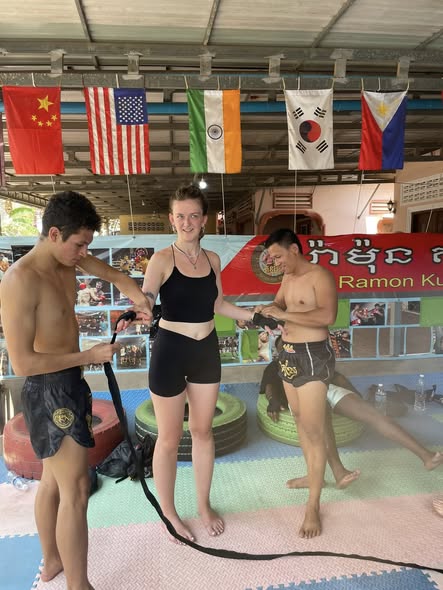
The session keeps its shape and the coach swaps the loading pattern, not the class. The standard session runs about 60–90 minutes through hand-wrapping, a warm-up, technique drills, pad work with a coach, and conditioning — all barefoot on mats, with gloves, hand wraps, and pads provided (what a beginner class covers); a coach can run that same skeleton lighter, slower, or reshaped around one joint. The hand-protection layer is built in too: wraps exist "to protect the hand and wrist against injuries induced by punching" and strengthen the metacarpus against the fracture known as the boxer's fracture (Wikipedia) — and the gym supplies wraps, gloves, and pads at every tier, so an old hand injury is met with fresh equipment rather than your own worn kit. Where the scaling is most precise is a private lesson — $25 per hour, per person, at times arranged with the coaches — an hour built around your body from the first minute, with head coaches Kon Phanet and Ramon bringing a combined 50+ professional Kun Khmer fights in Cambodia to it. What a scaled session never includes is contact: no sparring requirement exists for beginners at any point.
How a session scales around what hurts — our coaching practice, not a medical protocol
| What you're carrying | How the session scales |
|---|---|
| Sore lower body | Punch-heavy pad rounds; kicking volume cut; the coach sets a pace you can hold |
| Sore shoulders or an old hand injury | More footwork and defense; wraps re-taped before class; nothing loaded through the sore side |
| Blistered traveler feet | Barefoot drills shortened in favor of static pad work while it heals |
| Doctor-cleared and returning | Lighter rounds on request; any round can stop the moment you say so |
How Do You Tell Normal Soreness From an Injury?
Soreness has a schedule, and pain that ignores the schedule is the line where you stop guessing and start asking. Delayed onset muscle soreness "usually happens after you try a new activity, kind of training or a workout that's more intense than you're used to," sets in one to three days after the work, is "usually nothing to worry about," and "should go away in a few days" — per the Cleveland Clinic's DOMS overview. So expect the first sessions of a training trip to ache on that delay — not during the work, but a day or two after it — and to stop mattering within days. Sharp pain in one spot, swelling, or soreness that is still deepening on day four does not match that pattern — that is the wait list above, and a doctor reads it better than any coach. Pushing through worsening pain is also how the textbook overtraining loop starts, where a person "exceeds their body's ability to recover from strenuous exercise" and performance drops or plateaus (Wikipedia). How often to schedule sessions covers the spacing that keeps soreness on the normal side of the line.
DOMS (delayed onset muscle soreness) is a common side effect of challenging your muscles. Muscle pain sets in one to three days after intense exercise.
How Do You Train With an Injury in Siem Reap's Heat?
Heat is the condition every traveling body manages here, injured or not — Siem Reap's average high temperatures never fall below 30 °C in any month, which is why the class runs at 5:00 PM rather than midday, in line with the WHO's advice to avoid strenuous activity during the hottest time of day. An injured or medicated body handles heat worse, not better: the CDC notes that people who exercise on hot days are more likely to become dehydrated and get heat-related illness, and its guidance for athletes is to pace activity — "start activities slow and pick up the pace gradually" — and to stop at the warning signs: "Muscle cramping may be an early sign of heat-related illness," and "If you feel faint or weak, STOP all activity and get to a cool place." Water is part of the session, not an afterthought: the WHO's figure is at least 2–3 litres per day, and the CDC adds not to wait until you're thirsty. The best time of day to train here explains the scheduling logic in full.
- Train at 5:00 PM, not midday — the slot exists partly because of the heat curve
- Drink 2–3 litres across the day (WHO), more than thirst asks for (CDC)
- Say the injury to the coach before the warm-up — pacing starts slower for you
- Cramping, faintness, or weakness means stop and cool down — the round can wait
- Treat the following day as recovery: shade, water, and no second session
What About Blisters and Beat-Up Traveler Feet?
Blisters are the classic traveler's small injury — temple stairs and new sandals do it — and they change footwear and drill choice, not the trip. The NHS expects blisters to heal on their own within a week, caused mostly by "friction, burns and skin reactions," and its care rules are short: keep it clean and covered, "do not burst a blister yourself," and "do not wear the shoes or use the equipment that caused your blister until it heals." An infected blister — hot, tender, green or yellow pus — is the one version that needs medical attention: "Do not ignore an infected blister. Without treatment it could lead to a skin or blood infection." In class, training is barefoot on mats, so a foot blister mainly means shorter footwork drills and more static pad work — a coach's adjustment, not a treatment. Gear-wise you bring nothing: what to wear and what to pack both start from the fact that gloves, wraps, and pads are provided.
- Keep it clean, covered with a plaster or padded dressing (NHS)
- Never burst it yourself or peel the skin (NHS)
- Retire the shoes that caused it until it heals (NHS)
- Hot, pus-filled, or spreading — medical care, not a plaster (NHS)
- In class: say so, and the session shifts toward pad work while it heals
What If You Have a Chronic Condition Like High Blood Pressure or Diabetes?
A chronic condition makes the doctor conversation come first and the coaching conversation second — and the medical guidance is more permissive than most people expect. The National Institute on Aging opens its chronic-conditions guidance with "Almost anyone, at any age, can do some type of physical activity, even with a chronic condition," calls moderate-intensity activity safe for most "especially if you build up slowly," and directs the plan itself to a clinician: "Talk with a doctor about your health condition and create a physical activity plan that works for you." Condition-specific notes carry straight into a striking class: with diabetes, "choosing appropriate footwear" and "avoiding injury to their feet" matter (relevant to a barefoot-mat sport); with arthritis, the NIA suggests low-impact loading and to "speak with a health care provider about what exercises may work for you." The CDC's older-adult line is the honest summary of the whole arrangement: be as physically active as your abilities and conditions allow. How the calculus shifts by decade is covered in martial arts over 40 and martial arts over 50; residents building a routine around a condition are the expat-gym case in the best gym for expats in Siem Reap.
Doctor first, coach second
Nothing on this page replaces your doctor's clearance. The class can be scaled around a condition; only you and your doctor can clear one. Message the details ahead and the coach plans the hour around them — or tells you honestly that this isn't the week.
What Should You Tell the Coach Before You Arrive?
One message before class turns "scaled session" from hope into plan — booking isn't required, but a heads-up lets a coach pair beginners appropriately, size gear in advance, and suggest a private slot when that fits better than the group class. For an injured traveler the useful details are specific: what the injury is, what movements aggravate it, what your doctor said, and how many days you're actually training for. How to book a class in advance covers the mechanics, and training with a friend works the same way — one message, several new faces expected.
- Message the WhatsApp number with the injury and what aggravates it
- Say what your doctor said — cleared, restricted, or still waiting
- Say how many days you're in town, so the pass follows the trip
- Show up at 5:00 PM; the coach already knows your name and what to scale
- Say how the session felt after — the next one scales off that
How Much Does a Scaled Session Cost?
Scaling costs nothing — the same price list covers every body, and there is no contract behind a pause (the full price list). A $9 day pass means an injured traveler trains the days the body allows and loses nothing on the days it doesn't; a private at $25 per hour, per person, is the injury-aware hour; the $69 weekly pass covers a daily-class week at $9-a-day economics if every day goes to plan — and if it doesn't, nothing is owed. The $299 fight camp is the structured version: a 6-week program where the coaches adjust load week to week, which is what how long a training camp should be and how drop-in classes work describe from the two ends of the commitment scale.
The price list is the same for scaled sessions — per our published prices
| Format | Price | How it fits an injury-aware trip |
|---|---|---|
| Day pass group class | $9 | Train the days the body allows; skip without owing anything |
| Private session | $25 per hour, per person | The whole hour built around one injury |
| Weekly pass | $69 | Seven daily classes; rest days cost nothing extra |
| Monthly pass | $129 | The resident's rhythm — scaled sessions on repeat |
| 6-week fight camp | $299 | Structured program, coach-adjusted load throughout |
FAQ
What if I have an injury or medical condition?
Tell the coach before the warm-up — most sessions can be scaled around a named, doctor-cleared injury, because beginners hit pads rather than partners and no sparring is required. Fresh swelling, fever, or anything a doctor has taken off training means waiting instead; clearance is the doctor's call and scaling is the coach's.
Is There Risk of Injury?
Some risk exists in any physical sport, and the recorded martial-arts injury profile is dominated by falls, throws, and jumps (33% of mechanisms) plus fractures (20%) in emergency-department records across all styles — contexts a beginner pad-only class largely removes. That is not a safety guarantee; it is a reason the coached, pad-only, no-sparring-unless-asked structure matters.
What happens if I get sick or injured and cannot train?
Stop and recover first — a body fighting illness or injury cannot also adapt to training load. There is no contract behind the $9 day pass or the weekly and monthly passes, so an interrupted week costs nothing structurally; resume at your previous cadence and scale back up as the soreness signals allow.
What if I can't keep up in fitness classes?
Sessions are scaled to the student by design: strikes are taught from zero, pad rounds run at your pace, and the coach corrects rather than pushes past form. Nobody is measured against a fighter's output — the point of a scaled class is that progress doesn't depend on keeping up.
What can I expect the following day(s)?
Delayed onset muscle soreness after new work: it sets in one to three days later, is usually nothing to worry about, and should go away in a few days per the Cleveland Clinic. Fading soreness is normal; sharp, one-sided, or worsening pain is the signal to rest the area and ask a doctor.
I don't want to get hit. Is this a contact workout?
No — beginner classes are pad-only: your punches and kicks land on pads the coach holds, and sparring exists only later, on request, for students who ask for it. The clinch arrives even later, once stance and striking basics are solid. You control every step of that ladder.
Key takeaways
- Usually yes: pads, not partners, means a coach can scale the session around a named injury — your doctor clears the condition, the coach scales the class.
- Wait instead of scaling for fresh swelling, fever, or anything a doctor has taken off training — localized pain and swelling is rest-and-call-the-doctor territory (NIA).
- Soreness follows a schedule — arrives one to three days after new work, fades in days (Cleveland Clinic); sharp, one-sided, or worsening pain is a medical question.
- Recorded martial-arts injuries cluster in falls, throws (33%), and fractures (20%, lower limb 41%) — partner and competition contexts a beginner pad class mostly removes; not a safety guarantee.
- Heat is the traveler's constant injury risk here: 5:00 PM slot, 2–3 litres of water a day, pace up slowly, stop if faint or weak (CDC/WHO) — and everything on this page is general information, not medical advice.
Sources & further reading
- NIA (NIH) — Exercising With Chronic Conditions — "Almost anyone, at any age, can do some type of physical activity, even with a chronic condition"; moderate activity safe "especially if you build up slowly"; "Talk with a doctor about your health condition and create a physical activity plan"; chronic-pain rest guidance; diabetes footwear/foot-injury note; "Speak with a health care provider about what exercises may work for you" (arthritis). Fetched fresh 2026-10-27: curl 200, saved to docs/seo-evidence/w4-injuries-fetches/nia-chronic.html (page-reviewed date January 14, 2025). — source
- McPherson & Pickett — Characteristics of martial art injuries in a defined Canadian population (BMC Public Health 2010;10:595) — "The most common mechanisms of injury were falls, throws and jumps (33%)"; "Fractures (20%) were the most frequently reported type of injury and the lower limb was the most common site of injury (41%)"; "Over 70% of injuries were reported at a training site or at a competition…"; Table 2 (n=920): Mild 684 (74%) / Severe 236 (26%). Fetched fresh 2026-10-27: curl 200 (171,498 bytes), saved to docs/seo-evidence/w4-injuries-fetches/pmc3022864.html. — source
- NHS — Blisters — "Blisters often heal on their own within a week"; caused mostly by "friction, burns and skin reactions"; "do not burst a blister yourself"; "do not wear the shoes or use the equipment that caused your blister until it heals"; "Do not ignore an infected blister." Fetched fresh 2026-10-27: curl 200, saved to docs/seo-evidence/w4-injuries-fetches/nhs-blisters.html (page last reviewed 22 November 2023). — source
- CDC — Heat and Athletes — "People who exercise on hot days are more likely to become dehydrated and get heat-related illness"; "Pace activity. Start activities slow and pick up the pace gradually."; "Muscle cramping may be an early sign of heat-related illness"; "If you feel faint or weak, STOP all activity and get to a cool place"; "Drink more water than usual, and don't wait until you're thirsty to drink more" (docs/seo-evidence/phase3b2-citations.md:24; phase3b5-citations.md:53). — source
- WHO — Climate change, heat and health fact sheet — "Avoid going outside and doing strenuous activity during the hottest time of day"; "Drink water regularly (1 cup of water per hour and at least 2–3 litres per day)"; "Heatstroke is a medical emergency with a high-case fatality rate" (docs/seo-evidence/phase3b2-citations.md:23; phase3b3-citations.md:28). — source
- Cleveland Clinic — Delayed Onset Muscle Soreness (DOMS) — "Muscle pain sets in one to three days after intense exercise"; DOMS "usually happens after you try a new activity, kind of training or a workout that's more intense than you're used to"; "It's usually nothing to worry about"; "DOMS should go away in a few days" (docs/seo-evidence/phase3b2-citations.md:28). — source
- CDC — Older Adult Activity: An Overview — "If you have trouble meeting these recommendations, be as physically active as your abilities and conditions allow." (docs/seo-evidence/w4-martial-arts-over-40-fresh-fetch.md; phase3b4-citations.md:46). — source
- Wikipedia — Hand wrap — Wraps exist "to protect the hand and wrist against injuries induced by punching"; they "significantly strengthen[] the metacarpus, reducing the likelihood of a fracture of one of the metacarpal bones. Such a fracture is often called the boxer's fracture" (docs/seo-evidence/phase3b3-citations.md:25). — source
- Wikipedia — Overtraining — "Overtraining occurs when a person exceeds their body's ability to recover from strenuous exercise … a person may have a decrease in performance or plateau" (docs/seo-evidence/phase3b1-citations.md:31). — source
- Wikipedia — Siem Reap (climate) — Average high temperatures never falling below 30 °C in any month; April mean daily max 35.8 °C — the climate basis for the 5:00 PM training slot (docs/seo-evidence/phase4w1-citations.md row 7; phase3b5-citations.md:32). — source
- Chonburi Muay Thai — FAQ (competitor reference) — "most drills are taught with contact made either to Thai pads or your partner's gloves"; "injuries should be minimal when employing what is taught" — a Thailand camp's own published FAQ wording (docs/seo-evidence/phase4w1-citations.md, row 26, fetched 200 curl). — source
- Kun Khmer Club — price list and schedule — $9 day pass, $69 weekly, $129 monthly, $25 per hour per person privates, $299 6-week fight camp, 5:00 PM daily class, privates/off-schedule times by arrangement, coaches' combined 50+ professional fights (lib/business.ts:18-36); class structure 60–90 minutes with gear provided (lib/blogContent/booking.ts:372). — source
Reviewed 2026-10-27
Written by the coaches
Kun Khmer Club — Coaches Kon Phanet & Ramon
Head coaches Kon Phanet and Ramon have a combined 50+ professional Kun Khmer fights in Cambodia. We coach beginners, travelers, expats, and fighters at our gym in Siem Reap.
Ready to train in Siem Reap?
Drop in for a $9 day pass — the group class starts at 5:00 PM every day, and all gear is provided. Message us for today’s times.