

Can You Do Martial Arts Over 50? Yes
Yes — technique-first pad work means nothing hits back and every round scales to you. What changes at 50, when to ask a doctor first, and what two-to-three classes a week delivers against the CDC's older-adult benchmarks.
On this page
- Is 50 Too Late to Start Martial Arts?
- What Should Change in Your Training After 50?
- How Do You Load Joints Without Battering Them in a Striking Art?
- Should You Get a Doctor's Sign-Off Before Starting?
- What Pace Should a 50+ Beginner Actually Expect?
- What Do Students Training Here Actually Do?
- But Isn't Kun Khmer the Elbow Sport? Does That Matter at 50?
- How Many Sessions a Week Can a 50-Something Recover From?
- What Does Martial Arts Actually Do for a Body Over 50?
- What Should Your First Month at 50 Look Like?
Can you do martial arts over 50? Yes — and the honest version of how is the same one every beginner here gets: technique first, pads instead of partners, and a coach who sets your tempo round by round. The benchmarks matter more than the birthday — the CDC asks adults 65 and older for at least 150 minutes of moderate activity, two muscle-strengthening days, and balance work each week, and a beginner striking class is one structure that trains all three at once. The rest of the first-timer path is mapped in the beginner training hub.
Is 50 Too Late to Start Martial Arts?
No — the National Institute on Aging's own framing for people with chronic conditions opens with "Almost anyone, at any age, can do some type of physical activity," and starting at 50 changes the plan, not the answer. What separates students is training age, not birthday: every beginner starts from the same stance, and drills are scaled by the coach rather than by a standard you must already meet. The difference between the decade pages is emphasis, not permission — the 40s version lives in martial arts over 40, the general zero-background walkthrough in can older beginners try Kun Khmer.
- No fitness test at the door — the only gate is medical sense, at any age
- Every technique starts in the air, then on pads — nothing is thrown at you
- Progress tracks consistency, not the year you were born
- 50–64 and 65+ get the same class with a different recovery budget
What Should Change in Your Training After 50?
Three inputs genuinely change: warm-ups get longer — a warm-up is "a gradual increase in intensity in physical activity (a 'pulse raiser'), joint mobility exercise, and stretching, followed by the activity" (Wikipedia), and the opening minutes are where that work happens — rest days start doing real training work, and the weekly mix tilts toward the official older-adult pillars. The CDC names balance activities explicitly for adults 65 and older — "walking heel-to-toe or standing from a sitting position" is its own example — alongside the 150 minutes and two strength days, and its benefits page supplies the why: "As you age, it's important to protect your bones, joints, and muscles" (CDC). Why the 5:00 PM start matters for older bodies in this climate is covered in the best time of day to train in Siem Reap, and what the syllabus looks like is in beginner Kun Khmer classes.
What changes at 50, and how the class absorbs it
| What changes | Why | How this class handles it |
|---|---|---|
| Warm-up length | The body needs more gradual ramp-up | Guided warm-up before any striking |
| Recovery budget | Rest days carry more of the adaptation | Two to three classes a week, days between |
| Balance demand | A named CDC pillar for adults 65+ | Stance shifts, checking, weight recovery |
| Contact appetite | Joint caution is sensible | Pads only — sparring never required |
How Do You Load Joints Without Battering Them in a Striking Art?
By building the load gradually and keeping the impact on pads — which is the order the class already runs. The CDC benefits page states the principle for any age: "Slowly increasing the amount of weight and number of repetitions as part of muscle-strengthening activities will give you even more benefits, no matter your age" (CDC), and its older-adult guidance lists the muscle groups strength work should cover — "legs, hips, back, abdomen, chest, shoulders, and arms" — which is precisely what striking drills under tension ask of the body. The clinch is "introduced only once a student has solid stance and striking basics," a staged mid-term skill rather than a day-one one, per our own training guide. If your joints are already cranky, the NIA's arthritis advice is to favor "low-impact activities, such as swimming, walking, and tai chi, which put less stress on your joints" and to "speak with a health care provider about what exercises may work for you" (NIA) — a conversation to have before class, and easiest to act on in a one-on-one private lesson, where the hour is built around your body from the first minute.
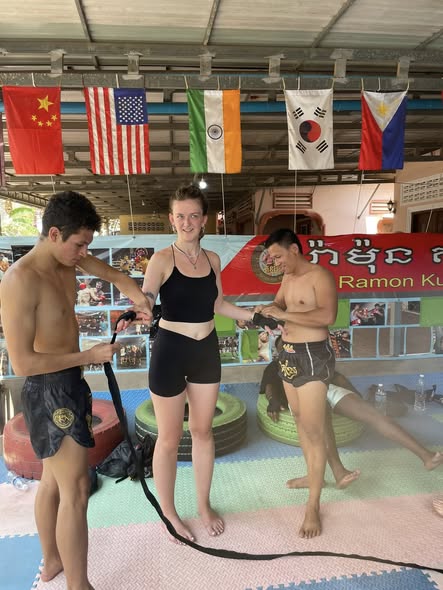
- Hand-wrapping, with gloves fitted from the gym's own supply
- Warm-up — the gradual-intensity, joint-mobility ramp the CDC's pillars assume
- Technique drills in the air, at zero impact
- Pad work — the coach holds the pads and sets your tempo
- Conditioning, scaled to the person doing it
Should You Get a Doctor's Sign-Off Before Starting?
The honest version: for most people, moderate-intensity activity is safe to begin — "especially if you build up slowly," per the NIA, which still says to "[t]alk with a doctor about your health condition and create a physical activity plan that works for you" (NIA). The CDC covers the rest of the honesty spectrum: "If you have trouble meeting these recommendations, be as physically active as your abilities and conditions allow. Remember that some physical activity is better than none at all" (CDC older-adult guidance). Concretely, at 50: manage a heart condition, high blood pressure, diabetes, or a joint replacement — ask the doctor first, and the NIA adds for blood pressure to "[w]ork with your health care provider as you increase physical activity." Manage an old knee or shoulder — tell the coach before class so drills adjust around it, the playbook in training with injuries, with the contact-staging context in is Kun Khmer safe for beginners.
Doctor-check honesty, condition by condition
| If you manage... | The honest step |
|---|---|
| Nothing / generally healthy | Start at moderate pace and build up slowly (NIA wording) |
| Heart condition or high blood pressure | Ask your doctor first; work with your provider as activity increases (NIA) |
| Diabetes or another chronic condition | Talk with a doctor and build an activity plan together (NIA) |
| Arthritis or old joint injuries | Favor low-impact variants, speak with a provider, and tell the coach before class |
| Just unsure | Message ahead — the coach plans around what you declare |
What Pace Should a 50+ Beginner Actually Expect?
Beginner pace — which is the same class everyone gets, with the tempo dialed to the person in it. The session runs about 60–90 minutes through hand-wrapping, a warm-up, technique drills, pad work with a coach, and conditioning, barefoot on mats with every piece of gear provided, and pad rounds are set by the coach holding them — so intensity is a dial, not a test (our own class-length guide breaks the session down, and what to bring to your first class ends at "workout clothes and water"). The verification for this isn't marketing copy; it is the club's review record — 5.0 from 8 reviews on Google (pulled 2026-10-25):
Great coach! Explains everything very well and really takes the time for you! The classes are also a good combination of cardio, strength, and technique, where you learn a lot right from lesson 1! Highly recommended!
What Do Students Training Here Actually Do?
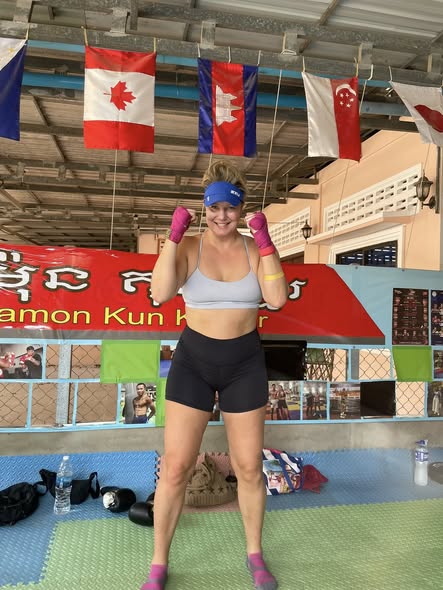
Honest scope first: the club publishes no age roster, and this page will not invent one — what we can show is what first-timers actually do in this room, which is the same room a 50-something walks into. Every class starts the same way, wraps fitted and techniques broken down move by move, and the Google reviews read like a log of first sessions: one student — Manuel Jungwirth, October 2026 — wrote: "Was the first time in my life to do any type of boxing or martial arts - will definetely do it again" (his own spelling), and another that the class "were shown all the techniques for kun khmer, and had a great laugh with our instructor" (Ciara Owens, August 2026). Beginners here are walked through, shown techniques step by step, and allowed to laugh mid-session — the structure a single day pass buys into, and the club-vetting framework behind how to judge a gym in Siem Reap.
What a first-timer's session here actually contains
| What happens | Where it's recorded |
|---|---|
| Wraps and gloves fitted; all gear provided | Our own class walkthrough (first-party) |
| Techniques "shown all the techniques" step by step | Ciara Owens Google review, August 2026 |
| First-ever session walked through, not thrown in | Manuel Jungwirth Google review, October 2026 |
| Coach "really takes the time for you" | Sanne Van den brink Google review, September 2026 |
| 5:00 PM daily start, $9 day pass, no contract | lib/business.ts (first-party) |
But Isn't Kun Khmer the Elbow Sport? Does That Matter at 50?
The reputation is earned — "In Kun Khmer, more victories come by way of an elbow technique than any other strikes," and a pro match is "five three-minute rounds" of a full-contact sport (Wikipedia) — but the reputation describes the ring, not the beginner room. Your introduction is technique drills and pad work where nothing strikes back; sparring only ever enters later, for people who ask for it once "stance, guard, and control are solid" (our sparring policy), and what the ring version adds — for the curious, not the required — is in Kun Khmer rules explained.
Elbows are taught the way everything else is — slowly
You learn the elbow in the air, then on pads, at the tempo the coach sets — as technique, not as threat. Beginners do not take elbows, throw them at speed at a partner, or share a ring with anyone who does. Sparring is never required: pad work is a complete training practice on its own, and "is this a contact workout?" is answered directly in is Kun Khmer a contact workout.
How Many Sessions a Week Can a 50-Something Recover From?
Two to three, with rest days that actually stay rest days. Two 60-minute classes put you at 120 minutes for the week — at or near the WHO's line of at least 150 minutes of moderate-intensity physical activity per week, the benchmark 31% of adults worldwide miss — and three clear it outright at 180–270 minutes once wrapping and conditioning time is counted, the same arithmetic worked through in how often should I train Muay Thai and priced out in what a class costs in Siem Reap. The reason the band doesn't stretch at 50 is recovery: next-day soreness after a new-to-you session is DOMS, which "usually happens after you try a new activity" and "should go away in a few days" (Cleveland Clinic), while overtraining is what happens when the body's ability to recover is exceeded — performance drops instead of rising. What the day after class actually feels like is covered in after your first class.
Weekly load at 50+, against the 150-minute benchmark
| Weekly load | Minutes on the mats | Who it suits |
|---|---|---|
| 1 class | About 60 | The trial — the $9 day-pass decision |
| 2 classes | 120–180 with wrapping and conditioning counted | The honest rebuild — progress with real rest |
| 3 classes | 180–270 | Clears the WHO line outright |
| 2 classes + 1 private | Group sessions plus a $25/hour private | Corrections at private pace |
What Does Martial Arts Actually Do for a Body Over 50?
The honest list is the CDC's, not ours. Regular physical activity "can help keep your thinking, learning, and judgment skills sharp as you age," reduces short-term feelings of anxiety for adults, and helps you sleep better; at 150 minutes a week of moderate activity it "can put you at a lower risk" of heart disease and stroke, and it "can also lower blood pressure and improve your cholesterol levels" (CDC benefits). The muscle piece is the one striking training happens to serve directly: "Muscle strengthening is important for older adults who experience reduced muscle mass and muscle strength with aging." None of this is a promise of personal outcomes — it is the risk-and-benefit record the CDC publishes, and class is one way to bank it. On energy: the Harvard tables put boxing sparring at 270–378 kcal and general martial arts at 300–420 kcal per 30 minutes at 125–185 lb — table estimates, not measurements — worked through in how many calories a class burns and the weight-loss guides (can Kun Khmer help with weight loss; Muay Thai for weight loss).
- Brain — thinking, learning, and judgment "sharp as you age" (CDC)
- Mood — reduced short-term anxiety for adults (CDC)
- Sleep — activity helps you sleep better (CDC)
- Muscle — strength work against age-related muscle loss (CDC)
- Heart — 150 minutes a week, lower heart-disease and stroke risk (CDC)
What Should Your First Month at 50 Look Like?
Small, scheduled, and reversible. Week one is a single class on a $9 day pass — gear included, nothing to cancel; week two is two classes with rest days between them; from week three the pattern is two to three sessions a week, plus a $25-per-hour private whenever a correction is stuck. Message the coaches on WhatsApp (+855 96 228 8585) before the 5:00 PM class any day — a heads-up lets the coach expect you, per our booking guide, and plans stay flexible through booking changes and cancellations. Head coaches Kon Phanet and Ramon have a combined 50+ professional Kun Khmer fights in Cambodia, which matters at 50 for one reason: the corrections you need are ones they have made before.
Training options and exact prices — the same at every age
| Option | Price | What it includes |
|---|---|---|
| Day pass | $9 | One group class, gear included |
| Weekly pass | $69 | A week of classes |
| Monthly training | $129 | A month of classes |
| Private lesson | $25/hour/person | 1-on-1, paced entirely to you |
| 6-week fight camp | $299 | The full structured camp |
- Week 1: one class on the $9 day pass — meet the coach, declare anything you manage
- Week 2: two classes with rest days between; expect ordinary next-day soreness
- Week 3+: two to three sessions a week; add a $25 private hour when a fix won't stick
- Any week: message ahead on WhatsApp if you'd rather the coach expect you
FAQ
Do I Need to Be in Shape?
No — fitness is an outcome of training, not a prerequisite, and every round in the beginner class scales to the person doing it. The CDC's own advice for anyone who finds the weekly targets hard is to "be as physically active as your abilities and conditions allow," which is exactly how the class runs.
What if I have an injury or medical condition?
Tell the coach before class so drills adjust around it — a normal request handled without ceremony. If you manage a heart condition, high blood pressure, diabetes, or a joint replacement, clear starting with your doctor first; the NIA's exact advice is to "talk with a doctor about your health condition and create a physical activity plan that works for you."
I don't want to get hit. Is this a contact workout?
No — beginner training here is pads, not partners. You throw full techniques against pads the coach holds; nothing strikes back, sparring is never required, and it only enters later for people who ask, once their stance, guard, and control are solid.
What can I expect the following day(s)?
Ordinary next-day soreness: DOMS "usually happens after you try a new activity" and "should go away in a few days," per the Cleveland Clinic. Sharp or joint pain is different — that is a stop signal, and coaches adjust drills when you declare an injury.
Can I bring a friend?
Yes — sessions are drop-in friendly and a $9 day pass covers each of you, gear included. Mention it when you message ahead so the coach expects several new faces at once rather than one.
Nervous about starting tomorrow.
That is the standard first-class feeling, and the review record here is mostly first-timers — one student's first-ever session of any martial art ended with "will definetely do it again." You will be fitted for wraps, walked through the techniques, and paced by the coach; nobody is thrown in.
Key takeaways
- Yes — martial arts over 50 works here: technique-first, pad-based, nothing hits back, and every round scales to you.
- The CDC's older-adult benchmarks — 150 minutes, two strength days, balance work — are trained by the same single class structure.
- Doctor honesty: healthy at 50, start slow; managing a condition, ask your doctor first — the NIA's words, not our marketing.
- Pace norms: 60–90-minute classes, two to three a week with real rest days; DOMS fades in days, sharp pain is a stop signal.
- Prices never check your birth year: $9 day pass, $69 weekly, $129 monthly, $25/hour privates, $299 6-week fight camp — gear included.
Sources & further reading
- CDC — Older Adult Activity: An Overview — Adults 65+ need at least 150 minutes at moderate intensity (or 75 vigorous), at least 2 days of muscle-strengthening activity, and activities to improve balance; "be as physically active as your abilities and conditions allow"; some activity is better than none; activity "can prevent or delay many of the health problems that seem to come with age" — source
- CDC — Benefits of Physical Activity — "Keep your thinking, learning, and judgment skills sharp as you age"; reduced short-term anxiety and better sleep; "protect your bones, joints, and muscles" with age; muscle strengthening for age-related muscle and strength loss, at any age; 150 minutes a week lowers heart-disease and stroke risk; lowers blood pressure and improves cholesterol — source
- NIA — Exercising With Chronic Conditions — "Almost anyone, at any age, can do some type of physical activity"; moderate activity safe "especially if you build up slowly"; "Talk with a doctor about your health condition and create a physical activity plan"; low-impact options for arthritis; "Work with your health care provider as you increase physical activity" (blood pressure) — source
- WHO — Physical activity fact sheet — "At least 150 minutes of moderate-intensity physical activity per week" is the adult benchmark; 31% of adults worldwide (1.8 billion) do not meet it — source
- Cleveland Clinic — Delayed Onset Muscle Soreness (DOMS) — Muscle pain sets in one to three days after intense exercise; DOMS follows new or more-intense activity; "usually nothing to worry about"; "should go away in a few days" — source
- Harvard Health — Calories burned in 30 minutes — Boxing sparring 270/324/378 kcal and martial arts 300/360/420 kcal per 30 minutes at 125/155/185 lb (table estimates) — source
- Wikipedia — Kun Khmer — Four types of strikes (punches, kicks, elbows, knee strikes); "more victories come by way of an elbow technique than any other strikes"; a match is five three-minute rounds — source
- Wikipedia — Overtraining — Overtraining occurs when the body's ability to recover from strenuous exercise is exceeded, with decreased performance or plateau — source
- Wikipedia — Warm-up — A warm-up is a gradual intensity increase ("pulse raiser") plus joint mobility work and stretching, before the activity — source
- Google Maps — Kun Khmer Club listing — 5.0 rating from 8 reviews; quotes from Manuel Jungwirth, Sanne Van den brink, and Ciara Owens verbatim per docs/seo-evidence/google-reviews.md (pulled 2026-10-25) — source
Reviewed 2026-10-27

Written by the coaches
Kun Khmer Club — Coaches Kon Phanet & Ramon
Head coaches Kon Phanet and Ramon have a combined 50+ professional Kun Khmer fights in Cambodia. We coach beginners, travelers, expats, and fighters at our gym in Siem Reap.
Ready to train in Siem Reap?
Drop in for a $9 day pass — the group class starts at 5:00 PM every day, and all gear is provided. Message us for today’s times.